



Drones with Long Battery Life Complete Buying Guide
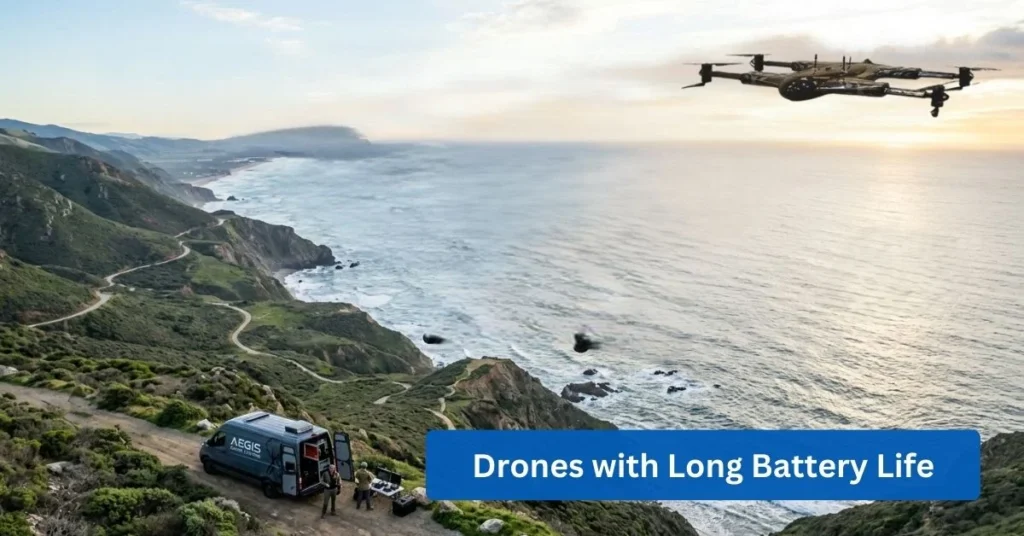
Most modern jobs and professions benefit from technology such as unmanned aerial vehicles (UAVs) and drones, prompting operators to consider drones with long battery life. Respecting drone battery life helps make the most of these innovations and devices, ultimately making work experience easier and more efficient.
UAV battery life is a fundamental factor for each flight operation, and this blog will explain and discuss how that came to be.
In this blog, there will be discussions of drones with long battery life, including the complete buying guide of the best drone battery life.
What Is the Battery Life of a Drone?
Operating a UAV for a particular project entails knowing the battery life of a drone. To discover more about drone battery life, firms and operators should be aware of the following:
Firstly, the drone battery life refers to both the endurance and the life cycle of a drone. The meaning of drone battery life specifically denotes the amount of time the UAV can operate on a single charge. Pilots should be knowledgeable about how long drones fly in order to successfully manage daily operations and long-term equipment costs.
Hover Time vs Real-World Flight Time
A drone’s hover time represents the maximum duration a drone can stay airborne in zero-wind conditions, whereas real-world flight time takes into account the wind, maneuvering, and sensor power draw. Knowing the differences between such can enable operators to calculate the drone’s safety and consider real-world factors.
Learn more about hover time and real-world flight time with the table below:
Performance Metric | Hover Time | Real-World Flight Time |
Physics/Aerodynamics | Static lift; motors work constantly to maintain a fixed position (OGE – Out of Ground Effect). | Translational lift; forward motion at “cruise speed” can actually increase efficiency. |
Standard Duration | Shortest. Often 10–15% less than a cruise flight due to a lack of aerodynamic lift. | Variable. It can be longer than hover at steady speeds, or much shorter in high winds. |
Operational Goal | Precision. Best for stationary inspections (e.g., cell towers). | Endurance. Best for mapping or transit where forward momentum is maintained. |
What is the Average Battery Life of a Drone?
The average battery life of a drone in 2026 typically ranges from 25-45 minutes for standard multi-rotors, although bear in mind the class of the drone is a factor that varies the average drone battery life. Learning about the average battery life of a drone leads to proper mission planning and fleet procurement.
It’s best to opt for average models for most flight operations; however, drones with long battery life often involve hybrid systems
How long is the Battery Life on a Drone?
Moreover, the battery life on a drone can last long, depending on its specific category. Toy drones last 5-10 minutes, while consumer models can operate for 30-47 minutes, and industrial UAVs can fly for more than 60 minutes. Each category of drones matches the flight duration with the complexity of a flight operation or task, as portrayed by the table below:
Drone Category | Typical Flight Time | Standard Use Cases |
Toy Drones | 5 – 10 minutes | Indoor flying, basic flight training, and children’s play. |
Consumer Models | 30 – 47 minutes | 4K videography, travel vlogging, hobbyist exploration. |
Industrial UAVs | 60+ minutes | Agricultural spraying, heavy cargo delivery, and cinematography. |
Consumer vs Professional Drone Endurance
When it comes to a drone’s endurance, there are differences in terms of consumer and professional models. Consumer drones can endure a flight time of 20–45 minutes, and professional drones have the endurance to stay airborne for 1–2 hours or more. Here’s a table that showcases the difference in drone endurance:
Feature | Consumer Drones | Professional Drones |
Max Flight Time | 25 – 45 minutes. Often drops to 20 mins in the wind or cold. | 50 – 90+ minutes. Optimized for industrial workflows. |
Battery Chemistry | Lithium-Polymer (LiPo). High power delivery, lower density. | Lithium-Ion (Li-ion). Higher energy density for longer flights. |
How Long Does a Drone Battery Last in Real-World Flying?
Other than what’s in theory, it’s also important to conduct operations in a real-world setting. Firms and organizations can be more informed about how long does a drone battery last can refer to the following:
- Manufacturer Claims vs Real Usage: The manufacturer’s claims are the maximum advertised flight durations of drone companies, measured under no wind and no payload. With that, manufacturers’ claims establish a theoretical drone performance. However, operators should bear in mind that there may be differences in real-world UAV flight time, as it takes into account internal and external factors.
- Weather and Environmental Effects: Alluding to external factors, these would include weather and environmental effects. These effects can be the wind resistance and extreme temperature a drone experiences during flight operations, enabling the UAV to operate harder to maintain airborne. Weather and environmental effects must be analyzed since these can affect UAV battery performance in real-world flying, and understanding these effects can help prevent power failure.
- Payload and Camera Power Usage: Internal factors such as payload and camera power usage should also be regarded, with how this additional equipment can consume the drone’s battery and energy. Heavy gimbals, LiDAR sensors, and signal systems can affect the data quality and drone endurance time. Therefore, operators need to consider airtime with the extra weight and electrical draw.
- Why Real-World Battery Life is Shorter: Real-world battery life is shorter due to reasons like constant micro-adjustments to flight controllers to counteract gravity and drag. Once firms and pilots recognize that real-world battery life is short, there is a need to implement a plan for a safe landing. Dynamic variables can affect how long does a drone battery last, and operators should at least expect flexible changes and quick adjustments in order to ensure drone and equipment safety.
What Drone Has the Longest Battery Life Today?
After understanding what drone battery life is and how long it can last, it’s imperative to ascertain what drone has the longest battery life. Here are the factors to consider when deciding to operate the longest flying drone:
- Drones with the longest flight times worldwide: To start, the longest flying drone worldwide for 2026 is built like hydrogen-powered units and solar-electric hybrids. Long-endurance drones are optimal for companies with projects that require a persistent eye in the skies for days rather than minutes. With these UAVs and their ability to sustain long flights, operations can reach peak performance efficiently.
- Fixed-wing vs Multirotor Endurance: Fixed-wing drones use their wings for lift; meanwhile, multirotor drones rely on constant motor thrust. Pilots need to understand the distinction between the two when choosing between the efficiency of a fixed-wing drone or the agility of a multirotor drone for a particular mission. Although a multirotor can offer more agility for 51 minutes, the fixed-wing drone can fly for up to 480 minutes.
- Commercial vs Military UAV Endurance: Other drones, like commercial and military UAVs, have a specific endurance. Commercial drones range from 20–55 minutes, and military drones ensure mission success in high-stakes environments with an endurance of over 34 hours. While these military UAVs have a high budget, firms can still utilize commercial drones that are adopting modern features and high-density battery technologies.
- Why Fixed-Wing Drones Dominate Battery Life: All drone models and types can offer different purposes along with extended flight drones, yet fixed-wing drones are still the necessary choice for battery life. Fixed-wing drones significantly use less energy through vertical lift, and this aerodynamic advantage gives this specific drone type an opportunity to carry larger batteries for long periods of time.
What Are the Best Consumer Drones With Long Battery Life?
Moreover, there are the best consumer drones with long battery life that can make flight operations easier. The best consumer drones with long battery life in 2026 is as follows:
- DJI Air 3 battery life: Consumer drones with long battery life, like the DJI Air 3, are powered by a 4241 mAh Intelligent Flight Battery. This specific consumer drone is designed to deliver a maximum flight time of 46 minutes, allowing a reach to distant landmarks without low-battery warnings. The DJI Air 3 has reliable stamina among consumer drones.
- DJI Mavic 3 flight time: Another choice for consumer drones is the DJI Mavic 3, which is equipped with a 5000 mAh LiPo 4S battery, allowing a flight duration of 43-46 minutes. With that, this specific product can take complex, cinematic tracking shots for various project missions.
- Autel EVO Lite+ Battery Performance: The Autel EVO Lite+ uses a 6175 mAh battery that can provide 40 minutes of flight time, and this performance is leading among competitors in terms of hover stability. Having this endurance and robust power management offers flight duration and adjustable aperture control. Autel EVO Lite+ ensures proper documentation for every angle without frequent drone landings.
- Zenadrone Battery Life and Flight Time: A specialized octocopter through ZenaDrone 1000 is not only easy to use for consumers, but it can also have industrial performance with a flight time of 60 minutes. ZenaDrone 1000 is designed with eight rotors that can maintain high stability and redundancy, equipped with advanced sensors.
- Mini Drones vs Full-size Drones: Drones have weight categories, with mini drones that are recognized to be under 250 grams and full-size drones to are much heavier and have a flight range of 31-47 minutes. These mini drones provide maximum portability and regulatory freedom, whereas larger drones are built to manage wind better.
Real-world Consumer Drone Comparison
Mentioned above are the best consumer drones with long battery life, which should highlight the comparisons of real-world consumer drones. Observe the table below for a comparison of the best consumer drones:
Drone Model | Max Flight Time | Battery Capacity | Primary Target Audience |
DJI Air 3 | 46 Minutes | 4,241 mAh | Travel photographers & outdoor adventurers. |
DJI Mavic 3 | 46 Minutes | 5,000 mAh | Cinematic professionals & conservationists. |
Autel EVO Lite+ | 40 Minutes | 6,175 mAh | Real estate agents & creative hobbyists. |
Zenadrone 1000 | 60 Minutes | High-Capacity (Octo) | Industrial inspectors & agricultural managers. |
Which Professional and Commercial Drones Offer the Longest Flight Time?
There are also professional and commercial drones to consider for missions that involve long endurance. Discover more about commercial and professional drones’ battery life with the following:
- Fixed-wing Mapping and Surveying Drones: Starting with fixed-wing mapping drones, which are non-hovering UAVs that can generate lift with reduced power consumption. On the other hand, a surveying drone’s battery life ensures high-quality data collection without the need for multiple battery swaps and recharging.
- VTOL Commercial Drones: Vertical Take-Off and Landing drones are capable of hovering and high-speed flight. This VTOL drone design enables launch and recovery in confined or rugged environments, making it versatile enough to be recognized as a long-endurance drone. Organizations that choose to operate a drone but lack traditional runways should consider VTOL commercial drones.
- Long-endurance Inspection UAVs: Long-endurance inspection UAVs are multirotors engineered with battery systems that enable prolonged hovering. Long-endurance inspection UAVs indicate that operations are thorough and uninterrupted. Assessments that are conducted with this specific professional drone ensure that no fault goes undetected.
- Agriculture, Security, and Infrastructure Use Cases: Professional and commercial drones can operate effectively across diverse environments, especially in agriculture, security, and infrastructure applications. This technology is designed to automate large-scale data acquisition and persistent surveillance, which can be particularly useful in such circumstances.
These industries can have a technological and endurance edge with professional and commercial drones.
How Does Zenadrone Perform for Long Drone Battery Life?
ZenaDrone is able to perform with a long drone battery life, as it is built to do so. Here is how ZenaDrone battery life can perform for various flight operations:
ZenaDrone 1000 Battery Life and Endurance Focus
Engineered to be a professional-grade octocopter with power management, the ZenaDrone 1000 has long-lasting battery life. These features improve battery life and endurance to help complete comprehensive missions on a single battery charge. ZenaDrone 1000 and its sustained performance can help firms ensure that operations are testament to ZenaDrone UAV endurance.
How Zenadrone Balances Payload and Flight Time
Achieving a balance between payload and flight time is feasible with ZenaDrone 1000, as its carbon-fiber frame and eight-rotor propulsion system are able to distribute the motor load. Having this particular build can carry heavy sensors without causing drone battery drain, leading to the actual drone flight time being exactly as planned.
Zenadrone vs DJI and Wingtra
ZenaDrone emphasizes its octocopter design, which supports stable hovering and can handle heavier payloads compared to smaller multirotor setups. The company also promotes extended flight time and flexible configurations for enterprise use. Performance will always vary depending on the specific model and mission, especially when comparing brands like DJI or Wingtra, but ZenaDrone positions its platform as a versatile option for industrial and commercial applications.
Best Zenadrone Use Cases for Long-flight Missions
Choosing to operate a ZenaDrone for long-flight missions that require high-resolution data capture and significant time is necessary. ZenaDrone can help provide AI-powered capabilities that perform these flight operations with or without less human intervention.
Utilizing the advanced features and ZenaDrone’s battery life can help firms easily and more efficiently achieve their mission goals.
What Drone Has a 2-Hour Battery Life or More?
Throughout the discussions, drones are designed to operate for about an hour. Organizations and pilots that need a drone with a 2-hour battery life, consider the technology below:
- Fixed-wing Drones Exceeding 2 Hours: These fixed-wing drones can exceed 2 hours of flight time thanks to rigid wings and aerodynamic efficiency. Fixed-wing drones can be used for ultra-long flights due to their ability to cover large areas on a single battery. A specialized design for fixed-wing drones allows actual flight time to exceed that of any multirotor, enabling this technology to endure 2 hours of flight time.
- Solar-powered UAV Technology: Another drone with a 2-hour battery life is the solar-powered UAV, which integrates its power source into the drone’s wings to charge onboard batteries during flight. These solar-powered UAV technologies are used for persistent monitoring or telecommunications and can further provide data collection without ever landing.
- Hydrogen Fuel-Cell Drone Endurance: Drones that fly for hours also include the hydrogen fuel-cell drone, since it is regarded as generating electricity and offering up to five times the energy density of traditional batteries. Hydrogen fuel-cell drones offer hovering stability with the UAV endurance record of a fixed-wing plane. This drone has the technological and convenient capabilities suitable for complex missions.
- Why These Drones are not Consumer-grade: These long-endurance drones are not considered consumer-grade due to their high cost, complex logistics, and strict regulatory requirements. Drones with a 2-hour battery life are used in the professional and military fields, so trained personnel can operate them in diverse situations for hydrogen management and solar wingspans.
What Affects Drone Battery Life the Most?
Furthermore, a drone’s battery life can be affected by numerous factors. Operating drones and ensuring they last must come with a proactive sense of knowing what affects drone battery life, such as:
- Battery Capacity: Drone battery performance can be affected by battery capacity, which represents the total energy stored within a drone. Battery capacity establishes a metric for the aircraft, and a higher capacity allows more potential flight time. Although a larger capacity indicates more flight time, it also increases the drone’s weight, which can diminish its power efficiency.
- Drone Weight and Payload Impact: In addition to factors that affect drone battery life, the drone’s weight and payload also affect its battery life. As mentioned above, the drone’s weight can affect its power, as the total mass requires the vehicle to generate more thrust to stay airborne. Drone weight and payload impact must be managed properly to prevent motors from overworking and flight failure.
- Wind, Altitude, and Temperature: These environmental variables can also affect the drone’s battery life, as wind, altitude, and temperature can affect air density and battery chemistry. Drones are then forced to constantly adjust their flight controllers and motor speeds to withstand external factors.
- Flight Speed and Maneuvering: Another factor is the drone’s flight speed and maneuvering, which can drain the battery life at higher speeds and during aggressive maneuvers. Pilots need to optimize flight paths in order to conserve energy and maximize the drone’s operational range and capabilities.
- Sensors, Cameras, and Transmission Systems: Lastly, onboard electronics such as sensors, cameras, and transmission systems can draw secondary power from the main battery. High-efficiency integrations can be worth the investment, providing high-quality data coverage, but they need to be balanced.
Why Is Drone Battery Life So Short?
Modern organizations expect drones with long battery life to sustain long flight operations, yet there are circumstances where drone battery life falls short. These are causes that operators can look out for as to why drone battery life is short:
- High Energy Demand of Multirotors: Short drone flight time can be caused by many factors, including the high energy demand of multirotors. Certain flight missions use multiple vertical propellers to generate lift. Quadcopters are utilized for hovering precision and agility, and this high energy demand can be a primary reason for drone power limitations.
- Battery Weight Limitations: Additionally, battery weight limitations can also be a reason why drone battery life is short. Battery weight limitations entail that adding a larger battery increases the drone’s total mass. This constraint prompts operators to maximize a power-to-weight ratio.
- Heat and Inefficiency Losses: Electrical energy from the battery is converted into unwanted thermal energy, resulting in heat and inefficiency losses. This can cause the drone’s battery life to be short, and can be resolved by analyzing these losses to improve drone power efficiency.
- Safety Limits of Lithium Batteries: The last reason why drone battery life is short is the safety limits of lithium batteries that involve chemical and regulatory thresholds. Limiting such things can protect both the pilot and the environment from the high energy density of certain batteries, and safety limits can restrict the usage of drones and UAVs.
Which Battery Type Is Best for Long Drone Flight Time?
Drones with long battery life have been discussed, and it’s also important to highlight the battery type best suited for long drone flights. Below is a list of batteries for a drone:
LiPo vs Li-ion Comparison
Lithium Polymer and Lithium-ion are two drone battery types well-known for their electrolyte form and energy delivery. These two have dominant differences that are portrayed by the table below:
Feature | LiPo (Lithium Polymer) | Li-ion (Lithium-ion) |
Physical Form | Soft pouch (flexible shapes). | Rigid cylindrical or prismatic case. |
Best Use Case | Racing, heavy-lift, and acrobatics. | Endurance, mapping, and delivery. |
Energy Density and Lifespan
The amount of power stored per unit of weight is recognized as the energy density, while the total number of usable charge cycles is the lifespan. A drone battery leverages energy density to extend flight time and performance, making UAVs efficient for sustained operations.
Charging Cycles and Degradation
UAV battery technology can withstand charging cycles. The process of full discharge and recharge after capacity degradation must be properly tracked to maintain drone safety. Operators can also predict when a battery will degrade by planning charging cycles correctly.
Role of BMS in Battery Efficiency
A Battery Management System (BMS) refers to the real-time monitoring of voltage, temperature, and cell balance. An intelligent BMS for battery efficiency is most recommended, as it prevents over-discharge and ensures energy is contributed equally to flight operations. Not only does the BMS manage heat and power distribution, but it can also help operators extend the usable battery for a drone.
How to Calculate Drone Battery Life?
Drones with long battery life have a foundation of engineering and technology. Pilots can calculate drone battery life in order to ensure that the UAV endures diverse flight operations with the following:
- Battery Life Calculation Formula: Calculating a drone’s battery life starts with the drone flight time formula. The battery life calculation formula is a mathematical estimate that is defined by dividing a battery’s total capacity in Watt-hours (Wh) by the aircraft’s average drone power draw in Watts (W), then multiplying by 60 for minutes.
- Estimating Real-world Endurance: To estimate real-world endurance, the drone battery capacity needs to be adjusted by 20%-30%. Real-world endurance refers to including environmental resistance and landing reserves, as it is a realistic operation that prevents emergency landings.
- Power Draw vs Fight Time: Drone power draw refers to how the motors and electronics consume the total current (Amps) or power (Watts) during flight operations. Learning more about power draw and flight time enables a better understanding of how to calculate drone battery life.
- Tools and Apps for Calculations: Modern tools and apps for drone battery capacity calculation are optimal with how software platforms integrate the aircraft weight, battery chemistry, and motor efficiency. By using tools and apps for calculations, pilots are able to predict flight windows and can have actionable data from simplifying complex physics.
How to Extend and Increase Drone Battery Life?
A drone’s battery life can vary depending on the complexity of its respective flight operation. It’s critical for a pilot to extend and increase the drone’s battery life through the following methods:
- Proper charging practices: Most firms want to extend and improve drones’ battery life to increase operational value, and this can start with proper charging practices. This involves using the original manufacturer chargers and allowing the drone’s batteries to reach a thermal equilibrium. Proper charging practices can prevent chemical scarring and reduce capacity. Avoiding fast chargers also increases UAV battery life and ensures long-term reliability for the drone.
- Avoiding deep discharge: To extend drone battery life, avoid deep discharge by landing the drone with 20%-30% remaining rather than flying it until the battery is completely empty. Having this limit can protect the battery’s chemical health and help it be reliably recharged until the next flight operation.
- Flying in optimal conditions: Operators can improve drone flight time by flying in optimal conditions. This involves conducting flight missions in moderate temperatures and calm winds to minimize the efforts required by the motors. Environmental conditions are indeed unpredictable, yet it is still highly suggested to fly in calm weather and surroundings in order to reduce the workload from flight controllers.
- Reducing payload weight: Removing any non-essential accessories is one of the notable drone battery-saving tips. Prop guards, extra landing gear, and heavy lens filters may be unnecessary for certain cases, and reducing payload weight can greatly improve the power-to-weight ratio. With that, drones with long battery life are feasible, and the drone can fly smoothly and easily.
- Firmware and calibration tips: Lastly are the firmware and calibration tips, which involve keeping both the battery and aircraft software constantly updated. This can reset the internal fuel gauge and enable digital updates that optimize the BMS algorithms for better energy distribution.
Common Question About Drones with Long Battery Life
How long does a drone battery last?
Drone battery last depends on the drone category. Toy drones last for 5-12 minutes, consumer models last for 30–48 minutes, and industrial fixed-wings last for 2–10+ hours.
What is the average battery life of a drone?
The average battery life of a drone is approximately 35-40 minutes.
What drone has the longest battery life today?
In February 2026, the JOUAV CW-30E is the drone that has the longest battery life, with an airborne flight for up to 8 hours.
Can drones fly for hours continuously?
Yes. Specifically, fixed-wing or hybrid VTOL drones can fly for 2-12 hours continuously.
How long does a ZenaDrone battery last?
The ZenaDrone 1000 is engineered to have long-lasting battery life.
Contact Us

Thank you for your message. It has been sent.