



How Fast Can a Drone Fly? High Speeds, Types & Legal Limits
Recent technological developments have introduced how drone speed has progressed from toy drones to high-performance Unmanned Aerial Vehicles (UAVs). This advancement in drones and UAVs opens opportunities for industries where aerial performance is measured in miles per hour. With that, the average drone speed is a crucial testament to how unmanned flight can exceed expectations in modern society.
Unmanned flight and drone top speed starts with understanding why it is significant, particularly the performance, applications, and safety. Since the speed of a drone is also an indication of its utility, safety, and operational success, it’s vital to learn how it can lead to operational success. This particular technological leap in drone performance not only brings faster results but also improves efficiency and ensures pilot safety.
Drone top speed is a common theme in the world of aviation, which refers to the maximum horizontal velocity, and the highest speed a drone is capable of is when it can maintain in level flight under optimized conditions. Achieving this top speed can be significant in most critical flight operations. This blog can help in discovering how fast can a drone fly, and what it can contribute to diverse industries.
2. What is the Maximum Speed a Drone Can Fly Legally?
Firms, organizations, and most industries need to recognize and follow the legal drone speed limit in order to protect the public and the integrity of national airspaces. Establishing these rules and regulations prompts operators to know the maximum allowed drone speed based on their current area, location, state, or country.
As a matter of fact, the United States has the FAA drone speed rule strictly dictates that a small unmanned aircraft’s groundspeed must not exceed 100 miles per hour (87 knots), while the European Union Aviation Safety Agency (EASA) has mandated that the “Open Category” drones cap at 19 meters per second (approximately 42.5 mph). In other areas of the world, like China and India, the legal drone speed limit ranges from 62 to 83 miles per hour. Here’s a table that shows drone speed limits by country (mph/km/h):
Country / Region | Regulatory Body | Maximum Legal Speed |
United States | FAA | 100 mph (161 km/h) |
European Union | EASA | 42.5 mph (68 km/h) *Limited to C0/C1 class drones in the “Open” category. Otherwise, speed may vary in higher classes. |
China | CAAC | 62 mph (100 km/h) |
India | DGCA | 83 mph (133 km/h) |
United Kingdom | CAA | No fixed limit (Safe distance rules apply) |
Australia | CASA | No fixed limit (Safe distance rules apply) |
3. How Fast Can a Consumer Drone Fly?
There are different types of drones with their own respective speed. Starting with beginner drone performance, a consumer drone speed is regarded as a balance of exhilaration and user-friendly control. Most modern recreational drone speed can typically operate with a range of 25-45 miles per hour. As stated above, the consumer drone speed is capped by manufacturers with the intention of having a safety net that fulfills drone missions without the risk of losing control.
Although beginner UAV performance often starts at lower speeds, other advanced models are capable of more functions, like avoiding obstacles and processing data in real-time by using integrated sensors. In addition, easy control and camera stability can also be possible with high-level models, which should be considered by potential operators for smoother flight operations.
Speed of Popular Consumer Drones
Moreover, there are popular consumer drones that offer various speed limits. The table below shows a comparison table of popular models like the DJI drone top speed, including the show flight mode vs. top speed:
Drone Model | Normal Mode Speed | Top Speed (Sport Mode) |
DJI Mini 4 Pro | 27 mph (12 m/s) | 36 mph (16 m/s) |
DJI Mavic 3 Pro | 33 mph (15 m/s) | 47 mph (21 m/s) |
Autel EVO II Pro | 22 mph (10 m/s) | 45 mph (20 m/s) |
Skydio 2+ | 36 mph (Autonomous) | 36 mph (Manual) |
4. How Fast Can a Racing FPV Drone Fly?
Other than consumer drones, there is also the matter of the racing FPV drone speed. This particular type of drone is most appropriate for industries that center on engineering and pilot skills, as FPV (First-Person View) drones provide extreme agility. An operator can expect that the FPV drone speed can reach more than 100 miles per hour within seconds with its high thrust-to-weight ratio and its specialized brushless motors.
Having this racing drone speed is necessary for certain situations like the professional sport of drone racing, where pilots are tasked to navigate complex 3D courses. Its real-time control and velocity allow operators to test the boundaries of human reaction time and electrical efficiency. Nonetheless, there are still challenges when using this specific type of drone, such as physical limits pertaining to heat build-up and aerodynamic drag.
Speed of Popular FPV Drones
Alluding to FPV drones, observe the table below for the top list of popular FPV drones with their maximum speeds:
Drone Model | Max Speed (mph) | Max Speed (km/h) |
DRL Racer X | 179.6 mph | 289 km/h |
DJI FPV | 87.2 mph | 140 km/h |
BetaFPV X9 | 50-60 + mph | 80-100+ km/h |
High-Speed Performance in Tough Conditions
Mentioned above was how FPV drones have certain physical challenges. The high-speed performance in tough conditions can force the drone to streamline its frames to maintain stability. Since high-speed flights demand immense power from the drone, the batteries tend to overheat or “sag” under the load.
High-speed performance in tough conditions happens in circumstances that involve FPV drones to utilize their small diagnostic tools and sensors across large-scale areas. During these kinds of flight operations, high-speed FPV drones must fight high-altitude winds in order to maintain stable flight. Based on this reality, drone performance is regarded as more than just raw power, and it requires a robust cooling and signal strategy.
5. How Fast Can a Professional Drone Fly?
Additionally, professional drone speed is also important for stability and payload capacity. Professional drones are engineered to carry heavy sensors like 8K cinema cameras and Light Detection and Ranging (LiDAR) sensors in order to maintain a steady flight path while mapping. With these features, the professional drone speed and other enterprise drones are capped at 70 miles per hour.
Maintaining a controlled, consistent speed enables these professional drones to ensure that all data and information collected is of high quality. Industrial drone performance has a combination of power and restraint that makes it feasible for operators to confidently manage complex missions.
Speed of Popular Professional Drones
Compare ZenaDrone, DJI Matrice 350 RTK, Inspire 3, and Freefly Alta X. When it comes to the speed of popular professional drones, the table below portrays the comparison of their respective top speed:
Drone Model | Top Speed (mph) |
Freefly Alta X | 70 mph |
DJI Inspire 3 | 58.4 mph |
DJI Matrice 350 RTK | 51.4 mph |
50 mph |
6. How Fast Can a Police Drone Fly?
Some industries, like the police force, need a specific drone for their various missions. A law enforcement drone is designed to arrive on-scene rapidly in order to assess threats before working personnel enter an area, branding them as a “Drone as First Responder” (DFR). This police drone speed can be operated between 40-60 miles per hour, and has the necessary velocity to help officers and dispatch in tracking and surveillance.
Maintaining the tactical UAV’s speed and endurance is most critical during pursuit drone missions and other similar operations. Deploying these advanced technologies can significantly assist agencies in mitigating the risks and provide personnel with an aerial view that is both stealthy and efficient. In fact, police departments have implemented the DJI Matrice 30T and the BRINC Lemur 2 as law enforcement drones.
Speed of Popular Police Drones
As stated above, popular police drones have been utilized for essential missions, and the table below shows the model, top speed, flight time, and use case for each:
Drone Model | Top Speed | Max Flight Time | Primary Use Case |
DJI Matrice 30T | 51.4 mph (23 m/s) | 41 Minutes | Pursuit & Thermal SAR |
BRINC Lemur 2 | 48 mph (77 km/h) | 20 Minutes | Tactical Indoor/S.W.A.T. |
Skydio X10 | 45 mph (20 m/s) | 40 Minutes | Autonomous Patrol |
DJI Mavic 3T | 47 mph (21 m/s) | 45 Minutes | Rapid Response |
7. How Fast Can a Delivery Drone Fly?
In this modern society where purchasing is prevalent among industries and individuals alike, it’s essential to learn more about delivery drone speed, why it matters, and how it can be improved. A parcel drone refers to a specialized aircraft that is capable of aerodynamic lift with the heavy physical demands of cargo. Most delivery drone speed ranges from 50-70 miles per hour, which allows this specific type of drone to bypass urban congestion and complete operations faster.
Drone logistics requires a velocity that maximizes a drone’s service radius while operating within its limited battery life. However, there is an issue pertaining to its weight, range, and speed; as the payload of a drone increases, the energy that is needed to maintain high speeds also rises exponentially. This particular limitation urges industries to optimize drone logistics and AI-driven route planning.
Comparison of Top Delivery Drones
Here’s a table that includes the top delivery drones and their respective delivery drone speed, payload capacity, and radius:
Drone Platform | Top Speed (mph) | Max Payload | Radius / Range |
Zipline P2 (Zip) | 70 mph | 8 lbs (3.6 kg) | 10 miles |
Amazon Prime Air MK30 | 65 mph | 5 lbs (2.2 kg) | 7.5 miles |
Wing (Alphabet) | 65 mph | 3 lbs (1.4 kg) | 6 miles |
Matternet M2 | 45 mph | 4.4 lbs (2.0 kg) | 12.4 miles |
Why Speed Matters in Delivery Drones
Delivering is a renowned task for its urgency and convenience. The speed of a parcel drone is a highly vital factor in its operational success, which leads to the notion that speed is indeed important for current and upcoming delivery drones. Maintaining a high delivery drone speed enables logistics providers to be efficient in serving multiple sectors.
Certain industries, like the healthcare industry, prioritize accuracy and urgency. Medical-grade delivery drones are able to transport blood units, vaccines, and emergency medications to remote clinics faster. Having this advanced technology ensures that patients are attended to and medical assistance is provided, portraying speed as a critical metric for global health.
Enhancing Delivery Efficiency
When it comes to delivery efficiency, there are still areas for improvement. Although there is tangible progress in drones and UAVs, considering the high-density power solutions like lithium-metal and solid-state batteries, there is also the aspect of innovation, where AI-driven route optimization can help in analyzing environmental conditions to determine efficient flight paths.
These physical and technological developments have allowed drones to maintain higher speeds for longer durations during tedious flight operations. Combining these mechanical and digital upgrades leads logistics providers and their operators to utilize technology that is sustainably productive in this modern society.

8. How Fast Can a Military Drone Fly?
The last specific type of drone is the military drone, which is a UAV designed with critical survival attributes. Modern Unmanned Combat Aerial Vehicles (UCAVs) have its military drone speed between 200-700 miles per hour. With that kind of speed, military industries can ensure rapid global reach and the ability to penetrate contested airspaces.
Here’s a table showcasing the fastest military UAVs and their speeds:
Drone Model | Top Speed (mph) | Engine Type |
BAE Systems Taranis | 700+ mph | Turbojet |
RQ-170 Sentinel | 590 mph | Turbofan |
Boeing MQ-25 Stingray | 580 mph | Turbofan |
RQ-4 Global Hawk | 400 mph | Turbofan |
MQ-9 Reaper | 300 mph | Turboprop |
Why Are Combat Drones So Fast?
Other than the medical industry, the military forces also require urgency. These combat UAVs are able to provide the necessary mission requirements, range, and stealth design that allows fast movement while remaining digitally invisible. Its design makes it a necessity for surviving flight missions and hostile environments, as it is engineered with advanced aerodynamics and internal weapon bays. Military personnel can utilize these high-speed combat UAVs in gathering intelligence and executing strikes with maximum precision and minimum risk.
Stealth and Maneuverability Matter
The military regards its stealth drones for their contribution to maneuverability, radar avoidance, and aerodynamics. These features are significant in terms of remaining undetected for mission longevity. Modern combat UAVs are integrated with fly-by-wire systems and thrust vectoring that redirects engine exhaust to provide control torque, which is important for performing aggressive evasive maneuvers and maintaining a stable flight path.
9. Applications of the Fastest Drones
After discovering different types of drones and UAVs used by numerous industries, it’s also noteworthy to gain knowledge on the applications of high-speed drones. These high-velocity unmanned aircraft grant operators an easy experience when it comes to minimizing response times and maximizing area coverage. Dynamic firms and organizations are able to have efficient workflows when utilizing the advanced technologies offered by multiple drone industries.
Thus, there are more and more uses of drones in complex tasks. Here are some of the many applications of high-speed drones in today’s modern society:
Search and rescue: With critical missions like search and rescue (SAR), the speed of a SAR drone is considered to be a valuable asset. Operators are able to make the most out of these drones in reaching remote or hazardous locations faster than ground crews. This rapid deployment allows first responders and rescuers to pinpoint the missing victims in SAR operations.
Primary Purpose | Real-World Industry | Typical Top Sped |
Life-saving speed | Emergency Response | 56–70 miles per hour |
Surveillance: In addition, surveillance drones are engineered to have leverage high speeds for conducting expansive perimeter surveillance and detect potential intrusions in real-time. Flight operations that involve surveillance entail that the drones are used for observing the chosen site or a particular area, and that they can also identify any anomalies, like unauthorized personnel or safety hazards.
Primary Purpose | Real-World Industry | Typical Top Sped |
Rapid threat detection | Mining & Campus Security | 45–60 miles per hour |
Military: Operations within the military sector need a drone top speed that helps all military ranks in achieving supersonic velocities for combat and reconnaissance. Having this speed ensures survivability in contested airspaces and reaching global targets with minimal warning. Combining velocity and stealth leads to optimal performance in high-risk missions without endangering human pilots.
Primary Purpose | Real-World Industry | Typical Top Sped |
Combat & Stealth | Defense & Aerospace | 200–700+ miles per hour |
Traffic monitoring: Lastly, the high-speed drones can also be a great contribution to urban management by providing real-time data on traffic flow and incident sites. Monitoring allows operators to map patterns and monitor different areas and locations from an aerial perspective. These monitoring drones emphasize how it’s essential to maintain their function in the pulse of a heavy-function site.
Primary Purpose | Real-World Industry | Typical Top Sped |
Incident management | Urban Planning | 45–55 miles per hour |
10. What are the World’s Fastest Drones in 2026?
Modernizing industry workflows globally has led to technological developments like drones and UAVs. Different fields from various countries have consistently utilized unmanned aircraft for dynamic tasks, and in some cases, demand fast drones to expedite operations while maintaining efficiency. Learning about the fastest drone models 2025 starts with recognizing the innovation brought by Peregreen 2, DRL Racer X, and Red Bull drone.
Peregreen V4 has been the global benchmark for the fastest drone model as of 2026, as it claims the Guinness World Record with an average speed of 408 miles per hour (657 km/h). This top drone speed ranking sheds light on specific models and provides more knowledge on how they emerge as propulsion systems in the world of drones and UAVs. Accordingly, here’s a table that shows the top 5 fastest drones that include the speed, type, and manufacturer of each model:
Drone Model | Top Speed (mph) | Type | Manufacturer / Designer |
Peregreen V4 | 408 mph | Custom DIY (Record Holder) | Luke & Mike Bell |
Blackbird | 389 mph | Custom DIY | Ben Biggs |
Peregreen 2 | 300+ mph | Custom DIY (Former Record) | Luke & Mike Bell |
XLR V3 | 257 mph | Custom FPV | Ryan Lademann |
Red Bull Drone | 217 mph | Custom Racing/Camera | Dutch Drone Gods |
DRL Racer X | 179 mph | Pro Racing Standard | Drone Racing League |
11. Key Features That Enable High Drone Speed
Acknowledging the importance of high-speed drones and how they can offer multiple advantages in multiple aspects of complex missions aligns with taking into consideration their key features. These high-speed drone features explain how efficient engineering produces powerful drones that can be operated in diverse industries. High drone speeds are enabled through key features, such as:
Design:
Starting with a drone’s design, this key feature has the primary goal of minimizing parasitic drag. Aerodynamic design, like teardrop-shaped fuselages and internalized wiring made out of carbon fiber bodies, allows these drones to fly with speed through the air. Having a streamlined design ensures that the force generated by the drone’s motors is enough to be used for velocity during flight operations.
Materials:
Another key feature of high drone speed is materials that are specialized to have an exceptional strength-to-weight ratio. Carbon fiber is regarded to be a standard material in terms of drones, as it can provide the rigidity that is appropriate for twist prevention. The specific type of material used in drones determines how the drone will react to the demands of particular strenuous missions, and in some cases, involves the immense torque of motors.
Stabilization:
Each flight operation certainly has drones flying at high speed, which makes the advanced technology hyper-sensitive to the slightest vibration or environmental conditions like wind gusts. Proper stabilization of a drone prevents catastrophic tumble from wind and other extreme weather. Hence, drones need to have advanced stabilization to keep the flight path lase-straight all throughout/
Firmware Updates:
The last key feature is the firmware updates that surround digital enhancement for drones and UAVs. With consistent firmware updates, operators gain access to advanced algorithms that enable the propulsion system to react with near-zero latency. As a result, the flight operations remain controllable even at the drone’s physical limit.
Furthermore, these key features have continuously enabled high drone speed. More and more UAVs are evolving, and manufacturers are able to improve their key features in order to have better flight operations. Observe the table below on engineering features that increase drone speed:
Feature | Primary Component | Speed Impact | Purpose in Flight |
Thrust-to-Weight | Brushless Motors | +40% Acceleration | Overcomes inertia instantly |
Drag Reduction | Aerodynamic Airfoil | +25% Top End | Minimizes air resistance |
Power Delivery | High-C Rated Batteries | +15% Consistency | Maintains peak voltage/RPM |
Propeller Pitch | High-Pitch Blades | +20% Velocity | Increases air displacement |
12. Factors That Affect Drone Top Speed
In addition to the key features, there are also factors that affect drone top speed. Drones and UAVs alike must overcome a wide variety of physical and electrical constraints, and understanding the factors affecting drone speed can help overcome this particular challenge. Here are some factors that affect how fast a drone can fly:
Motor power:
A starting factor can be the drone motor power and how it determines how fast the motor spins. The RPM per volt (KV) can be either high or low; higher KV motors indicate that the motors spin smaller props at extreme speeds, whereas lower KV motors provide the torque needed for larger, heavier aircraft. Drone top speed depends on a specific kind of task, so it is best to discern the project’s mission prior to deciding the motor power of the drone.
Voltage:
The next factor to consider is the battery voltage, since this provides the electrical pressure required to reach high RPMs. An increasing voltage is commonly the most direct way to increase the top end, considering that the motors and ESCs can handle the drone’s heat.
Weight:
Drones have their added gram from integrations and payload, which increases the all-up weight (AUW). A heavier weight can force the drone’s motors to use more thrust in order to maintain altitude. This prompts industries and their operators to have a better thrust-to-weight ratio for faster horizontal acceleration, especially for lighter drones.
Aerodynamics:
When it comes to aerodynamics, this factor refers to the streamlined frame that can reduce the drag from the air’s resistance against the drone’s physical body. Progressive aerodynamics have encouraged manufacturers to apply a teardrop-shaped canopy to their high-speed models for a flight with minimal turbulence.
Drone type:
A drone’s type is also a factor that needs to be considered due to how fixed-wing drones are inherently faster and more efficient than multi-rotors that use wings for lift. Though the different drone types serve different purposes, the operator has to determine the drone type in order to have a smooth flight operation.
Internal components:
Another factor that should be considered is the internal components of the UAV. This would include the flight controller, motors and propellers, and electronic speed controllers (ESCs). These internal components help the drone in terms of propulsion and managing its speed, making these parts extremely important for a successful flight.
Weather:
Drone operations can encounter weather, and extreme weather conditions can impact a UAV’s performance. Strong tailwind can boost ground speed, while headwind can force the drone to fight the air. Weather, as a critical factor in influencing drone speed, caps its airspeed.
Altitude:
The last factor affecting drone top speed is the altitude, wherein thin air reduces aerodynamic drag. Although that may be the case, high altitude also gives the propellers less grip, which requires higher RPMs in order to maintain the same speed.
13. Risks of Flying a Drone Too Fast
Like any other process in modern workflows, there are always challenges and limitations during so. Pilots encounter drone flight risks while operating this technology, and it’s important to at least be aware of such issues. Be prepared by understanding drone flight risks like the following:
Overheating:
Flying at maximum throttle can lead to the drone overheating, which drains the batteries and can potentially create a thermal load that melts the internal plastic components. This mechanical problem not only indicates the drone has a short flight span, but it also creates a possibility of a direct crash risk because of such.
Legal Liabilities:
Other than hardware damage, high-speed flight with drones carries legal liabilities. Global rules and regulations have stated that the drone legal speed cap at 100 miles per hour. Having these legal liabilities reminds firms and operators that utilizing drones and UAVs in being safe and respecting the physical and legal barriers designed to keep the skies secure.
Hardware Strain:
The last risk of flying a drone too fast is the hardware strain that comes from the internal components having a mechanical fever. Hardware strain is caused by high-velocity flight, and this can impact the physical endurance of the propulsion system. Flying a drone too fast can result in pulling the copper windings off, which leads to the drone violently vibrating.
14. How to Control and Fly a Fast Drone Safely
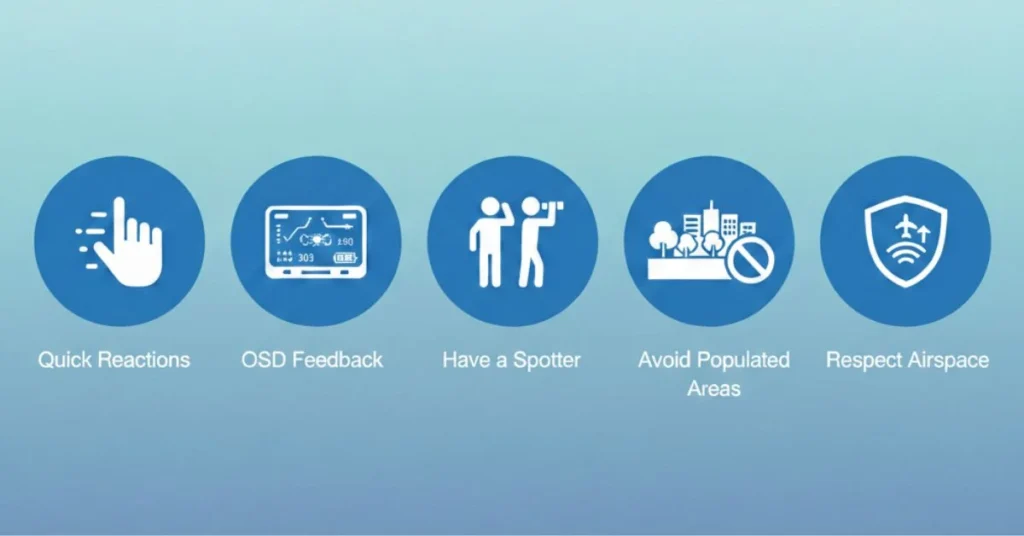
Being aware of the risks of flying a drone too fast can help in being prepared for such; nevertheless, it’s better to be proactive and respond with proper drone training. Operators can start by learning more about how to control and fly a fast drone safely. Listed below are tips for safe drone flying:
Develop quick reactions:
To start, pilots need to develop quick reactions as flight operations frequently involve high-speed flight. Managing a fast drone safely requires the pilot to build enough muscle memory by consistently training with drones and simulations. A successful drone training ensures that operators and pilots can react appropriately when an obstacle appears in a flight mission.
Use OSD feedback:
A flight On-Screen Display (OSD) helps the operator through a digital cockpit, which provides real-time telemetry such as battery voltage, speed, and GPS coordinates. Having access to this data allows easy monitoring that can help prevent problems like power failure or signal loss, thus avoiding a drone crash in total.
Have a spotter:
Spotter refers to an individual who can observe, and this particular case includes a dedicated spotter who can maintain a visual line-of-sight along with the operator and pilot. Peripheral vision might still be limited even with FPV control, and having a spotter can help in alerting when the UAV happens to approach physical structures or other tangible objects.
Avoid populated areas:
Flying in remote locations and less populated areas can reassure the pilot of the potential risk of flying a high-speed drone. Avoiding populated areas implies that the risk to people or property is minimized, since safety is always paramount when flying a UAV.
Respect airspace:
Most importantly, firms and pilots should always check for local flight restrictions and regulations. Following these rules, like staying below regulated altitudes, indicates that there is respect for the airspace. This ensures that high-speed flight operations do not interfere with other emergency helicopters or commercial aviation.
15. Future of Drone Speed and Technology
Technological developments towards drones and UAVs have been consistent, and this opens multiple doors to the future of drone speed. Drone innovation can be enhanced by the integration of AI-powered drones that utilize neural networks in order to process the gathered data instantly, which allows better high-speed flight. With this evolution, operators and pilots have an improved experience when it comes to managing drones and overall aerial flight.
Additionally, battery evolution is also feasible with how there are upgrades being made towards propulsion. Hydrogen fuel cells and solid-state batteries are testaments to drone speeds and long-distance endurance. This ensures that firms can utilize drones and UAVs longer, making data collection and processing more efficient with more flight time.
Racing drone trends have been a consistent foundation when it comes to drone speed. Professional racing involves the next-gen drones that can compete against top-tier human pilots through a combination of autonomous flight systems and high-torque hardware. The future of drone speed and technology emphasizes that the experience, both as an operator and a spectator, can be more immersive than as of late.
16. Conclusion
With all the drones’ high speeds, types, and legal limits having been said and done, it’s necessary to keep in mind drone capabilities and responsible flying. Firms and operators now recognize how high-speed flight is capable of serving multiple industries, from medical assistance, tactical law enforcement, to critical infrastructure maintenance. Having these accomplished features should also take into consideration responsible flying, which comes with an increased duty of care in order to maintain the safety of the public and surrounding property.
FAQ
Does higher speed burn batteries faster?
Yes. Flying at maximum speed forces the motors to spin at higher RPMs, which significantly drains the battery faster.
How fast can a small drone fly?
Small drones usually reach flight speeds of 15-30 miles per hour.
How fast can a quadcopter drone fly
Typical quadcopter drones fly at around 42-47 miles per hour.
How fast can a fixed-wing drone fly?
Commercial fixed-wing drones fly at a speed of 40-60 miles per hour, while jet-powered fixed-wing UAVs can fly between 200-700 miles per hour.
What is the fastest drone speed ever recorded?
As of January 2026, the Peregreen V4 is the fastest drone speed ever recorded, with a verified average top speed of 407 miles per hour.
Can weather affect a drone’s maximum speed?
Yes. Tailwinds can increase ground speed for the drone, but headwinds can reduce it.
How can I make my drone fly faster safely?
In order to fly drones faster and safely, operators and pilots need to consider using a software toggle that unlocks higher tilt angles and motor output, reducing the drone’s payload, checking its battery health, and that it is fully charged, and flying with a tailwind that can push the drone into the air.
Contact Us

Thank you for your message. It has been sent.