



Complete Sinkhole Guide Causes Types Signs and Safety
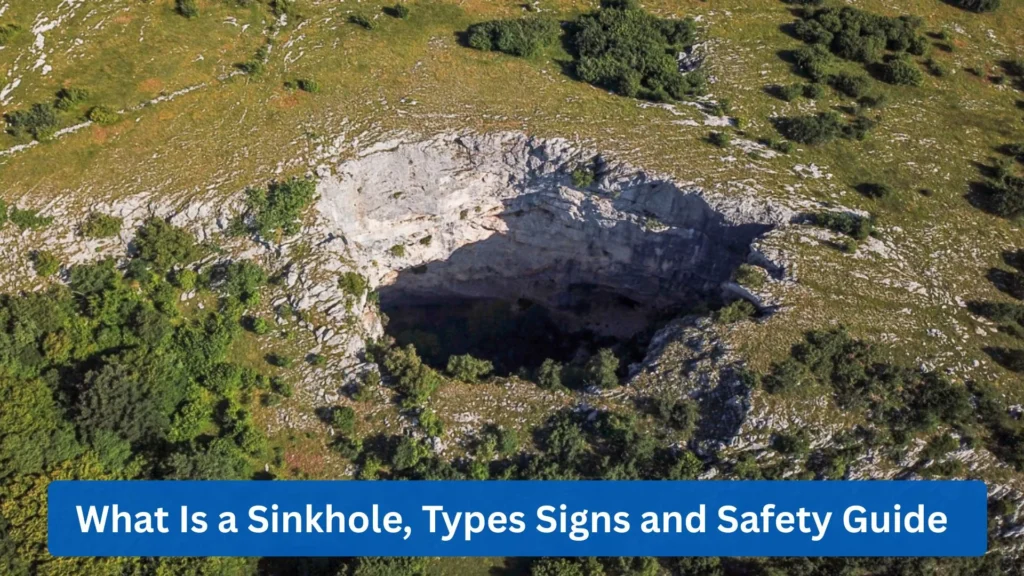
Sinkholes are not new to everyone. Although not surprising, sinkholes are still both fascinating and terrifying natural phenomena. Its large consumption of land space and its depth added a quite intriguing question as to how it is created. Even in the film industry, sinkholes occur in movies with a horror genre to create a sense of impending doom. But what exactly is a sinkhole’s meaning? How do sinkholes form? Is there a mystery behind how sinkholes form? What are the causes of sinkholes?
Using the lens of geology, sinkhole’s definition is truly scientific. A sinkhole is a cavity in limestone bedrock. It exists due to water erosion that allows surface water to disappear underground. It usually occurs in areas known as “karst terrain” according to geologists. These areas feature rock formations beneath the surface that can be naturally eroded by groundwater as it flows through them. Rocks that can dissolve in water consist of salt beds and domes, gypsum, limestone, and various other types of carbonate rock. Although many types of sinkholes can be the result of natural causes, human causes are still a contributor to their development.
Heavy construction, leaking water lines, drilling, damaged storm drains, or taking too much groundwater out of the ground can form sinkholes. These are the reasons why the ground underneath is unstable, causing collapses far sooner than they would happen naturally. Natural sinkholes are formed when long-period geological processes slowly weaken the ground in karst. As time runs, underground cavities form until the surface layer can no longer support its own weight. This can lead to either sudden or gradual collapse, often surprising communities with full reliance on stable ground.
Basic knowledge of terms like “cavity,” “collapse,” and “karst” should be familiarized to spot risks and act with confidence, especially when safety and peace of mind are at stake.
What Causes Sinkholes to Form?
When the ground loses its support, sinkholes form. This causes the collapse of the surface suddenly or slowly. There are two (2) factors why sinkholes form (Natural Causes & Human-Caused).
Natural Factors
- Water Erosion: The moving water underground gradually weakens soil and rock. As time passes by, these hidden spaces become large enough to make the surface unstable.
- Dissolution of Limestone: Rainwater and groundwater gradually erode limestone, creating hidden cavities beneath the surface. The presence of these cavities may ultimately lead to a collapse of the ground above.
- Karst Terrain Conditions: Naturally, karst areas contain soluble rocks that erode easily. This makes land more vulnerable to sudden sinkhole formations.
Human-Caused Factors
- Groundwater Withdrawal: Pumping excessive amounts of water removes support from underground soil and rock layers. This causes the ground to weaken and triggers collapses.
- Drilling Activities: Stable underground layers can be affected by drilling activities, as well as create cracks that may lead to sudden sinkhole formation.
- Construction Work: Heavy human construction adds weight and vibrations that stress already weak soil, accelerating sinkhole development in vulnerable areas.
- Broken Pipe/Sewer Lines: Soil gets into holes in the ground when pipes leak. Such erosion makes the ground fall apart without warning.
- Mining Activities: Taking out underground coal seams changes the structure of the rock, which makes the ground below unstable and eventually causes it to collapse.
What Are the Different Types of Sinkholes?
There are different ways that sinkholes can look based on what’s below and how the surface collapses.
Dissolution Sinkhole
- This type of sinkhole forms when exposed limestone or similar rock slowly dissolves from rainwater or groundwater. Dissolution sinkholes usually develop gradually and appear as shallow depressions in the landscape.
- The easiest to spot in areas with thin soil or visible limestone outcrop. Dissolution sinkholes are commonly found in karst regions with abundant karst terrain.
Cover-Collapse Sinkhole
- This sinkhole occurs when a soil or sand covering a void suddenly falls into the cavity below. In addition, these sinkholes can appear almost overnight, posing serious danger to structures and people nearby.
- Cracks that appear out of nowhere in roads, sidewalks, or foundations are a sign. They can be found in places where the soil is clay-rich and the rocks above are limestone or other soluble rocks.
Cover-Subsidence Sinkhole
- A cover-subsidence sinkhole grows slowly as loose or sandy soil slowly seeps into holes in the ground. The surface sinks slowly, making gentle depressions instead of rapid falls.
- This type of sinkhole is harder to spot at first, but you can notice them when the ground is uneven, fences are leaning, or sidewalks are sinking. Cover-Subsidence sinkholes can be found in areas that were built on karst land.
Where Do Sinkholes Commonly Occur?
Sinkholes can commonly be seen in karst places. In the United States, there are states in the country where most sinkhole activity occurs due to the natural land state or human activities that affect it.
Common U.S. sinkhole states are Florida, Texas, Kentucky, and Missouri.
- The state of Florida sits on a massive foundation of porous limestone that can be easily dissolved by water. Sudden changes in water levels when a storm or a drought occurs, pumping of groundwater, and the temperature of the state that is humid can all cause collapses.
- The state of Texas has numerous sinkholes due to both natural karst formations and human activities. Places with a high concentration of limestone and salt are prone to sinkhole formation, which is why Texas experiences a significant amount of sinkhole activity. The situation in the state worsened due to groundwater pumping and oil and gas extraction which sped up the formation of sinkholes.
- Kentucky has many sinkholes due to its location. Kentucky sits above a large karst system with plenty of limestone, caves, and underground streams. Erosion naturally creates gaps underground, leading to frequent collapses.
- Missouri has many sinkholes because of its limestone and dolomite formations, which erode easily over time. In other countries, such as Mexico, China, Turkey, and Italy, sinkholes are common too. These are the countries where the presence of soluble rock and natural erosion leads to regular ground collapses.
Urban VS. Rural Settings
In urban settings, the risks escalate when aging pipelines, construction activities, or drainage problems disrupt the underground soil, leading to unforeseen surface depressions. On the other hand, rural areas tend to see sinkhole formation at a slower pace, with changes that are less noticeable, typically resulting from natural erosion or the gradual settling of soil over time.
What Are the Signs a Sinkhole Is Forming?
It is important to recognize early signs of sinkholes in order to protect the homes, property, and lives in a community before the sudden and unexpected collapse occurs. Oftentimes, warning signs appear both indoors and outdoors. These warnings help alert the residents regarding the potential instability underneath their land or structures.
Indoor Indicators
- Indoor indicators encompass structural cracks in ceilings, walls, or floors, also including even doors and windows that no longer close properly.
- Plumbing issues (leaking pipes or unusual drainage problems), may also indicate that ground settling is occurring beneath a home’s foundation.
Outdoor Indicators
- Signs of potential issues outdoors can manifest as sagging driveways, sloping yards, leaning trees, and depressions in lawns or roadways that were once even.
- Still water is an indication of underground voids in karst areas with soil susceptible to erosion.
Homeowners must call experts right away if they notice several early indicators of sinkholes occurring at the same time. This will guarantee a precise evaluation.
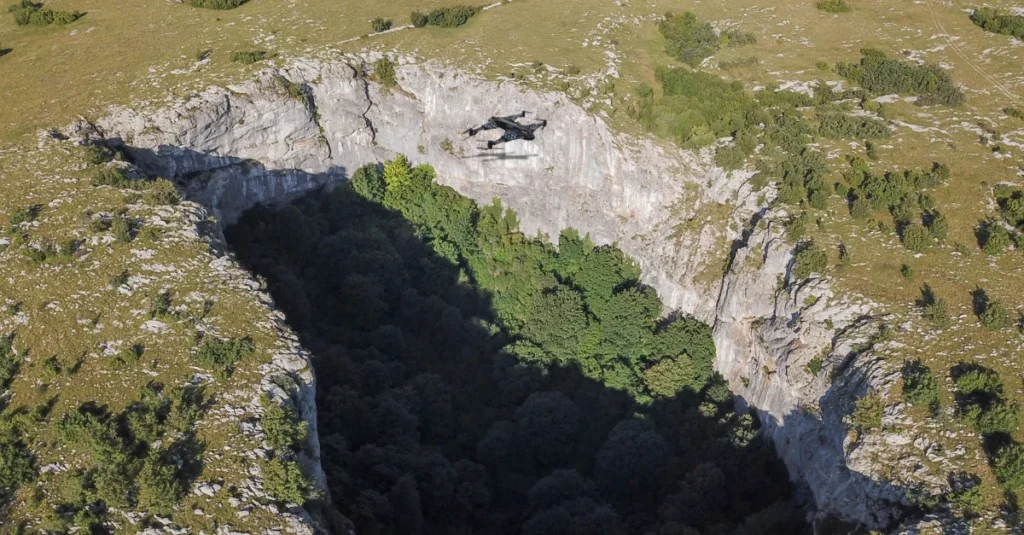
How Can the Zenadrone 1000 Assist in Sinkhole Detection and Monitoring?
Modern sinkhole detection technology is now enhanced by Zenadrone 1000, by providing accurate aerial mapping and identification of ground stability as early as possible. Zenadrone 1000 advanced sensors and imaging tools assist the professionals in detecting subtle changes that might indicate potential sinkhole activity.
In simple words, this powerful ground assessment drone helps experts identify underground risks before they become dangerous surface collapses.
How Advanced Drone Imaging Helps
- Early sinkhole warning signs can be detected by Zenadrone 1000’s high-resolution aerial imaging before they become visible at ground level. A proof enough that this is a highly advanced sinkhole monitoring drone. It is also helpful in identifying surface depressions, soil movement, and unusual moisture patterns connected to underground void
Using Multispectral and LiDAR Data
- Vegetation stress caused by hidden soil erosion or water flow changes can be revealed by multispectral imaging.
- Experts can spot deformation linked to developing sinkholes with the help of LiDAR scanning. This measures ground elevation with extreme accuracy.
Monitoring High-Risk Areas
- After heavy rainfall which commonly accelerates erosion and increases sinkhole formation risks, the drone performs aerial mapping.
- It can be used in construction zones where excavation, drilling, or heavy vibration can destabilize weak soil layers.
Real-Time Support for Professionals
- Geologists analyze cavity development and soil behavior with greater accuracy with real-time drone data.
- Drone imagery is used by Engineers and emergency teams to plan responses, reduce risk, and prioritize public safety.
Drone-based inspections vs. Manual ground inspection
- Aerial mapping and improved sinkhole detection technology allow Drone-based inspections to quickly cover large areas, making them safer and providing thorough data for ground assessment.
- Manual ground inspection for finding early signs of sinkholes is slower and riskier, and partial since it needs close physical access to unstable ground.
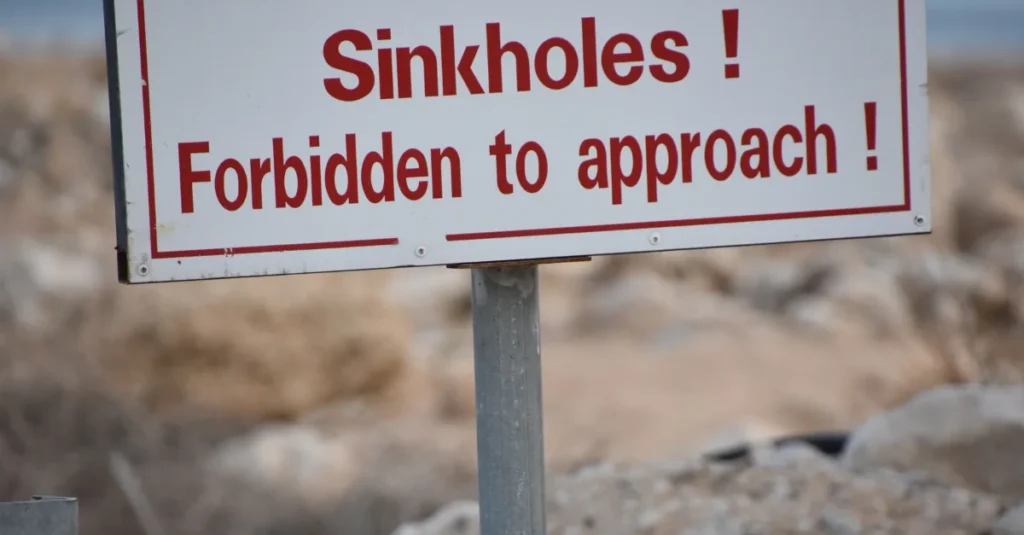
What Should You Do If a Sinkhole Appears?
When a sinkhole appears, prioritize proper sinkhole safety procedures to protect everyone nearby. If the ground continues to shift and may require a full sinkhole evacuation it’s important to remember these emergency steps:
- Move people and pets immediately away from the sinkhole and avoid standing near the edges.
- Evacuate the area if cracks widen, soil sinks, or the ground continues to shift unexpectedly.
If everyone is already safe, you can proceed to secure your property.
- Mark or rope off the sinkhole perimeter and document damage (take photos or videos from a safe distance).
- Keep cars, heavy tools, and foot traffic away to prevent the collapse from getting worse.
Who to Contact
- The local authorities
- Sinkhole repair experts
- Utility companies
- Geologists or structural experts for assessments
- Insurance Providers (report potential damage and understand coverage related to sinkhole events)
How Is Sinkhole Damage Repaired?
Specialized sinkhole repair methods are required in repairing sinkhole damage. These stabilize the ground and protect property. The process typically includes:
Filling and Stabilizing Methods
- Compaction grouting covers holes in the ground with a material that acts like cement to make the soil stronger and stop it from falling apart further.
- For homes and buildings that are sinking, structural stabilization may include adding support columns or underpinning the foundations.
Professional vs. DIY Limitations
An attempt to repair a sinkhole that requires an expert to fix is highly discouraged. Improper methods bred by the lack of knowledge and experience can worsen the collapse and compromise the area’s safety.
Instead of relying on yourself, contact a professional person with expertise in such a field to do the job for you. Stability can only be reliably achieved by a trained professional with the use of their specialized equipment and techniques designed to reinforce soil and protect structures. “DIY” (Do It Yourself) is not harmless if it is limited only to creative pursuits and making things around someone’s life easier. However, in situations that involve the safety of everyone, DIY is strictly not advisable.
Long-Term Ground Monitoring
- The stability of repaired areas remaining over time are ensured through an ongoing process of observation. This is supported by the use of surveys, sensors, and drone inspections. In addition, through monitoring early warning signs of new movement, homeowners can be worry-free of their safety.
How Much Does Sinkhole Damage Cost Each Year?
Over the past 15 years, sinkhole damage is worth an average amount of at least 300 million USD per year. This estimated amount is probably lower than the actual amount, since there is no national tracking of sinkhole damage costs. Although the estimated amount is still unsettled, it is undeniable that the damage costs are substantial. Homes, businesses, and public infrastructure are the affected industries and properties of these natural phenomena.
Residential property owners often face higher expenses. Their built foundations, driveways, and landscaping require extensive repairs after the ground collapse occurred. Construction industries, as well as utilities and transportation, experience more losses due to operational disruptions, pipeline repairs, and road damage from sinkholes’ existence.
Sinkhole insurance cost increases constantly, since more homeowners find coverage for unpredictable ground subsidence, especially in high-risk karst terrain regions. The states Florida, Texas, and Kentucky are indicated by property damage statistics as the states that consistently report the most sinkhole-related claims, highlighting the geographic concentration of risks.
Also, insurance companies keep their finances safe and the benefits they offer are stable by keeping an eye on trends, changing the coverage levels, adjusting the premiums, or looking at the risk of homes in sinkhole-prone areas.
It is important for homeowners to understand these financial impacts considering how helpful it is for both homeowners and business plans (repairs, insurance needs, and preventive measures against costly sinkhole damage).
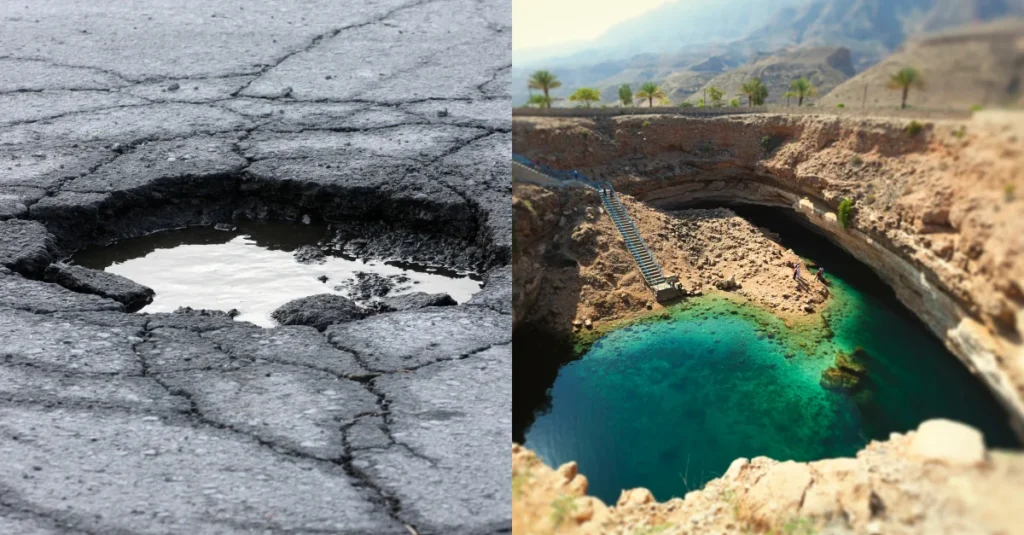
What’s the Difference between a Sinkhole and a Pothole?
- When the ground falls into an underground hole produced by subsurface erosion, it creates a sinkhole. This happens a lot in karst terrain.
- Potholes are usually formed when the surface gradually gets weak and the water seeps in. Vehicles repeatedly driven over the weak surface is also the reason. It affects the layer of pavement.
Structural Risks (Sinkhole VS. Pothole)
- Sinkholes can badly affect entire roads, homes, and structures because collapses are often sudden and extensive. This causes major road damage.
- Potholes usually cause minor vehicle damage or localized pavement deterioration, rarely affecting underlying structures.
City Management (Sinkhole VS. Pothole)
- Sinkholes are managed by monitoring high-risk zones, reinforcing vulnerable areas, and sometimes relocating infrastructure.
- Potholes are routinely fixed with patching, resurfacing, and preventive maintenance. These are helpful in maintaining safe driving conditions.
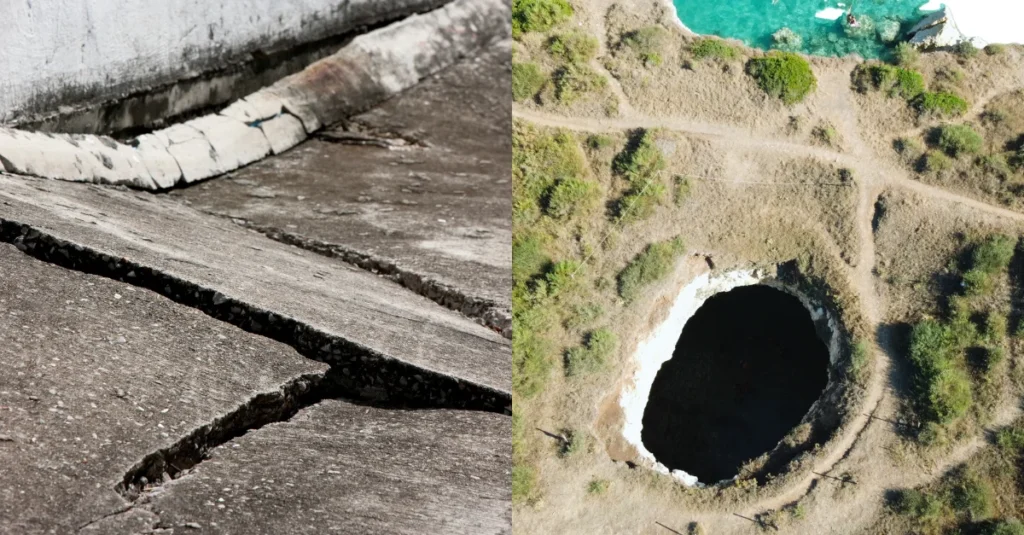
What’s the Difference Between a Sinkhole and Land Subsidence
- Land subsidence happens slowly over time as the land sinks due to soil compaction or the removal of groundwater.
- When subsurface cavities collapse, a sinkhole arises quickly, causing depressions on the surface that are more detrimental to people and properties.
Causes & Diagnostics (Land Subsidence VS. Sinkhole)
- Land subsidence occurs when the ground slowly sinks due to either natural processes or human activities. Both are causes of slow but significant surface lowering as time passes by.
- Sinkholes are commonly found in karst terrain, where soluble rocks, such as limestone, dissolve, forming detectable underground voids.
Impact on Buildings & Infrastructure
- Land subsidence’s slow ground settling can lead to cracks in building foundations, damage to roads, and disruptions in pipelines, resulting in enduring structural and utility issues.
- Sinkholes occur when people least expect it, posing urgent dangers that jeopardize structures and roadways often forcing them to evacuate without any preparations.
What Is the Largest Sinkhole in the United States?
The biggest U.S. sinkhole is the Bayou Corne Sinkhole in Louisiana. Bayou Corne’s collapse in 2012 forced a mandatory evacuation of the nearby town.
Although there are numerous famous large sinkholes, among them Bayou Corne Sinkhole gained the public’s attention. Its massive size, depth, and dramatic impact are the reasons why this sinkhole remains famous in the country.
Geologically speaking, the formation of the sinkhole is due to the collapse of an underground salt dome, illustrating how notable sinkholes result from both natural and human-influenced processes. With its over 34 acres of measurement and 750 feet of depth, it is undeniable that the Bayou Corne Sinkhole is deemed the most destructive recorded sinkhole in U.S. history.
Despite its hazardous nature, the site has become relevant for scientific research. Considering its existence, geologists were able to study subsurface erosion, karst processes, and ground stability. Its notoriety also pulls tourists, photographers, and geology enthusiasts interested in observing one of the famous sinkholes that changed an entire community.
Through studying this biggest U.S. sinkhole, people are reminded of urban planning, disaster preparedness, and public awareness in regions vulnerable to sudden ground collapse
Frequently Asked Questions
Can sinkholes be predicted?
It can, but it’s difficult, since they often form underground without visible warning signs. Early ground movement detection can be done through advanced monitoring technologies.
Are sinkholes becoming more common?
Occurrences of sinkholes may be increasing due to urban development, groundwater withdrawal, and climate-related heavy rainfall.
Can heavy rain cause sinkholes?
Yes, since it weakens soil and accelerates erosion. Heavy rain can trigger sinkholes in vulnerable areas.
Do sinkholes happen suddenly or slowly?
Both. It can form gradually and suddenly. Cover-subsidence sinkholes develop slowly, showing small depressions first. Cover-collapse sinkholes occur abruptly, creating immediate hazards.
Can sinkholes swallow houses?
In some cases, sinkholes can eat an entire structure, especially if the collapse is sudden. Homes standing on unstable limestone face the greatest risk.
How deep can sinkholes get?
From a few feet to several hundred feet. Depth depends on geology and underground cavity size.
Are sinkholes covered by home insurance?
Standard home insurance often excludes sinkhole damage. Policies in high-risk states like Florida may include coverage if purchased separately.
How can homeowners reduce sinkhole risk?
Watching out for cracks or settling ground, property checking in karst areas, and ensuring drainage stability.
Contact Us

Thank you for your message. It has been sent.