



NJ Drone Laws: Complete Guide to Flying Drones
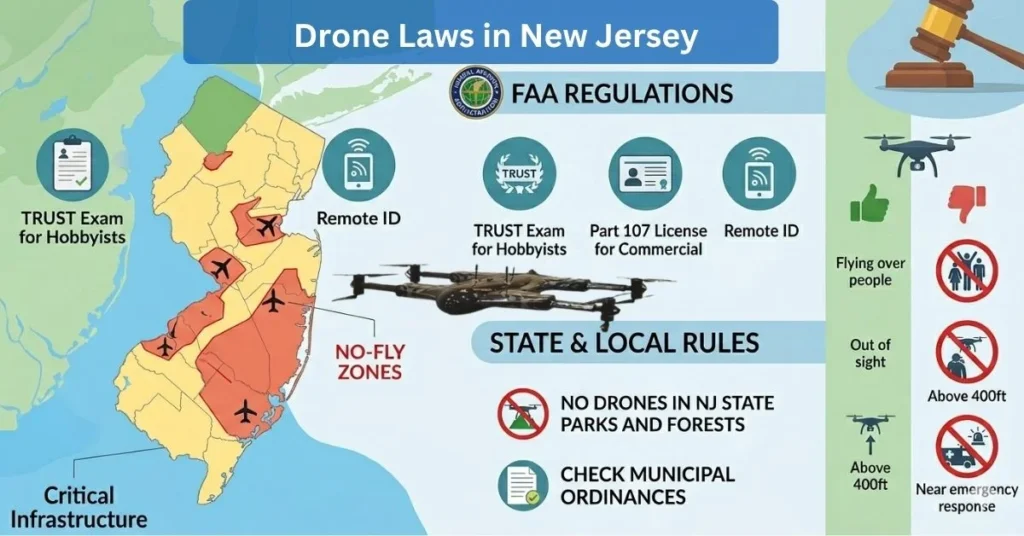
Different areas and states have different rules and regulations, and even New Jersey has its own set of drone laws set in place for firms to abide by when choosing to operate an unmanned aerial vehicle (UAV). These drone laws in New Jersey are a multi-layered legal framework that combines Federal Aviation Administration (FAA) mandates, state statutes, and local municipal ordinances. With these established NJ drone laws, the environment and skies remain secure for all residents, devices, and properties in New Jersey.
Understanding New Jersey drone laws is essential, knowing how the state is one of the most densely populated and airspace-congested in the country. Firms and their pilots need to follow these laws when flying drones in New Jersey in order to be safe and legal.
This blog will act as a complete guide that explains and discusses the NJ Drone Laws mandated, including matters relating to the current regulations, the FAA, and other related topics.
Federal vs State Drone Regulations in NJ
Operators can learn how to fly drones legally by first knowing the federal vs state drone laws in New Jersey. While implementing drone laws in New Jersey and other UAV regulations is necessary, the specific federal and state regulations in the state represent a dual-authority system. To understand more about New Jersey drone regulations, the text below pertains to the specific federal drone laws and state drone regulations.
Role of the FAA in Regulating NJ Drones
The FAA is authorized to manage the national airspace, whereas the specific state can govern conduct on the ground. Specifically, the role of the FAA in regulating New Jersey drones is to define flight safety and pilot certification standards nationwide. Holding exclusive authority over the United States’ navigable airspace allows the FAA to ensure that all manned and unmanned aircraft are operating under a single safety standard.
- FAA Authority Over Airspace in New Jersey
Moreover, the FAA controls U.S. airspace as it considers drones as aircraft, and the federal law generally overrides local rules. With that, the federal preemption can prevent conflicting flight rules that would make navigation impossible among pilots crossing municipal lines. FAA authority over drones in New Jersey makes it easier for operations when it comes to altitude and safety mandates, which proves that federal oversight warrants that the national airspace remains open and consistently regulated for every current flight operation.
- FAA Rules That Apply to All NJ Drone Pilots
For all New Jersey drone pilots, the FAA rules mandate that they adhere to specific safety protocols. This also applies to drone registration for any aircraft that weighs over 250 grams. Commercial operators are required to have a Part 107 Remote Pilot Certificate, while hobbyist operators should pass the recent TRUST (The Recreational UAS Safety Test); both of which are requirements that help create a registry of accountable pilots who fully comprehend basic aeronautical safety.
How New Jersey Drone Laws Differ From Federal Rules
As mentioned above, New Jersey drone laws are appropriate for safety and compliance, and they differ from federal rules in terms of the UAV operator and their reason for flying drones. Having these state-specific restrictions established fills in the gaps for public safety that might be overlooked by federal flight rules. Learn more about state-specific drone restrictions and local drone rules below.
State-Specific Drone Restrictions in New Jersey
New Jersey has a specific statute, Title 2C:40-28, that prohibits flying UAVs while intoxicated or operating a drone with the intention to harass others. Since the FAA does not explicitly cover these crimes, this particular New Jersey drone law is necessary for the sake of public safety. There are circumstances wherein the FAA allows drone flight operations during emergency response and near critical infrastructure; however, New Jersey drone laws strictly prohibit them to prevent contraband smuggling.
Local Drone Rules Set by Cities and Parks
City and municipal drone restrictions include the specific location of the drone’s takeoff and landing, even if the FAA allows it in the air above. These local drone rules set by cities and parks help in managing land use and protecting high-traffic public spaces from noise and safety hazards. Other state parks and beach drone policies require special permits to operate UAVs that fly over areas that have banned recreational flight, like Liberty State Park.
Flying a Drone in NJ What’s Legal and what’s not?
After distinguishing the difference between federal laws and state drone regulations, it’s also significant to ascertain the rules for flying drones in New Jersey. Flying a drone in New Jersey entails that operators and pilots follow both FAA safety standards and New Jersey’s unique penal codes, such as the Senate Bill 3370, which states that specific behaviors like flying intoxicated or near prisons are not allowed.
Legal flight in New Jersey is centered on registration, certification, and authorization. The process starts with every pilot registering their aircraft with the FAA, then obtaining a Part 107 license or a TRUST certificate. Nonetheless, there are still common mistakes when flying a drone in New Jersey, such as conducting a drone takeoff in any location within New Jersey. Here’s a table that depicts the summary of the New Jersey flight:
|
Legal Status |
Potential Penalty |
|
|
Flying near MetLife Stadium |
Illegal (TFR Zone) |
Federal Felony / Large Fines |
|
Night flight with strobes |
Legal |
N/A |
|
Flying near a Prison |
Illegal (4th Degree Crime) |
Up to 18 Months Prison |
|
Operation while Intoxicated |
Illegal (Disorderly Person) |
Jail time / Fines |
|
Flying over your neighbor |
Legal (with caveats) |
Potential Harassment Charge |
Recreational Drone Rules in New Jersey
Certain flight operations need a specific type of drone, like how recreational drones are utilized for personal enjoyment, hobbies, or leisure purposes. Recreational drone laws in New Jersey delineate the set of legal mandates and safety guidelines associated with operating UAVs for both gratification and non-commercial reasons. New Jersey drone rules for hobbyists are discussed below, involving the pilots, FAA rules, and registration requirements.
Hobbyist Drone Laws in NJ
According to the FAA, a hobbyist or a recreational flyer refers to an individual who operates a drone for entertainment without a business or profit motive. This includes aerial photography and videography for a person’s social media and other reasons, like educational and personal development. Hobbyist drone laws in New Jersey are implemented in order to ensure that pilots take into consideration the safety of the national airspace, along with the privacy of the state’s residents.
- Who Is Considered a Recreational Drone Pilot in NJ
Recreational drone use pertains to pleasure or personal education, and commercial use refers to operations for compensation and/or hire. It’s important to understand the differences since they determine which certification and registration rules must be followed for compliance with New Jersey drone regulations. Hence, New Jersey considers a recreational drone pilot an individual who operates a UAV solely for personal enjoyment.
- FAA Rules Hobbyist Drone Pilots Must Follow in NJ
Furthermore, hobbyist drone pilots based in New Jersey must follow a set of FAA rules. This includes obtaining prior authorization to fly in controlled airspace, while adhering to maintain a maximum altitude of 400 feet and keeping the aircraft within a visual line-of-sight (VLOS) requirement. Recreational drone pilots must also yield to the right-of-way to all manned aircraft, people, and buildings at all times during the flight operation.
Registration Requirements for Drones in New Jersey
In terms of drone registration in New Jersey, this includes the requirements and the method for obtaining the registration. Firms and their pilots should consider the following:
- When Drone Registration Is Required in NJ
Federal law mandates that any drone or UAV that is classified to weigh between 250 grams and 55 pounds must be registered with the FAA. Otherwise, drones that are “sub-250” are exempt from registration unless used for commercial purposes. FAA registration rules for hobbyists involve properly listing drones, and for all pilots in New Jersey to be law-abiding, encouraging accountability for every incident or safety violation.
- How to Register a Drone for Recreational Use
Registering a drone for recreational use in New Jersey involves an online process that can be conducted through the FAA DroneZone portal, which costs $5 for a three-year term. This process has the applicants receive a single registration number that can be used for the entire fleet of recreational aircraft. Having the mark on the outside of the drone as a physical identification indicates that the pilot and drone are registered for flight within New Jersey.
Commercial Drone Laws in NJ
Other than recreational drone regulations, there are also commercial drone laws established in New Jersey. These rules define the mandatory legal framework that governs any unmanned aircraft system (UAS) operation conducted for commercial purposes, or similar intention to that of a business. Commercial drone laws integrate professional aerial operations safely while protecting New Jersey’s ground-level privacy, in addition to the following:
Business and Professional Drone Use in New Jersey
Utilizing drones and UAVs in New Jersey should center on the intention. It’s important to identify if the purpose is for business and professional gains, in which case it falls under FAA Part 107 regulations.
What Qualifies as Commercial Drone Use in NJ
Drone operations that are associated with supporting a business, a non-profit, or similar cases of promotion are qualified as commercial drones and must follow FAA Part 107 regulations. This entails that commercial drone pilots must meet a uniform safety standard, making a recognizable difference between them from recreational drone pilots.
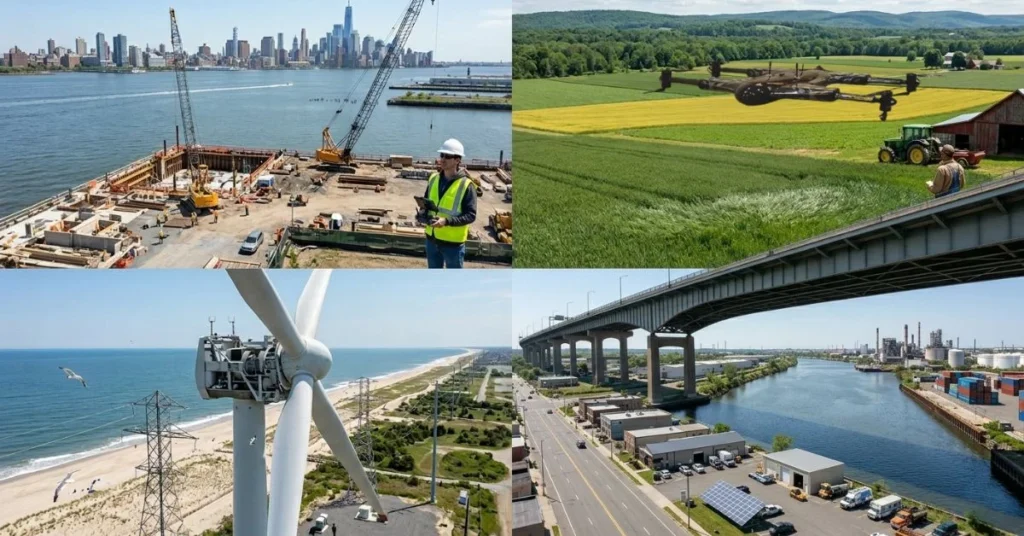
Industries Using Commercial Drones in New Jersey
Real Estate and Aerial Photography
New Jersey is a state that has diverse industries that utilize commercial drones; real estate and aerial photography are one primary industry, as it offers high image quality and reliable obstacle avoidance for this particular sector.
Infrastructure Inspection and Construction
Additionally, infrastructure inspection and construction can also benefit from commercial drones. It provides workers and teams with the data that they need for mapping and surveying, including the necessary information to continue the process of construction through drone inspection and monitoring.
Agriculture and Land Surveying
Commercial drones can also be used for agriculture and land surveying, wherein the UAV offers farmers related data to their crops, fields, and even livestock. The high-resolution aerial data from land surveying accelerates farm workflows and also reduces operational costs.
Public Safety and Emergency Services
Lastly, New Jersey also has public safety and emergency services that implement commercial drones for surveying. This advanced technology is capable of providing real-time aerial intelligence that can help security personnel and first responders have better situational awareness and improve efficiency across operations.
Licensing and Part 107 Requirements
There are also licensing and Part 107 requirements for New Jersey drone pilots, which must be strictly adhered to when pilots opt to fly UAVs with commercial intentions. More details and information on licensing and Part 107 requirements below
Part 107 Certification Requirements for NJ Drone Pilots
Obtaining a remote pilot certificate requires being at least 16 years old, proficient in the English language, and passing the comprehensive aeronautical knowledge exam. In addition, the pilot should also pass a TSA background check during the application process. These FAA Part 107 eligibility criteria and TSA background check are necessary to verify that the pilot fully understands airspace classifications, weather patterns, emergency procedures, and other essential information.
Operating Rules Commercial Drone Pilots Must Follow
Additionally, daylight and night operations are allowed, provided the drone meets specific safety criteria and is equipped with anti-collision lighting. Flying near people and moving vehicles follow strict operational limits under Part 107, stating to maintain a VLOS and yield to all manned aircraft. Airspace authorization and waivers also allow the pilots and operators to proceed with flight missions with surgical precision, protecting both the aircraft and the public.
Observe the table below for a brief and concise depiction of commercial drone use, and the specific requirements must be followed:
|
Requirement |
Commercial Drone Use |
|
FAA Part 107 license |
Required |
|
Drone registration |
Required regardless of weight |
|
Airspace authorization |
Required in controlled airspace |
|
Night operations |
Allowed with proper compliance |
|
Waivers |
Available for certain restrictions |
Drone Ban in New Jersey: Restricted and No-Fly Areas
Drone bans are specific geographic locations where drone flight and UAS takeoff or landing are prohibited. These restrictions include restricted areas and no-fly zones (NFZs), like the airspace in Newark Liberty International Airport. On the other hand, Temporary Flight Restrictions (TFRs) are implemented for security during special events.
Enforcing these drone bans in New Jersey can help prevent catastrophic mid-air collisions and safeguard critical buildings and structures from potential surveillance or interference. Therefore, it’s essential to be knowledgeable of the no-fly zones across New Jersey; those would be near correctional facilities, military bases like the Joint Base McGuire-Dix-Lakehurst, and critical energy hubs like the Hope Creek Nuclear Generating Station. For TFRs, there are places such as Bedminster during diplomatic visits or at MetLife Stadium during major events like live sports and concerts.
Where You Can Fly Drones in New Jersey?
After knowing more about drone bans, it’s important for firms and their pilots to be aware of where to fly drones in New Jersey. Determining the specific location requires an understanding of both FAA-authorized airspace and state-managed land. Flying drones in New Jersey is not allowed in most state parks and beaches unless permitted to do so in order to protect shorebirds and preserve the visitor experience.
Urban drone flying rules in New Jersey involve a mandatory LAANC authorization before every takeoff, whereas rural drone flying rules only require vigilance near military training routes. Although the rules for flying a drone in New Jersey shift between the specific regions of the operation, it is crucial to learn the flying rules to avoid penalties and fines. It’s also best for firms and pilots to regard their environment prior to the flight operation to tailor their safety protocols in accordance with the specific risks of the terrain.
Size of Drones in NJ and Weight Restrictions
When it comes to proportions, there are also restrictions for drone size and weight. The size and weight restrictions for drones in New Jersey are primarily based on the Maximum Takeoff Weight (MTOW), which considers the aircraft itself, its battery, and any payload. Establishing these weight classifications helps management of kinetic energy risk in the state’s populated areas, and it ensures the heavier aircraft meets stricter safety and certification standards.
Drone Size Limits in New Jersey
How Drone Size Is Classified in New Jersey
While the FAA primarily regards the drone’s weight to determine the legality, the state of New Jersey and its municipal codes actually take into account the physical dimensions of the drone. Drone size classification is essential for safety and airspace as it differentiates the small devices from the large industrial platforms that may pose risks, noise, or safety concerns within local residences. Hence, it’s important for pilots and operators in New Jersey to identify the specific size of their drone and/or UAV.
Small, Medium, and Large Drones Explained
Specifically, drone sizes have three functional size categories:
- Compact Consumer Drones
This specific size category refers to UAVs that are under 12 inches. Compact consumer drones are the ideal UAV for hobbyists.
- Mid-Range Professional Drones
For mid-range professional drones, these are classified to have a size range from 12-24 inches. This drone size is appropriate for professional photographers.
- Large Industrial and Agricultural Drones
These large industrial units are UAVs with a size of more than 24 inches, making it necessary for heavy-duty missions such as aerial monitoring systems or cargo transport.
Weight Categories and Registration Thresholds
Categorizing drones and UAVs by weight rather than their dimensions can help regulators apply the necessary proportional safety rules for multiple aircraft. Following these weight limits enables maintaining compliance with both federal and New Jersey drone laws.
Drone Weight Categories Recognized in NJ
New Jersey has inaugurated these drone weight categories in order to quantify the potential impact of a drone on public safety and property. In fact, New Jersey has recognized three primary drone weight categories, and those are the following:
- Micro
Drones that weigh under 250 grams are under the Micro drone size category, which are often exempted from certain recreational drone rules in New Jersey.
- Small
The UAVs that weigh from 250 grams to 55 pounds fall into the Small drone size category.
- Heavy
Lastly, heavy drones are those that weigh over 55 pounds. Heavy drones are strictly regulated under Part 91 and other experimental certifications.
Registration Thresholds Based on Drone Weight
As of 2026, drone registration is lenient for drones that weigh 250 grams or less. Drones and UAVs that weigh more than that are mandated to be registered with the FAA and broadcast a Remote ID signal. However, commercial pilots and their drones must be registered with the FAA regardless of the drone’s weight.
Weight can indeed have an impact on operational permissions, considering how it can carry enough kinetic energy that may cause injury. New Jersey drone laws implement weight thresholds to determine liability coverage for micro and standard UAS fleets. With that, having these registration thresholds based on drone weight is necessary for an efficient and safe flight operation.
New Jersey Drone Laws for Privacy and Safety
Discovering more about New Jersey drone laws also gives attention to the privacy laws that affect drones in New Jersey. These drone laws for privacy and safety are regarded as specific statutes and ordinances that are able to govern how UAS can interact with the personal space and the physical security of residents. Mandating these drone laws is vital for trespass standards, since it ensures that the drone’s ability to view from above is not used for ill intent, or for harassment, stalking, or voyeurism.
Privacy laws that affect drones in New Jersey, such as the N.J.S.A. 2C:40-28, which states that it is a criminal offense to be in possession of a surreptitious recording of people in settings and contexts where they expect to have their privacy respected. Applicable cases are private gatherings within fenced backyards or through home windows. With these boundaries, New Jersey is a state that highly acknowledges the protection and privacy of its citizens from modern surveillance, while also respecting drone pilots with a comprehensible rule to avoid civil and criminal liability.
In circumstances where operators are flying drones over people properly, there is strict control to mitigate the kinetic risks that are associated with high-density living. According to the FAA Part 107 and NJ’s disorderly person statutes, it is illegal to fly directly over any person who is not participating in the operation. This restriction prevents incidents and mechanical failures that can cause harm and injury to those in the vicinity of the flight operation, proving that proper flight planning can protect people and property and making a compromise between high population density and the need for drone flights.
Penalties for Violating Drone Laws in NJ
There are still unfortunate situations in which operators do not adhere to the FAA-mandated rules and regulations, and this results in penalties for violating drone laws. Specific penalties are categorized by the severity of the offense, operators receive a range of civil administrative fines to significant criminal imprisonment. N.J.S.A. 2C:40-28 explicitly states that the illegal act of operating a drone while intoxicated or using a UAV to interfere with first responders is recognized as a disorderly persons offense.
Fines and legal consequences in New Jersey are expected to include up to six months in jail and fines of $1,000. More severe drone law violations involve third or fourth–degree crimes, which can carry potential prison sentences of over 18 months to five years. Thus, firms and their pilots should be aware and cautious when operating drones in New Jersey.
Enforcing New Jersey drone laws ensures that airspace remains orderly and that the privacy of individuals and fellow residents is protected from aerial intrusion. Although the FAA manages the federal pilot certification and airspace violations, the state of New Jersey State Police and local municipal departments can legally administer state-level criminal statutes and local ordinances in order to allow immediate response to ground-level complaints.
Final Thoughts
Discovering more about drone laws gives the notion for firms and their pilots to stay compliant with New Jersey drone regulations. It’s imperative to be proactive in legal flight operations by adhering to federal certification requirements, state-specific conduct, and local land-use regulations. Complying can help protect the integrity of New Jersey’s congested skies and ensure that all operating drones in the state are viewed as a technological advancement, rather than a public threat.
In order to fly safely and legally in New Jersey, the pilot has to consistently use pre-flight tools and follow the VLOS rule at all times throughout the operation. Navigating the state’s geography can be challenging, but best practices minimize risk and enable an efficient drone flight. Committing to these tips for safe and legal drone flying in New Jersey represents the high standard of a privilege through responsibility in the skies.
FAQ
Do I need a license to fly drones in New Jersey?
Yes. Commercial pilots need to have an FAA Part 107 Certificate, while recreational pilots only need to pass the TRUST (The Recreational UAS Safety Test).
Are drones allowed everywhere in NJ?
No. Drones are not allowed in all New Jersey State parks, wildlife refuges, and historical sites, as well as other municipalities.
Can visitors fly drones in New Jersey?
Yes, as long as visitors follow all FAA rules. International visitors still need to register their drones with the FAA and pass the TRUST or obtain a FAA Part 107 Certificate.
What is the legal size of drones in NJ?
There is no specific size limit; however, any drone or UAV that weighs over 250 grams must be registered with the FAA and broadcast a Remote ID signal.
Are there drone no-fly zones in NJ?
Yes. No-fly zones in New Jersey are around airports, military bases, prisons, and power plants.
Can I fly a drone over private property in NJ?
New Jersey drone law prohibits surveillance over property where people expect to have privacy. Hovering a drone on private property can lead to harassment or stalking charges.
Can I fly a drone at night in NJ?
If your drone is equipped with anti-collision light for at least 3 statute miles, then it is legal to fly that drone at night in New Jersey.
What happens if I break drone laws in NJ?
Breaking drone laws in New Jersey results in FAA civil penalties (up to $27,500+), confiscation of equipment, and criminal charges.
Contact Us

Thank you for your message. It has been sent.