



Drone Parts Explained: Complete Guide to Components & Accessories
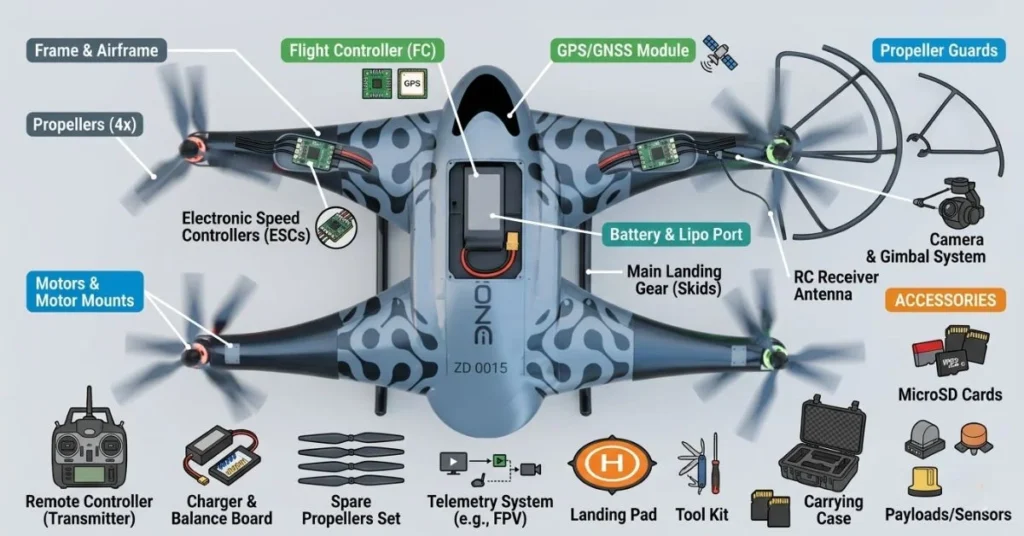
Regardless of whether you fly recreationally, race competitively, or operate commercially, it is important to understand the drone parts. Contemporary drones incorporate structural parts, propulsion, electronics, image, and communication into a small aircraft. All of these components have a particular role to play in providing safe flight, efficiency, and reliability of performance in various environments and applications.
In this comprehensive guide, we will discuss components of a drone, replacements, upgrades, maintenance tips, and the most valuable accessories of your aircraft to be able to fly safely and efficiently. Whether you are replacing worn-out parts or improving their function, knowing the purpose of each part will help you make sound decisions.
What Are the Main Parts of Drones?
To adapt to a controlled flight, drones are constructed using various combined systems, which work in conjunction to produce lift, stability, data processing, and controlled flight. Knowing the key components of a drone will enhance the maintenance, operation, and safe operation.
1. Frame and Structural System
All parts needed to build a drone are based on the frame.
It strengthens and maintains internal aspects and supports the rigidity of the structure. The frames are typically made out of carbon fiber, aluminum or poly composite based on durability needs and expenses. An efficient frame also improves air movement to the components and diminishes the amount of heat that would be between flights.
2. Arms and Motor Mounts
The central body has drone arms that carry motors. They should be accurately aligned to ensure balanced, equal thrust distribution across all rotors. Motor mounts hold motors in place and minimize vibration transmission while preventing the internal electronics from being subjected to unnecessary stress. Arms and other drone parts are among the most frequently replaced parts after a crash.
3. Propulsion System and Motors
Most modern drones operate under brushless DC motors. They use electrical energy to convert it to rotary energy that is used to rotate propellers effectively and reliably. The propulsion system comprises propellers, motors, and ESCs that together provide directional movement and lift.
High-quality motors make it more efficient and extend flight time. The right motor KV rating is one that will match your propeller size and battery voltage.
4. Propellers and the Production of Thrust
Propellers create a lifting effect on the air by pushing it down.
Every drone is expected to have two propellers, one counterclockwise (CCW) and one clockwise (CW), to counteract torque and stabilize rotation. Propeller design and materials directly affect noise levels and aerodynamic efficiency.
The most important are the diameter, pitch, and material composition. The most common drone component to be replaced is the propeller, as it is exposed to impacts and debris.
5. Electronic Speed Controllers (ESC)
ESCs control motor speed by varying the battery’s electrical input. They convert throttle commands from the flight controller into quick electrical impulses that rotate the motors at a particular RPM. New ESCs also feature thermal protection and current monitoring to enhance safety.
They provide accurate throttle control and protect motors from overloading. As well, advanced ESC firmware may enhance flight responsiveness and even smooth acceleration.
6. Flight Controller Board
The drone’s brain is its flight controller.
It takes sensor readings and corrects the aircraft in real time by calculating the changes in pitch, roll, and yaw. This board cannot control the drone’s flight without proper processing.
It has balance and altitude hold controls, as well as GPS and return-to-home functions. Sophisticated flight paths and safety redundancy are also supported in many high-end flight controllers.
7. Power Distribution Board (PDB)
The battery then powers the various systems, such as ESCs, the flight controller, GPS, and camera modules. It provides a balanced voltage to prevent power surges or electric shock.
An effective PDB reduces wiring clutter and minimizes electrical resistance. There is a direct increase in reliability and component life due to clean power distribution.
8. Battery and Power System
The lithium-polymer (LiPo) batteries are used in the majority of drones. The battery capacity directly influences the flight time, payload capacity, and the motor’s efficiency. An increase in mAh ratings adds durability but also weight.
The safety of operations depends on battery health. The correct charging regimen greatly increases the life of this vital component of the drone.
9. GPS Unit and Navigation System
GPS packages include position-holding, waypoint, return-home, and geofencing features. These systems use satellite communications to get the accurate coordinates.
Precise positioning is crucial for commercial and industrial drones. Dual-band GPS systems are more precise in adverse conditions.
10. IMU (Inertial Measurement Unit)
Accelerometers and gyroscopes are in the IMU. It counts movement, tilt, and orientation hundreds of times per second in order to stabilize. The calibration provides proper motion tracking.
This part operates throughout the flight to correct the drift and unexpected movements. Stable hovering cannot be achieved without a well-working IMU.
11. Sensors (Obstacle Avoidance, Compass, Barometer)
Modern drones are equipped with an altimeter to measure altitude, a compass to indicate the drone’s heading, and a collision avoidance system. Such drone components are highly automated, making them safer.
Obstacle sensors use infrared, ultrasonic, or vision-based sensing. Collectively, these sensors decrease workload and minimize risk to the pilots.
12. Camera and Imaging System
The drone cameras differ according to the needs, including 4K video and thermal and multispectral cameras. Image quality is defined by camera resolution, sensor size, and dynamic range. Professional-grade drones often allow payload changes.
The imaging components can be very costly drone parts. Good cameras should be invested in to enhance data accuracy and clarity on the visual scale.
13. A Gimbal Stabilization System
A gimbal is a stabilizer made out of motorized axes that stabilizes the camera. It corrects aircraft motion to produce a smooth video even in windy weather. Three-axis gimbals are more stable than two-axis systems.
Horizontal leveling is provided through proper calibration. The gimbals are damaged and are the most frequently replaced drone spares after crashes.
14. Remote Controller and Receiver
The drone takes radio signals emitted by the remote controller. The onboard receiver deciphers commands and sends telemetry information to the pilot. Newer controllers have built-in touchscreen displays and application interfaces.
Long-distance flights are safe due to reliable communication. Control is one area that can be severely affected by signal interference.
15. Communication Systems and Antennas
Signal strength and flight range depend on the antennas. Antenna gains increase the stability of the transmission and minimize the signal dropouts. Extended-range systems are among the most efficient accessories for drones in professional applications.
Diversity of antennas (dual antennas) enhances reliability. The proper orientation of an antenna also improves signal clarity.
16. Landing Gear
Landing gear cushions the drone during landing and takeoff. It cushions the camera and sensors against impact and damage. Other professional drones have retractable landing gear to keep camera views clear.
It is important to have durable landing gear in rough terrain. Damage to the gear must be repaired immediately to prevent additional stress of the structure.
How Do All Components Work Together?
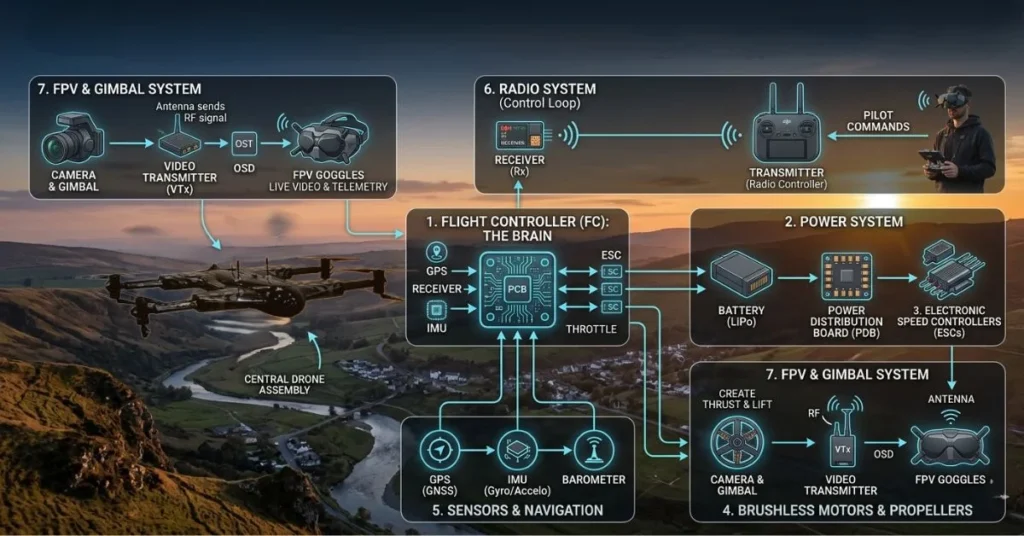
A drone works like a team. The information is collected by sensors, and the flight controller takes actions and the motors readjust immediately to ensure that the drone remains balanced and in a stable position.
Flight Control and Stabilization Process
Flight data is gathered by sensors. This information is processed by the flight controller, and the ESCs receive real-time adjustments. Motors will again adjust speed instantly to maintain balance and constant hover.
This cycle is repeated hundreds of times a second. These quick adaptations keep the drone stable even in moderate winds.
Power Flow from Battery to Motors
The battery power is directed to the PDB to the ESCs and the motors. The same voltage results in constant thrust and safe flight. Reduced lift or emergency landing may be caused by any voltage drop.
Power loss is avoided by efficient wiring. Resistance and overheating are minimized with high-quality connectors.
Communication Between Controller and Aircraft
The controller sends the radio signals to the drone’s receiver. The data of telemetry is reported in real-time, such as battery level, altitude, and GPS position. There are new systems that encrypt communication using state-of-the-art techniques.
The maximum range depends on signal strength. Effective communication distance can decrease when environmental interference occurs.
Navigation and GPS Positioning Explained
The GPS module will be able to communicate with satellites and identify the geographic coordinates. These are coordinates that allow position hold and autonomous flight functions. Others are drones that use GPS and GLONASS or Galileo positioning systems as a backup.
With proper positioning, mapping is enhanced. Accurate navigation information is guaranteed by calibration.
Most Commonly Replaced Parts for Drones
Crashes, vibration, or frequent use lead to the wear of some drone parts more than others. The information about the areas that fail the most will assist you in ensuring that you make safe and trustworthy flights.
Propellers and When to Replace Them
Signs of Damage or Imbalance
- Cracks or chips
- Excess vibration
- Loud buzzing sounds
Choosing the Correct Size and Pitch
Replacement of drone spare parts should always be done with original specifications.
Motors After Crashes
- Overheating and Bearing Failure
Sounds of grinding or disproportional spinning are pointers to internal damages.
- Repair vs. Replacement Decision
Small problems in bearings can be fixed; broken windings have to be repaired.
Battery Wear and Power Issues
- Average Lifespan
The average LiPo battery has a charge cycle of 200-300.
- Storage and Charging Safety
- Store at 40–60% charge
- Avoid extreme temperatures
- Use balanced chargers
-
Arms, Frames, and Structural Destruction: Cracks decline the structural integrity. Replacement of damaged parts on the spot.
-
Gimbal and camera replacement: Recalibration or parts replacement might be required in case of unsteady recordings or panning.
Spare Part Drone Options—OEM vs. Aftermarket
To replace the parts of drones, you are provided with several options in terms of original manufacturer parts or third-party ones. The decision to make lies in compatibility, quality and warranty cover.
Original Manufacturer Components
OEM components are compatible, have a warranty, and are performance-preserving.
Third-Party Alternatives
The aftermarket alternatives are cheaper and of different quality.
Compatibility and Fitment Guide
Before purchasing parts for a drone, verify:
- Model number
- Voltage rating
- Connector type
- Firmware compatibility
Warranty Considerations
The installation of non-OEM parts on drones can cancel the warranty of manufacturers.
Parts Comparison by Drone Type
|
Drone Type |
Frame |
Motors |
Camera |
Battery |
Typical Use |
|
Racing Models |
Lightweight Carbon |
High KV |
FPV cam |
Small high-discharge |
For competitive racing |
|
Aerial Photography |
Foldable Composite |
Efficient |
4K-8K |
Medium |
For cinematography |
|
Agricultural and Spraying |
Reinforced heavy-duty |
High torque |
Mapping Sensors |
Large capacity |
For spraying of crops |
|
Commercial Industrial |
Rugged modular |
Redundant systems |
Thermal/Multispectral |
Large |
For inspection |
|
FPV Models |
Compact Carbon |
Ultra-high RPM |
FPV camera |
Small LiPO |
For immersive flying |
|
Enterprise Inspection |
Weather-sealed |
Long endurance |
Thermal plus zoom |
Extended range |
For surveying an infrastructure |
Performance Upgrades and Enhancement Options
Replacing major drone parts can go a long way toward enhancing flight performance, stability, and mission-carrying capacity. The selection of the appropriate enhancements will be determined by the type of drone, usage, and the general purposes of the performance.
High-Capacity Battery Upgrades
Capacity battery upgrades as well as enabling longer missions that have a longer flight time and can be carried out without the need to make frequent landings. Nevertheless, they also increase the weight, and hence agility may suffer a little, and more powerful engines need to be installed to ensure the best performance.
Upgraded Propulsion Systems
More efficient motors are better in terms of the thrust-weight ratio and offer quicker acceleration and a means to control it better. When upgraded motors are used together with ESCs and propellers that match them, it guarantees a balanced performance and also avoids overloading of the electric supply.
Advanced Camera Enhancements
Improved imaging systems enhance inspection precision and results of cinematography to a better dynamic range and higher resolution. The use of advanced payloads like thermal or multispectral cameras also increases the commercial and industrial performance of the drone.
Extended Range Communication Systems
The most suitable accessories that support drones and long-range flight are signal boosters and superior antennas. Such systems can be used to increase stability and decrease interference of signals and also enable safe operation of the signal at long distances.
Lightweight Frame Materials
Carbon fiber upgrades reduce overall weight and improve structural durability. A reduction in weight also enhances energy efficiency and flight responsiveness without affecting strength.
Maintenance Checklist for Long-Term Performance
To maintain your aircraft in its best condition, it is important to include routine inspections of the main drone components and to check them daily. A well-organized maintenance checklist is not only beneficial in terms of longer lifetime of the components but also helps to decrease the number of mid-air failures and results in costly replacement of the drone spare parts.
Pre-Flight Inspection Routine
Before flying, you should always take some time to check your drone properly. Most frequent in-flight problems can be avoided with a quick check of the visual system.
- Check Propellers: Chips, looseness, warping, cracks, and even minor damage may lead to imbalance and vibration. Another easy method to keep your motors safe is to replace frayed propellers.
- Inspect Arms: Check the arms and mounts on the motor and at the motor hard landings for hairline fractures or loose screws. Design flaws in these vital components of a drone may result in instability during aggressive maneuvers.
- Verify Battery Charge: Before takeoff, make sure the battery is fully charged and the battery is properly locked in place. Always check that there is a balance between cell voltages by setting up your battery management system.
- Confirm GPS Lock: Wait until the drone has a strong enough signal from the satellites before takeoff. Failure to do this can disable return-to-home functions and reduce navigation accuracy.
Post-Flight Care
Proper post-flight maintenance will ensure your investment is protected and your drone parts last longer.
- Allow Batteries to Cool: After landing, batteries should be allowed to rest before charging or storage. The process of charging a hot battery may lead to a shorter life and more safety hazards.
- Unload Rubbish: Wipe off dust and sand, grass, or water on motors, landing gear, and ventilating openings. Overheating and early wear can be avoided by keeping internal systems clean.
- Inspect Flight Logs: The performance data of many drones includes voltage drops, signal interruptions, or compass warnings. Being aware of such information can save you a lot of trouble and help you recognize some problems that may occur and turn into big problems.
Cleaning and Storage Best Practices
Keep store drones in dry, temperature-controlled areas, away from direct sunlight and humidity. A padded case is applied to ensure that delicate drone accessories, including cameras and controllers are not damaged by dust and impacts during the transportation.
Firmware and Software Updates
Frequent updates enhance performance, fix bugs, and improve flight stability. A firmware update can usually be issued by manufacturers to fine-tune GPS accuracy, battery life, and communication stability; thus, keeping systems up to date ensures your components are compatible with drones.
Seasonal Storage Recommendations
If you intend to leave your drone unused for some time, it is best to keep your batteries half-charged (approximately 40-60 percent) and disconnected from your aircraft. Long-term storage in extreme temperatures can damage battery cells and shorten overall lifespan.
Common Problems and Troubleshooting Guide
The good state of drones occasionally has technical issues. Knowing how the different components of a drone interact makes it easier and faster to navigate.
Drone Not Taking Off
Common causes include:
- Low Battery: The bar in the system can be activated during takeoff if the voltage drops to undesirable levels. It is best to ensure that the battery is fully charged.
- Calibration Error: The IMU compass is not aligned with the motors, which impedes their arming. This is normally repacked in a short time owing to recalibration.
- Firmware Issues: Rusted or old firmware can reduce the flight capabilities. This issue can be addressed with a reset or an update.
In case these measures are unsuccessful, verify the motor connections, ESC wiring, and loose connections.
Excessive Vibration During Flight
The excessive vibration is normally caused by damaged propellers or bent motor shafts. Internal electronic strain and shortened life of delicate drone spares such as the gimbal or flight controller will be caused by vibration.
Motor Not Spinning
Check ESC connections and wiring to verify that power is flowing to the motor. Components that have been burnt or solder joints that are unconnected can be replaced after the crashes.
GPS Signal Issues
Work in open spaces away from tall buildings, power lines, thick trees, etc., which can block the signal of the satellites. Constant signal issues can be a sign of a broken GPS module as one of your essential drone components.
Short Flight Time
The typical causes of a shorter flight time are battery degradation or additional weight due to the inclusion of heavy drone accessories. Flight time can also be considerably reduced by cold weather, aggressive flying, and strong wind conditions.
Controller Connection Problems
In case the signal stops every now and then, reconnect the controller and check the antennas in case of physical damage. The process of upgrading the antennas is regarded as one of the most effective accessories in the case of long-range use.
Cost Breakdown and Budget Considerations
Understanding repair and replacement prices assists in planning the cost of ownership over a period of time. Drones can be invested in quality parts to minimize the time of maintenance and unforeseen downtime.
Average Cost of Replacement Components
- Propellers: 10 to 40 USD, varying with size and material.
- Motors: 20 to 150 USD in relation to performance classification.
- Batteries: 50 to 300 USD based on the capacity and branding.
- Cameras: 100 to 2000 USD due to their resolution and type of payload.
Prices vary widely between consumer, FPV, and enterprise models.
Most Expensive Components
The most expensive drone components are usually camera payload systems, enterprise drone flight controllers, and battery system capacity. Imaging sensors in professional imaging and thermal cameras can cost more than the aircraft itself.
Budget vs Premium Options
Drones usually use premium parts that have enhanced longevity, performance, and warranty. Although the budget components might be alluring at first, inferior materials might result in increased replacement and increased expenditures in the long run.
When Repair Is More Cost-Effective Than Replacement
There are minor frame cracks, slack wiring, and calibration problems, which can be repaired without a total replacement of the unit. Nonetheless, critical structural damage or frequent electrical failures can be the reason to invest in new drone spares due to safety reasons.
Safety and Regulatory Considerations
Safety should be the key element in working on and replacing the parts of the drone. It is operating well; hence, the pilot and the surrounding people are safe.
Battery Safety Guidelines
- LiPo batteries should not be pierced since internal chemical reactions will lead to fire.
- When charging or storing batteries, use fireproof charging bags.
- Batteries should not be charged too much or worn out completely, since it will accelerate the wear process and can be dangerous.
One of the most significant responsibilities of owning a drone is to take proper care of its battery.
Propeller Guard Recommendations
Prop guards are also worthwhile to a drone, particularly to those who are new or prefer flying inside. They minimize the risk of injury and preserve the objects around the area of operation when in close quarters.
FAA and Aviation Authority Compliance
The Federal Aviation Administration regulates drone operations in the United States. Remember to always verify the rules that govern aviation in your country to make sure that you register and fly within the airspace and within the altitude limits.
Commercial Operation Requirements
Depending on jurisdiction, commercial operators might need to be registered, certified, and have their flights cleared. Most of these areas also mandate the licensing of pilots and other forms of operational standards in the use of drones in business.
Where to Buy Reliable Replacement Components
The selection of an appropriate supplier guarantees that your drone spares are safe and compatible.
Online Retailers vs. Authorized Dealers
Official dealers offer genuine spare parts for drones, warranties, and quality customer service. The prices might be cheaper in the online marketplaces, yet the buyers have to be cautious about the credibility of the seller.
How to Identify Genuine Products
- Check against the manufacturers’ databases.
- Quality of check packaging and proof seals.
- Assure labeling and holographic authenticity icons by manufacturers.
Buying original components is also a guarantee of compatibility as well as long-term reliability.
Avoiding Counterfeit Components
Counterfeit batteries and electronics are really dangerous and can start breaking down without notice during the flight. It can result in costly losses of other key components of a drone by saving money on fake products.
Bulk and Wholesale Purchasing
Drones are usually purchased by commercial operators in large quantities to lower the cost of operation and the downtime. The connection to reputable suppliers may allow acquiring superior prices and predictable availability of the components in demand.
FAQs
What are the main parts of a drone?
Frame, arms, motors, propellers, ESC, flight controller, battery, GPS module, sensors, camera, gimbal, communication system, and landing gear.
Which drone parts wear out the fastest?
The most used drone spares include propellers, batteries, and motors.
Are drone accessories universal or model-specific?
A majority of drone accessories are model-dependent, especially batteries, propellers, and camera modules.
What are the best drone accessories for beginners?
The best accessories for drones include
- Spare batteries
- Extra propellers
- Propeller guards
- Carrying case
- Landing pad
How often should drone spare parts be replaced?
It depends on the frequency of usage, crash record, and maintenance procedures.
Can drone accessories affect flight time and stability?
Yes. Massive or incompatible accessories to a drone may decrease the duration of the flight and affect the balance.
Do replacement drone parts need to match the original specifications?
Yes, always make sure the voltage, size, firmware, and connector type match when installing a spare part drone component to keep your drone safe and flying reliably.
Contact Us

Thank you for your message. It has been sent.