



How Do Public Safety Drone Improve Emergency Response
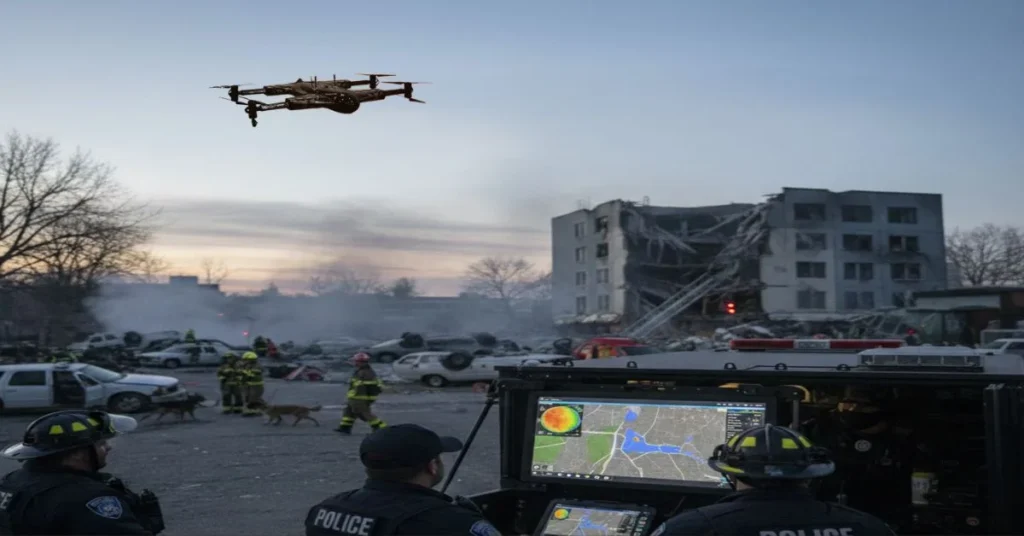
In times of emergencies, individuals rely on first responders to assist and respond to public safety. Emergency response has been consistent with pre-planned procedures, rapid assessment, and coordination among teams, yet there is a drive towards technological development. This blog will explore how public safety drones can bring a modern advantage to the emergency response scene, what they can do, which cases they can be used for, and more.
What Is a Public Safety Drone and How Does It Work?
Public safety drones are specialized unmanned aerial vehicles (UAVs) that are engineered to support first responders in dynamic situations like emergency response, law enforcement, and disaster management operations. Drones for public safety have the primary purpose of improving the responders’ situational awareness and enhancing their decision-making. With that, a public safety drone is necessary in terms of reliability, operational safety, and mission-critical performance.
While consumer drones are used by individuals for recreational activities like entertainment and hobbyist use, drones in public safety are utilized for professional use with their integrated advanced sensors and secure communication systems. These features help operators transmit data in real time to responders, allowing them to act immediately and respond to the emergency by locating missing persons, assessing the disaster, monitoring traffic accidents, and evaluating structural damage, while keeping personnel safe and confident.
Law enforcement and emergency services rely heavily on public safety drones, which can be used for a wide range of missions, including managing crime scenes and crowd control, and identifying hotspots during wildfires. This creates a strong impression of drones in public safety, specifically highlighting how advanced technology and UAVs actively help industries protect both citizens and responders. Public safety UAVs are adopted and deployed regularly because they have been proven to improve operational efficiency within modern public safety frameworks.
How Are Drones Used in Public Safety and Police Operations?
As mentioned above, public safety and police operations consistently utilize these public safety drones for their demanding missions. Drones in public safety are able to help officers and operators by providing real-time aerial intelligence that can improve the situation awareness, which lessens any risk for first responders. Having this advanced technology at hand allows agencies to rely on other police drones for UAV use cases in public safety, such as:
Police surveillance and tactical operations: Law enforcement drones can serve as an aerial surveillance system for police surveillance and tactical operations, enabling officers to monitor high-risk situations. This includes armed standoffs or hostage scenarios in which a police drone is deployed to observe suspect movements from above. Police drones are used in this particular case for minimized direct exposure and for optimized strategic planning.
Crime scene documentation and investigation: Similarly, police drone is also applied in situations that involve crime scene documentation and investigation. With public safety drones and UAVs, operators and officers are able to capture high-resolution imagery and three-dimensional (3D) maps. Obtaining this data can significantly improve evidence accuracy and reduce investigation time.
Firefighting and wildfire monitoring: Another case is for firefighting drones that are widely used for wildfire monitoring and structural fire assessment. These disasters are responded to by emergency management agencies that deploy drones equipped with the necessary tools, like thermal sensors, in order to identify any hotspots.
Search and rescue missions: In addition, search-and-rescue drones are used to locate missing persons by scanning large areas with infrared cameras. The attached infrared (IR) sensors detect radiation to sense aspects of their surroundings, helping first responders in search-and-rescue missions.
Disaster response and damage assessment: When it comes to disaster response drones, these UAVs are able to assist with damage assessment after floods, earthquakes, or storms. Humanitarian operations deploy disaster response drones to map affected communities and deliver aid.
Crowd monitoring and public event security: Finally, these drones are built to also support crowd monitoring and public event security. There are cases where a large crowd of individuals is present, and having these drones can help the team managers with live aerial views that help manage traffic flow and detect safety risks.
Why Are Drones Important for Public Safety and Emergency Response?
Learning about the key use cases and how often public safety drones are being used by different industries sheds light to its significance in this modern society. They are faster, safer, and more cost-effective in comparison to other technologies and traditional methods. Here are specific reasons as to why drones are important for public safety and emergency response:
Faster emergency response times: Emergencies and disasters require immediate action and response. With public safety drones, first responders can have a faster emergency response time as it offers them data instantly. The healthcare sector is particularly with this, considering emergency medical services will operate better with drones when they assess traffic accidents ahead of ambulances. Paramedics prepare equipment and determine optimal access routes, proving that drones reduce delays in life-critical situations.
Enhanced situational awareness: Another key advantage of public safety drones is enhanced situational awareness. Specifically, the transportation industry will be able to utilize drones when monitoring large-scale rail or highway incidents. Drones in public safety provide a comprehensive overview of hazards and enhance public safety communication systems with aerial intelligence.
Reduced risk to first responders: Drones for public safety also reduce risk to first responders and operators, as UAVs enable monitoring and inspection of emergencies and disasters from a safe distance. In the chemical manufacturing sector, drones are used to inspect hazardous material leaks, which lessens personnel’s exposure to toxic environments.
Cost-effective alternative to manned aircraft: One important advantage of public safety drones is their cost-effectiveness, as modern UAVs are regarded as cost-effective alternatives to other manned aircraft. Fire departments increasingly adopt drones and UAVs rather than helicopters. This implementation achieves similar coverage at a fraction of the operational cost invested in aerial vehicles.
Access to difficult or dangerous locations: Lastly, public safety drones also provide access to difficult or dangerous locations. Operators can easily view collapsed buildings or flooded areas, unlike traditional vehicles, which cannot operate in such conditions.
Case Study: How a Public Safety Drone Enabled a Rapid Search and Rescue Operation
In the event of natural disasters, accidents, or emergencies, individuals may be missing, and a call to emergency services must be made. Search and rescue (SAR) operations, specifically, are organized efforts to locate and aid missing persons in difficult terrain and low-visibility conditions.
Though most methods and technologies can be used in SAR operations, there are still issues that need to be addressed, such as limited ground visibility, time-sensitive rescue conditions, and safety risks to first responders. All challenges can be overcome with modern drone solutions that are equipped with thermal imaging and real-time video transmission. Public safety drones enable coverage of a large search area instantly, while also showcasing live video to detect any heat signatures and even assess the individual’s condition remotely. Having this practical use of drones in public safety emphasizes how advanced UAV technology is prepared to improve SAR operations and emergency response.
Drones for public safety also impact instant safety in terms of aerial situation awareness and faster target detection. Moreover, coordinators and operators can easily guide rescue teams by using precise Global Positioning System (GPS) coordinates that lead them to reach the victim safely and efficiently. This results in a successful rescue, along with a reduced search time and improved responder safety.
According to ZenaDrone on X, “Every Second Counts in an Emergency! Drones swiftly navigate hard-to-reach areas, providing critical insights while keeping responders out of harm’s way—a true game-changer for disaster response.”
Ultimately, public safety drones have been constantly attesting as to how technological developments are not only support tools, but also enhance workflows when it comes to response speed and safety in SAR operations. Public safety drones are utilized for each and every operation for their advantages to speed, safety, and life-saving outcomes.
Public Safety Drones vs Traditional Methods: How Do Drones Compare to Helicopters and Ground Patrols?
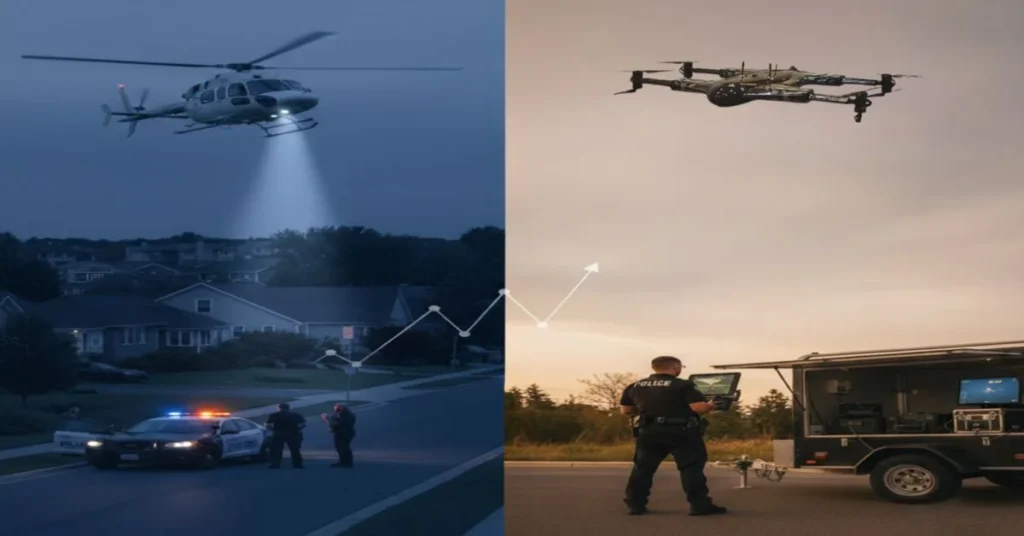
After learning how public safety drones can contribute to public safety and how they operate, and why they are highly significant in most emergency cases, it’s also essential to understand the differences between drones for public safety and other traditional methods. This comparison examines how distinct public safety drones are from other methods, such as helicopters and ground patrols, as well as their costs and efficiencies.
Drones vs Helicopters
Rapid deployment and launch time: Helicopter surveillance is the primary method for achieving aerial situational awareness in law enforcement and disaster response, yet technology has advanced with public safety drones engineered for rapid response scenarios.
Operational and maintenance costs: Unlike helicopters that require long preparation times, trained pilots, and significant fuel and maintenance budgets, drones in public safety can be deployed within minutes by a single operator. This reinforces how costs invested in drones are justified by their long-term performance.
Noise level and community impact: Drones can also operate quietly, whereas helicopters generate high noise levels that can disturb communities. This disadvantage of helicopter surveillance can even compromise sensitive operations.
Ability to operate in confined or hazardous areas: UAVs can be deployed to operate in confined and hazardous areas, considering that their general size allows them to do so. On the other hand, helicopters are mostly large since pilots and first responders need to be inside the vehicle themselves, which makes it difficult to operate in such dangerous circumstances.
Real-time data and camera flexibility: Teams increasingly favor public safety drones and UAVs to provide real-time video and thermal data. This allows coordinators and first responders to function the same as a helicopter; the only difference is that drones offer instant data and are more flexible.
Understanding the difference between public safety drones and helicopters helps in evaluating how modern aerial technologies can improve emergency response operations while also reducing the overall cost and human risk. Observe the table below for a brief comparison of drones vs helicopters:
Public safety drones | Helicopters |
Rapid deployment, low operating cost, quiet, flexible cameras, can access confined or hazardous areas | High operating and fuel costs, longer launch time, noisy, limited use in tight or urban spaces |
Drones vs Ground Patrols
Speed of area coverage: Although ground patrols are most appropriate for their direct intervention, public safety drones can survey large areas within minutes. This vast difference in the speed of area coverage brings attention to why drones are preferred over helicopters.
Access to hard-to-reach or dangerous locations: During missions, operators come across issues like physical access, terrain, and visibility. However, with drones, this can be easily resolved with how they are built to access hard-to-reach locations like flood zones, industrial rooftops, and dense forests.
Situational awareness from an aerial perspective: There are industries that utilize drones to monitor large regions instead of deploying ground patrols or multiple vehicles and officers. A single drone can provide real-time, comprehensive aerial situation awareness through an aerial viewpoint.
Resource allocation and manpower efficiency: A single drone operator can replace multiple patrol units and other ground patrols, which optimizes personnel deployment. Having public safety drones reduces operational strain while also maintaining comprehensive surveillance.
Safety of responders during high-risk situations: Given that drones can be operated and accessed remotely, operators and other workers remain at a safe distance from dangerous environments. This minimizes direct exposure to threats, making drones critical for reducing risk in public safety operations.
Now that the differences between drones for public safety and ground patrol units have been established, it’s easy to understand how aerial systems are advantageous in terms of coverage, efficiency, and responder safety. Here’s a table for a brief comparison of drones vs ground patrol:
Public safety drones | Ground patrol |
Fast area coverage, aerial situational awareness, access to hard-to-reach locations, reduced responder risk | Slower coverage, limited visibility, restricted by terrain, and physical access |
Cost and Efficiency Comparison
Acquisition and operating costs: Public safety drones need a significantly lower investment compared to other traditional methods, like helicopters and ground patrol units. Specifically, operating costs are minimal as drones only consume electricity and require fewer consumables. This makes public safety drones a cost-effective alternative for firms and industries with limited budgets.
Personnel requirements: Additionally, drones typically require only one qualified operator. However, helicopters and large patrol teams often involve multiple crew members. With these differences in personnel requirements, it shows how staffing needs lower labor costs and also allow managers to reassign personnel to other tasks and higher-priority missions.
Maintenance and fuel expenses: While manned aircraft run on expensive fuel and frequent mechanical servicing, drones are able to operate on rechargeable batteries and simpler systems. This leads to lighter maintenance schedules and substantially reduced long-term expenses.
Return on investment for public safety agencies: Firms and organizations regard investments, and this is justified by public safety drones. Modern UAVs can deliver high operational value through faster response times, improved situational awareness, and reduced risk. This leads to a return on investment for public safety agencies, especially in aspects involving training, equipment, and incident management.
Scalability for small and large departments: Public safety drones are highly scalable, which enables small agencies to deploy affordable aerial capabilities. This also applies to large departments where they are capable of building integrated, multi-drone fleets without excessive infrastructure costs.
Analysing the cost and efficiency helps in further comprehending the long-term return on investment of public safety drones compared to other traditional methods. Take a look at the table for a brief comparison of a drone’s cost and efficiency:
Public safety drones | Traditional Methods |
Low acquisition and maintenance costs, fewer personnel required, highly scalable for agencies of all sizes | High acquisition and operating costs, more manpower needed, less scalable, and resource-intensive |
What Are the Best Public Safety Drones Available Today?
In this modern society, public safety agencies have a variety of drones to choose from. This section of the blog will help as guidance for choosing the best public safety drone in particular cases, and which features are vital for certain flight missions.
Best drones for emergency response agencies: For emergency response agencies, it’s necessary to have multirotor platforms as they enable vertical takeoff, stable hovering, and precise maneuvering in urban and confined areas.
Best drones for search and rescue operations: In SAR operations, a thermal imaging drone is appropriate to deploy. This specific public safety drone is engineered to locate any missing individuals at night or in low-visibility areas.
Best drones for firefighting operations: During firefighting operations, agencies need to prioritize heat-resistant drones with thermal and zoom cameras. These features are able to assist firefighters in assessing roof integrity and fire spread without exposing workers to dangerous situations.
Fixed-wing vs multirotor drones for public safety: With public safety, agencies can either use fixed-wing drones or multirotor drones. Both drones are different platforms despite serving a similar purpose.
Multirotor drones are utilized for most public safety operations, as they offer vertical takeoff and landing (VTOL), precise hovering, and superior maneuverability. These features make this specific platform type ideal for key applications such as police surveillance, firefighting assessments, and crowd monitoring.
On the other hand, fixed-wing drones are implemented for long-range and large-area missions. Fixed-wing UAVs are frequently used for perimeter mapping and large area assessment, where endurance and coverage should be taken into consideration more than hovering. The disadvantage of this specific platform type is the required space for launch and land, which limits its use in dense urban response situations.
Comparison of Features, Flight Time, Range, Payloads, and Cost
Multirotor Drones | Fixed Wing Drones | |
Flight Time | 25–45 minutes | 60–180 minutes |
Range | 5–15 km | 50–150 km |
Payloads | Cameras, thermal, LiDAR | Mapping sensors, multispectral |
Cost | Moderate to high | High |
How to choose the right public safety drone for your agency
When choosing the right public safety drone, it’s crucial to align technology with operational reality. Public safety agencies should consider the following:
- Mission type (SAR, fire, policing, disaster)
- Environment (urban, rural, coastal, mountainous)
- Sensor needs (thermal, zoom, LiDAR, gas)
- Regulatory compliance
- Budget and training resources
Zenadrone — features, strengths & ideal public safety scenarios
With ZenaDrone, public safety agencies can easily seek advanced autonomy and data intelligence. Having integrated AI-powered analytics, autonomous flight planning, and modular payload systems leads to better workflows. ZenaDrone offers features and strengths that make it suitable for scenarios, such as:
- Search and rescue in low-visibility conditions
- Disaster response and damage assessment
- Perimeter security and crowd monitoring
- Infrastructure inspection for public safety agencies
What Features Should Drones for Public Safety?
Once public safety agencies have discovered how to choose the best drones for public safety, there should be a follow-up upon learning the necessary features for the UAV. There are different features to consider, such as:
Thermal and infrared imaging: Public safety drones with thermal and infrared imaging can detect heat signatures in areas with low visibility. Operators are able to view heat through smoke, fog, or darkness. Thermal drones are also used to locate missing individuals or injured animals during nighttime rescue missions, underscoring the importance of thermal imaging.
Zoom and low-light cameras: Another feature is the high optical zoom and low-light cameras, which enable detailed observation from a safe distance. Teams and operators use drones to inspect locations without deploying personnel on-site. With this feature, surveillance accuracy is greatly enhanced while reducing physical risk for workers.
Real-time video streaming: Additionally, real-time video transmission also ensures that command centers are able to receive live situational data. There are industries where drones are being used to stream crowd behavior during events and large gatherings, which can also help in rapid response to safety threats. Having this immediate visibility helps public safety teams in making decisions faster that lead to a better coordinated emergency response.
AI-assisted tracking and analytics: In this modern society, AI object detection allows public safety drones to automatically identify people, vehicles, or hazards. AI-powered drones can track movements in secured facilities, demonstrating that this feature can help monitor such areas. This feature is increasingly vital for scalable public safety operations.
Weather resistance and durability: The last important feature is a drone’s weather-resistant design that ensures continuous operation despite harsh conditions such as rain, wind, or extreme temperatures. Public safety drones can still operate in strong weather, underscoring how durability can deliver results even in challenging conditions.
What Regulations Govern Drones in Public Safety?
Moder drones in public safety and other UAVs need to comply with regulations. In order to abide by aviation and privacy laws, public safety agencies need to keep in mind the following regulations:
FAA Part 107 and COA requirements: In the United States, most public safety drone operations fall under FAA Part 107. This involves governing commercial UAV use. Agencies must also apply for a Certificate of Authorization (COA) when planning to operate outside standard limitations. This flexibility allows different industries to operate more effectively while maintaining compliance and acknowledging the importance of regulatory awareness.
BVLOS and night operations: Other than that, Beyond Visual Line of Sight (BVLOS) and night flights must also be complied with. These require special approval since there is a higher operational risk. Public safety agencies need to obtain authorization before further conducting upcoming flight missions, ensuring that advanced operations remain controlled and safe even at night.
Emergency waivers and authorizations: During emergencies and disasters, public safety agencies are able to request emergency waivers for rapid deployment. When drones are authorized to assess disasters like floods or forest fires, these waivers allow faster response while still maintaining oversight on the flight operations.
Privacy and data protection concerns: The data collected by these drones is highly critical. Hence, drones are to be used to ensure that the data is not captured or stored improperly. Complying with privacy and data protection highlights how legal frameworks protect public trust.
State and local drone regulations: Finally, state and local governments impose additional rules. Different locations have different standards, so drones must follow them to ensure value is still delivered while remaining safe, legal, and maintaining public confidence.
How Can Agencies Build a Public Safety Drone Program?
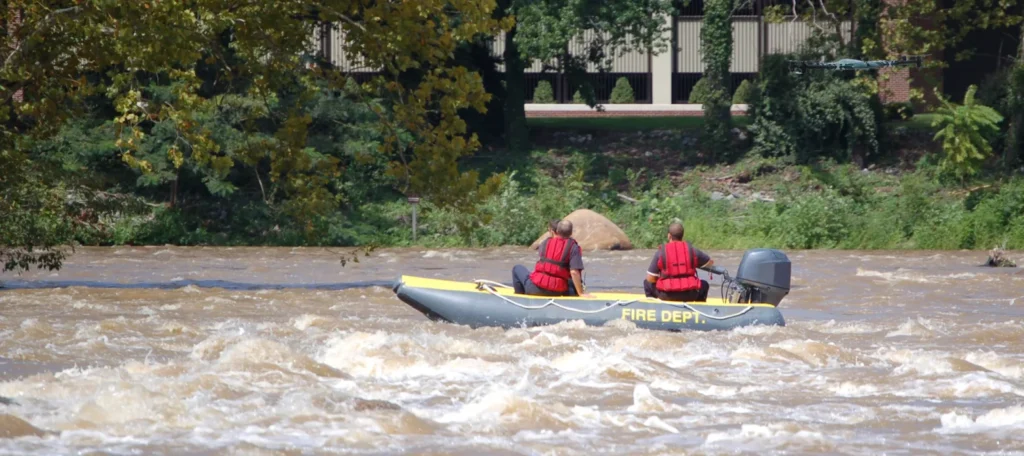
Recognizing how drones can be used in public safety situations and for emergency response leads to the launch of a public safety drone program. When building a public safety drone program, it’s most effective when considering the following:
Training and certification requirements: Drones for public safety are most effective when operated by certified drone pilots. Agencies should ensure that personnel and expect pilots complete formal UAV training, including flight operations, emergency procedures, and airspace compliance.
Developing operational policies: Establishing clear Standard Operating Procedures (SOPs) ensures that there is consistency and legal drone use. Drones in public safety are utilized properly while maintaining the respective agency’s SOPs.
Budgeting and funding options: Every public safety agency has different funding from another. It determines program scale, acquisitions, and even maintenance.
Fleet maintenance and lifecycle management: Regular maintenance prolongs a drone’s fleet life. Public safety agencies manage their drone schedule checks to ensure operational reliability in the long term.
Data storage and evidence handling: Lastly, secure storage and evidence protocols are essential. This involves the collected and gathered data that is extremely important for public safety agencies, indicating that it needs to be protected.
What Is the Future of Drones?
Discovering more about drones and public safety leads to pondering on the current state and the future of public safety drones. The new opportunities include autonomous and AI-driven drone operations, where the public safety drones will be able to operate independently, even in complex missions with minimal human intervention.
Another technological development of public safety drones is the expansion of BVLOS operations, in which modern drones and UAVs can cover larger areas, regardless of how remote or dangerous they are. Integrating with smart city infrastructure and advanced analytics can also be beneficial, especially in cases that prioritize decision-making and operational efficiency.
Next-generation public safety drone systems involve the best public safety drones that combine autonomous flight, AI analytics, and advanced BVLOS capabilities. All of these innovative features bring a new standard for proactive and efficient public safety operations across the world.
FAQs About Public Safety Drones
Are drones legal for police use?
Yes. Law enforcement agencies can operate drones under FAA Part 107 regulations or a Certificate of Authorization (COA).
Do public safety drones record video?
Yes. Drones for public safety can record high-resolution video and thermal imaging.
How much does a public safety drone program cost?
The cost of a public safety drone program varies depending on the drone’s type, sensors, software, and fleet size.
Can drones replace helicopters in emergencies?
Drones cannot fully replace helicopters in emergencies, though drones have the advantage when it comes to rapid aerial situational awareness and access to confined or hazardous locations.
Can drones be used at night for emergencies?
Yes. Drones equipped with infrared and thermal cameras can operate safely at night.
What training is required to operate public safety drones?
Operators and pilots must complete FAA Part 106 certification and agency-specific training programs, which cover flight operations, safety procedures, and emergency response protocols.
Contact Us

Thank you for your message. It has been sent.