



Warehousing and Inventory Management: Best Practices and Future Trends
Dedicated facilities, more often than not, have physical assets that require the structured oversight of receiving, storing, tracking, and distributing, and that’s where warehousing and inventory management come in. It’s imperative to consistently practice warehousing and inventory management, as it is highly regarded as the operational backbone of product-based businesses.
Having this specific administration of storage spaces and physical goods allows businesses to achieve an inventory accuracy improvement. In this blog, there will be discussions pertaining to warehousing and inventory, its methods and types, benefits and challenges, and more.
What is Warehousing and Inventory?
Warehousing and inventory management are critical for supply chain efficiency due to the smooth movement of materials across regional networks. Goods transition from manufacturing to delivery can reach optimal efficiency when adept practices, like warehousing and inventory management, are consistently implemented. This specific chain must be maintained in order to minimize inventory carrying costs, while ensuring that the business’s products remain available for immediate dispatch.
Hence, the role of warehousing in modern business operations becomes evident in most modern industries. Advanced distribution and inventory tracking systems fulfill the role of active data and fulfillment rather than being passive. Innovative businesses have the opportunity to achieve customer satisfaction and long-term business growth once warehousing and inventory management are properly established.
How Warehousing and Inventory Management Work?
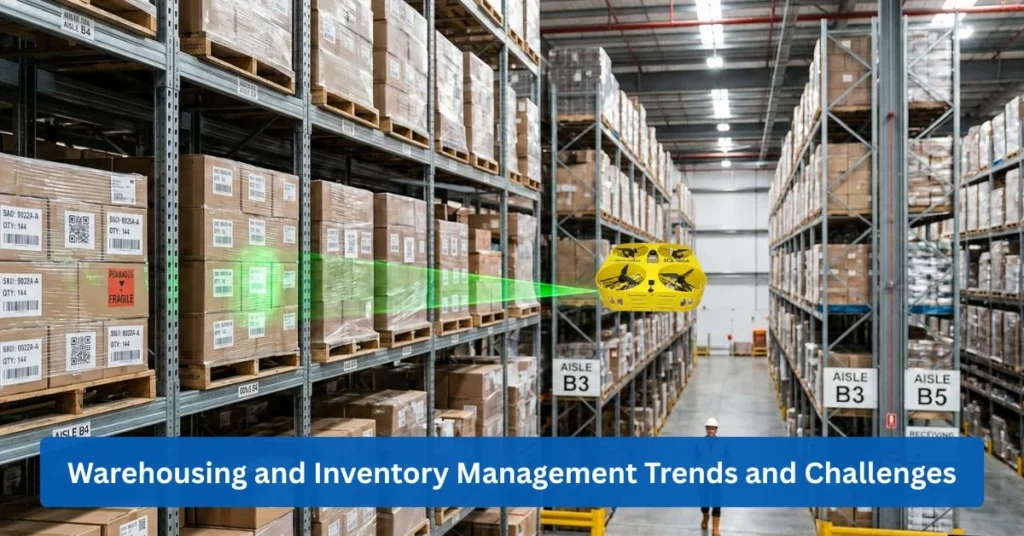
Drone inventory management start with key processes in daily warehouse operations. Each of the key processes in warehouse operations is associated with warehousing and inventory management, since the warehouse operations cover the inventory lifecycle from receiving to fulfillment. These operations encompass the end-to-end management of goods from the supplier to the final customer, and include the following:
- Receiving
- Putaway
- Inventory Control
- Order Picking
- Packing
- Shipping, and
- Returns Management
A laid-out map of this entire pathway is to achieve continuous real-time inventory visibility that leads to a responsive fulfillment channel and secures overall supply chain visibility. In addition to the warehouse operations management, the major stakeholders involved in warehouse management are the operational leaders, data analysts, and floor personnel, who are fully capable of collaborating in order to fulfill warehouse management, including accurate inventory forecasting and smooth inventory replenishment schedules.
Types of Warehouses and Inventory Systems
In order to effectively respond to shifting market demands, businesses should be knowledgeable about the types of warehouses and inventory systems. Choosing the right type and system for specific cases can lead companies to align the curated framework with specific financial and operational goals. Here are the types of warehouses and inventory systems
Public, Private, Bonded, and Smart Warehouses
- Public Warehouse: A public warehouse is a storage facility that is owned by a third-party logistics provider or government body that rents out a physical space to multiple businesses. This allows companies to scale inventory operations on a short- or long-term basis without the high upfront costs of owning a private facility.
- Private Warehouse: Another type is the private warehouse, which is owned, managed, and operated by a single company for its exclusive use. Having a private warehouse allows businesses to gain complete control over their inventory, distribution processes, and supply chain logistics.
- Bonded Warehouse: These bonded warehouses are secure storage facilities authorized by government authorities to hold imported goods.
- Smart Warehouse: For the last warehouse type, a smart warehouse is known for its integration with robotics, IoT, and AI-driven software to automate inventory storage, picking, and fulfillment. Interconnected systems over manual processes minimize human error, optimize supply chain efficiency, and provide real-time tracking.
Centralized vs Decentralized Inventory Management
Inventory management also has its types, centralized and decentralized. Check the table below for more details on the two types of inventory management:
System Type | Core Definition | Primary Operational Purpose | Resource & Cost Impact |
Centralized Management | Consolidating all corporate stock within a single, primary distribution mega-hub. | Maximizes bulk purchasing power and simplifies total warehouse stock management. | Higher final-mile shipping costs and longer delivery times significantly lower total inventory carrying costs. |
Decentralized Management | Distributing inventory across a network of smaller, localized regional fulfillment nodes. | Places products closer to the end consumer to maximize delivery speeds and responsiveness. | Higher overall holding costs across facilities; requires advanced warehouse inventory software to maintain supply chain visibility. |
Core Components of an Efficient Warehouse
Efficient warehouses involve utilizing the careful alignment of physical space, product labeling, and worker movement. Companies can successfully have an efficient warehouse with the following core components:
- Warehouse Layout and Space Optimization: The warehouse layout refers to the physical arrangement of racking, aisles, and transit zones, whereas the space optimization is the strategic design of floor plans to maximize usable storage volume. This specific core component dictates how fluidly assets move through a facility and, therefore, must be regarded in order to ensure safe, logical traffic flows.
- Inventory Tracking and SKU Management: Additionally, the inventory tracking and the Stock-Keeping Unit (SKU) management are the systematic classification of products using distinct alphanumeric codes to identify specific traits. Having this particular core component helps businesses in tracking physical items, recording exact quantities, and shelf locations.
- Picking, Packing, and Shipping Workflows: The last core component for efficient warehouses is the workflows that include picking, packing, and shipping. With these workflows, the business is able to coordinate the collection, verification, and boxing of stored goods for final dispatch.
Warehouse Inventory Management Technologies
In this society, where almost everything is associated with digital work, most businesses need to adapt to modern demands. That adaptation leads to innovations and technologies. Here are warehouse inventory management technologies that can help companies stay proactive:
- Warehouse Management Systems (WMS): A specialized logistics platform like the Warehouse Management Systems (WMS) is designed to optimize, coordinate, and direct daily distribution center workflows from inventory receipt to final shipping. This specific technology manages floor labor efficiently and guides dynamic product slotting.
- Barcode and Radio-Frequency Identification (RFID) Inventory Tracking: In addition to technologies, there is also barcode inventory tracking and RFID inventory management. Data capture hardware provides the physical link between physical inventory and digital tracking software, enabling instant, error-free scans when tracking pallets, items, and inventory.
- AI, IoT, and Automation in Warehousing: The last technology pertains to AI, IoT, and automation in warehousing, where the combination of artificial intelligence, connected sensors, and robotics can manage stock movements. Warehouse automation solutions that are innovative help companies to adapt immediately to shifting market trends.
Benefits of Effective Warehousing and Inventory Management
Learning about warehousing and inventory management brings opportunities for businesses to create a responsive ecosystem. The opportunities and benefits of effective warehousing and inventory management are the following:
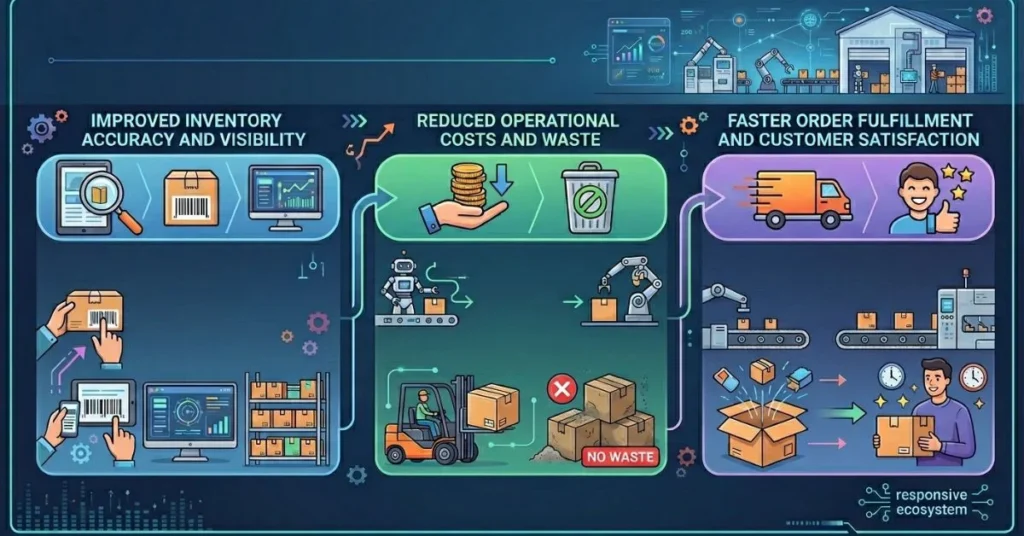
- Improved Inventory Accuracy and Visibility: The first benefit of effective warehousing and inventory management is improved inventory accuracy and visibility. Having this structured management allows businesses to continuously synchronize actual warehouse stock with digital records across all storage locations, ensuring that purchasing managers never duplicate orders or face sudden out-of-stock situations.
- Reduced Operational Costs and Waste: Another pro when warehousing and inventory management is implemented is the reduced operational costs and waste, which indicates a financial advantage. This benefit eliminates dead stock, shortening pick paths, and preventing physical product damage during storage.
- Faster Order Fulfillment and Customer Satisfaction: With warehousing and inventory management, order fulfillment is faster, and customer satisfaction is better. Having this particular benefit refers to the ability of a company to pick, pack, ship, and deliver an inbound customer order without facing processing delays. Once there is faster order fulfillment that is deemed successful, customer satisfaction is bound to follow.
Common Challenges in Warehousing and Inventory
However, there are still disadvantages when it comes to warehousing and inventory. Industries need to be prepared for the common challenges in warehousing and inventory, such as:
- Overstocking and Stockouts: A common challenge is overstocking and stockouts that shelves with slow-moving goods and leaving picking bins completely empty when an order arrives. Overstocking and stockouts cause an imbalance in product availability and must be addressed in order to stabilize company cash flow, helping managers avoid high inventory carrying costs while protecting the business from costly lost sales.
- Human Error and Inventory Inaccuracies: To add, human error and inventory inaccuracies are also common challenges. Businesses encounter such situations when discrepancies between recorded stock numbers and physical shelf numbers occur. These problems typically happen with manual data entry and handling mistakes on the warehouse floor.
- Labor Shortages and Rising Operational Costs: Furthermore, labor shortage and rising operational costs are also common challenges that industries must be aware of. A demanding financial environment can indicate a growing gap between available floor workers and required order volumes.
Inventory Optimization Strategies
When it comes to warehousing and inventory management, there are also inventory optimization strategies. These strategies are established to allow modern logistics managers to transform a storage facility into a precise, demand-driven fulfillment network. Here are the inventory optimization strategies:
- Demand Forecasting and Inventory Planning: One strategy for businesses is to demand forecasting and inventory planning. Predictive material coordination involves analyzing historic sales patterns, seasonal trends, and current market shifts to estimate future product needs. Businesses implement this in order to guide accurate inventory forecasting and timely inventory replenishment.
- Just-in-Time (JIT) Inventory Management: Additionally, JIT and inventory management are also an inventory optimization strategy that coordinates manufacturing or distribution schedules to match raw material arrivals exactly with active production demands, representing a highly refined logistics model.
- Cycle Counting and Inventory Audits: This cycle counting and inventory audits refer to the continuous, systematic validation of small, targeted batches of stock on a daily schedule, replacing the traditional practice of shutting down an entire facility for annual physical counts. This specific inventory optimization strategy delivers a continuous inventory accuracy improvement by catching and correcting data entry errors early.
Warehouse Automation and Smart Warehousing
As the inventories are growing, many companies are seeking warehouse automation solutions so they can ensure efficiency and uniformity. Depending on the needs of a facility and its size, automation can help to eliminate repetitive manual processes.
Common Automation Technologies
- Automated Storage and Retrieval Systems (ASRS)
- Find conveyor and sorting systems.
- Robots for picking and transporting goods. Pick and transport robots.
- Autonomous Mobile Robots (AMRs)
- Stock control software systems.
Whilst automation can improve productivity, it’s crucial that businesses also keep in mind the adaptability of the technology for their business and needs.
Warehousing and Inventory Use Cases Across Industries
The application of Warehousing and Inventory Management practices differs from industry to industry.
- E-Commerce: Typically, e-commerce companies sell a large volume of products and orders are diverse. The efficient warehouse inventory management aids in timely order processing and returns management.
- Manufacturing: Inventory control is essential for manufacturers to ensure that raw materials and components are available when necessary to manufacture products.
- Retail and Omnichannel Operations: Retailers hold stock in multiple places, including their retail locations, warehouses and online. Good warehouse stock management contributes to the availability of products throughout channels.
- Cold Storage and Pharmaceuticals: Items that need to be stored at a specific temperature need special storage, temperature monitoring and regulatory compliance procedures.
Supply Chain Integration and Inventory Visibility
Warehousing is closely related to the other activities of the supply chain. Information about the inventory is frequently required to be communicated between suppliers, transportation companies, and distribution channels.
Modern inventory tracking systems help increase supply chain visibility by providing accurate inventory data from the beginning to the end of the product lifecycle.
The advantages of more visibility are:
- More rapid response to demand change
- Improved inventory allocation
- Reduced stock discrepancies
- Improved coordination between multiple sites
Centralized warehouse inventory software is also an option for organizations with multiple facilities to help facilitate real-time inventory visibility across warehouses.
Inventory Management KPIs and Performance Metrics
Performance metrics are used for assessing the effectiveness of the Warehousing and Inventory Management processes of organizations.
KPI | Purpose |
Inventory Turnover Ratio | Indicates the number of times inventory is turned over |
Order Accuracy Rate | Tracks fulfillment accuracy |
Inventory Accuracy | Compares the physical stock to the recorded stock |
Warehouse Utilization | Measures usage of the capacity of measures |
Carrying Costs | Evaluates expenses associated with holding inventory |
Frequent monitoring can help pinpoint inefficiencies and aid in ongoing improvement efforts.
Best Practices for Warehouse and Inventory Management
There are several common practices which are usually adopted to make the warehouse to operate effectively:
Best Practices Checklist
- Label stock consistently for the organization
- Uniformize receiving, picking and shipping process
- Conduct a regular cycle counting process
- Ensure correct records of products are kept
- Provide training to staff on protocols
- Regularly review inventory information
- Optimize inventory optimization strategies and levels
Simple processes can be used to build up the inventory accuracy improvement and warehouse efficiencies.
Security and Compliance in Warehousing
There are risks in the warehouse that need to be constantly monitored, both physical and digital.
Physical Safety and Compliance
Typical means of safely protecting warehouses include:
- Safety training for employees
- Regular equipment checks
- Identifying workplace hazards
- Preparing for emergencies
Data Security and Risk Management
With the growing shift toward a digital inventory system, it’s important that the data that powers the system is secure. Business continuity is ensured by access controls, data backups and disaster recovery plans.
Future Trends in Warehousing and Inventory Management
Technology is still shaping the future of Warehousing and Inventory Management. Adoption rates differ, but there are some trends in practice.
AI-Powered Inventory Management
AI is being used more and more to help with inventory forecasting, demand analysis, and inventory replenishment planning.
Smart Warehouses and Digital Twins
The idea of smart warehouses is to offer enhanced visibility across the warehouse, enabled by analytics, connected devices, and sensors. Digital twins are virtual representations of warehouse environments to be used for planning and performance evaluation.
Sustainable Warehousing
There are many organizations looking into schemes that can help mitigate the environment, such as:
- Energy-efficient lighting systems
- Optimized transportation routes
- Sustainable packaging materials
- Improved space utilization
Since technologies are evolving, companies can still implement solutions that enable them to be both efficient and sustainable.
Frequently Asked Questions (FAQs)
What is the difference between warehousing and inventory management?
Warehousing is concerned with the physical storage, handling and movement of goods within a warehouse. The inventory management is about the tracking of inventory, inventory movement, and the availability of products when needed. They help in streamlined product storage and distribution.
How does a warehouse management system (WMS) improve operations?
A warehouse management system assists in organizing inventory details, track stock movement, manage storage areas, and aid in order fulfillment tasks. Warehouse Inventory Software is used by many businesses to increase visibility and decrease manual records.
What are the most common causes of inventory inaccuracies?
Manual data entry, inaccuracies received, lost inventory, counting errors and not keeping inventory updated consistently all lead to inventory inaccuracies. Regular audits and inventory tracking systems allow discrepancies to be identified.
How can businesses reduce warehouse operational costs?
Organizations can save money by optimizing warehouse spaces, better inventory planning, reducing excess stock and better warehouse stock management.
How does warehouse automation improve efficiency?
Warehouse automation solutions can decrease the manual work that is repetitive, enhance consistency, facilitate faster movement of inventory, and boost visibility of operations. The results, however, will vary depending on the type of technology and implementation strategy.
How can small businesses improve inventory tracking?
Consistent inventory records, bar code systems, frequent inventory counts and inventory management software appropriate to your operations can help small businesses to keep track.
How does AI impact warehouse and inventory operations?
AI can be used for demand forecasting, inventory analysis, route optimization, and trend analysis. These features could help organizations make better decisions, and offer real-time inventory visibility during warehouse processes.
Contact Us

Thank you for your message. It has been sent.