



Drones in Construction Safety: Improving Site Compliance
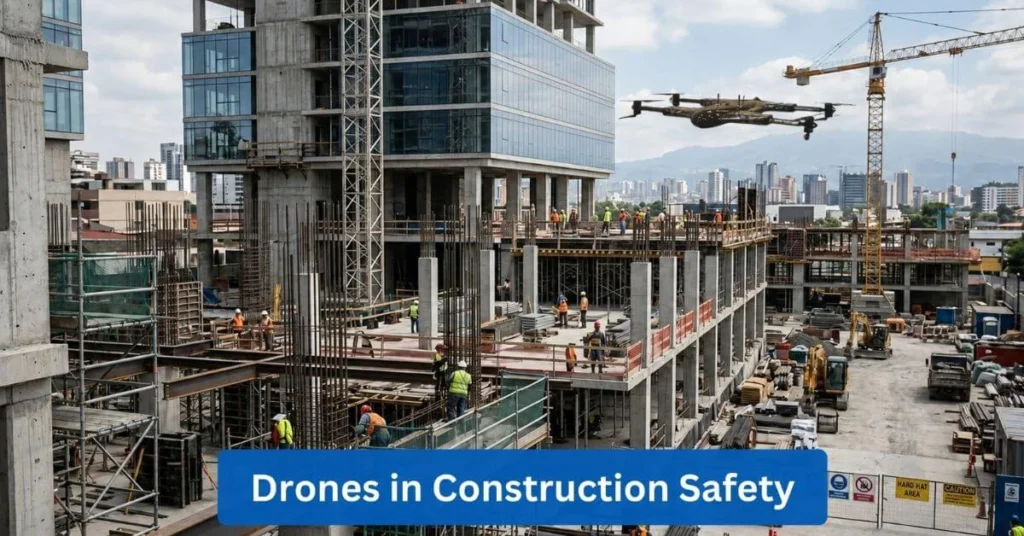
Construction has always carried more risk than most other industries, and that pressure has not eased up. Site safety managers, project managers, and HSE professionals are still expected to prevent accidents and stay compliant, even as crews get larger, sites get more complex, and oversight gets harder to keep up with. Falls, struck-by incidents, and unsafe working conditions remain a leading cause of construction fatalities year after year, and the truth is that walking a site with a clipboard simply doesn’t catch everything before it turns into an injury.
Drones in construction safety are changing that equation. Give a safety team an aerial vantage point over an active job site, and suddenly they’re spotting hazards earlier, documenting compliance with far more precision, and reacting to incidents faster than a foot patrol ever could. Digital construction safety isn’t a nice-to-have anymore for firms that want to stay competitive — it’s quickly becoming the baseline expectation.
This article walks through how drones in construction safety are reshaping building site compliance, covering everything from hazard detection and PPE usage tracking to predictive risk assessment and what’s coming next with autonomous, IoT-connected job sites.
What Is Building Site Safety Compliance?
At its core, building site safety compliance is the web of regulations, standards, and internal protocols a construction company has to follow to protect its workers, the public, and the surrounding infrastructure. In the U.S., most of this sits under OSHA’s construction standards — OSHA 1926 specifically — covering fall protection, scaffolding, excavation, electrical safety, and PPE. Other countries have their own versions of the same idea. The goal everywhere is identical: cut down on preventable injuries and keep a documented trail of accountability.
But meeting that obligation takes more than a few signs posted around the site or a weekly toolbox talk. Site safety managers are on the hook for proactive monitoring — catching unsafe conditions before they cause harm, tracking PPE usage, confirming fall protection systems are installed correctly, and keeping records that hold up if there’s ever an audit or incident investigation. That is worker safety management in practice, and it’s exactly what drones in construction safety programs are built to strengthen.
Here’s the problem with doing all of that manually:
- A safety officer can only be in one place at a time, watching one part of the site
- Plenty of the riskiest areas rooftops, scaffolding, trenches, confined spaces — need extra precautions just to inspect in the first place
- Those two limitations alone create blind spots, slow down hazard identification, and lead to inconsistent paperwork
Put those together and you get a higher likelihood of accidents and compliance failures, which is exactly why construction site safety drones have earned a permanent spot in modern safety programs.
How Drone Technology Improves Site Safety Compliance
What drones actually fix is the coverage problem. Real-time site surveillance across an entire site, combined with hazard detection using drones that flags emerging risks as they appear, means safety teams aren’t stuck waiting for the next scheduled walkthrough. A single flight can capture a comprehensive view of site conditions in minutes — work that would otherwise eat up hours on foot. This is arguably the clearest illustration of how drones in construction safety close the gap between when a hazard forms and when someone actually notices it, and it’s the foundation of effective construction site surveillance on any active project.
Construction site safety drones programs lean on this heavily, because it means hazards get caught quickly — a missing guardrail, an unsecured trench, a worker without proper fall protection, whatever it is. Aerial site inspections also open up areas that would otherwise be dangerous or impractical to reach directly: rooftops, tall structures, unstable terrain, all without putting a person up there.
There’s also the documentation side. Drone safety inspections produce records that manual methods simply can’t match in consistency:
Capability | What It Delivers |
Timestamped, geotagged imagery | A permanent, auditable record of site conditions on a given day |
Safety compliance documentation | Support for internal reviews and regulatory disputes |
Faster incident reporting | Immediate visual context instead of relying solely on witness accounts |
Drone Use Cases in Construction Safety
Drone construction safety programs show up in nearly every corner of a job site, often in ways teams don’t expect until they’ve tried it.
- PPE compliance monitoring. Aerial imagery at high resolution can show whether workers across an entire site are wearing the hard hats, harnesses, and high-vis gear they’re supposed to a far wider view than any single inspector could manage on foot.
- Working-at-height inspections. Drone safety inspections cover scaffolding, rooftops, and elevated structures without sending a worker up to physically check them, tackling one of the biggest causes of construction fatalities head-on.
- Excavation and trench monitoring. UAV construction inspections can read trench stability, shoring conditions, and proximity hazards from a safe distance exactly the kind of detail traditional inspections sometimes catch too late.
- Heavy equipment safety. Watching where cranes, excavators, and other machinery move relative to workers and structures is one of the core uses behind most drone construction safety strategies.
- Perimeter security and access control. Site safety monitoring drones running routine patrols pick up unauthorized access, fencing breaches, and unsecured boundaries rounding out the list of what drone construction safety programs typically cover.
Improving Risk Assessment with Drones
Risk assessment works best continuously, not periodically, and construction risk assessment is one area where aerial technology makes a real difference. Instead of leaning on scheduled walkthroughs that only ever capture a snapshot, drones can fly regularly enough to catch unsafe conditions as they develop — and drone-based hazard identification methods can flag a lot of that automatically.
High-risk zones, whether that’s heights, excavation, heavy machinery, or confined spaces, can get monitored far more often without pulling safety staff off everything else they’re responsible for. That consistency feeds directly into better emergency response planning, since teams already have an up-to-date picture of the site layout and where the hazard zones actually are before anything goes wrong.
Daily safety audits get more realistic at scale, too. Walking an entire site every single day isn’t always feasible, but a short drone flight can pull together what’s needed to keep construction site monitoring current, leaving safety managers free to fix problems instead of hunting for them. And the data piles up over time — patterns in near-misses or recurring hazards start to surface, which is what predictive safety management is really about: stepping in before the accident, not writing the report after.
Technologies behind Construction Safety Drones
UAV construction inspections, and construction drone technology more broadly, only work as well as the sensors and software packed into the platform itself:
- AI-Powered Safety Monitoring: Automatically flags potential PPE violations, unsafe proximity between people and equipment, or structural irregularities — cutting down dramatically on the time it takes to review footage by hand.
- Thermal cameras: Pick up electrical faults, overheating equipment, or moisture intrusion that’s invisible to the eye, often the same issues tied to fire risk or equipment failure down the line.
- LiDAR mapping: Generates highly accurate 3D site data, useful for terrain stability checks, planning safer equipment routes, and tracking ground condition changes that could turn into excavation risks.
- High-resolution imaging: Still the backbone of most inspection workflows, giving the visual clarity needed to document conditions properly and feeding into broader construction site analytics over time.
- Cloud-based reporting: Pull all of this together so safety teams, project managers, and compliance officers can pull records from one place instead of digging through scattered files.
- BIM and Drone Integration: Aerial data sit directly on top of building information models, so safety conditions can be assessed against the actual structural design rather than in isolation.
Benefits of Drone-Based Safety Compliance
Add it all up, and the improvement in site safety outcomes is measurable, not theoretical. Companies running site safety monitoring drones often report fewer workplace accidents, mostly because hazards get caught and fixed before anyone gets hurt. Falls are still the number-one cause of construction fatalities, and aerial inspection cuts down sharply on how often workers need to be up in elevated or unstable spots at all.
Here’s where the value tends to show up most:
- Better Construction Safety Compliance: Timestamped, geotagged records put companies in a much stronger position during OSHA inspections or internal audits.
- Reduced inspection time: A short flight from site safety monitoring drones can replace hours of manual walkthroughs, freeing up safety personnel for work that actually needs a human.
- Improved worker safety: Fewer people climbing structures or entering hazardous zones just to take a look around.
- Lower operational costs: Fewer insurance claims, fewer regulatory penalties, less downtime tied to accidents.
- Better project visibility: Construction site surveillance gives stakeholders a clearer, steadier read on site conditions, which makes decision-making faster across the board. Plenty of enterprise firms now build construction site surveillance into their weekly reporting rather than treating it as a once-in-a-while extra.
Challenges and Best Practices
None of this means drones can just be dropped into a safety program without thought. Integrating drones in construction safety properly means paying attention to a handful of practical issues:
- Regulatory requirements: Commercial drone operation in the U.S. requires a Remote Pilot Certificate under FAA Part 107, and as of 2026, Remote ID requirements apply to most operations — meaning every flight needs to be identifiable and accountable. Sites near controlled airspace may need additional clearance before anything gets off the ground.
- Pilot training: Part 107 is the legal floor, not the ceiling. A lot of contractors are finding that construction-specific UAS training matters just as much, since it’s the difference between collecting usable data and collecting footage that doesn’t actually answer the safety question.
- Privacy considerations: Worth thinking through carefully on sites near residential neighborhoods or shared infrastructure, where a flight path might capture more than intended.
- Weather limitations: High winds, rain, or poor visibility will ground a flight, so contingency planning for remote safety inspections during bad weather isn’t optional.
- Standard operating procedures: Pre-flight risk checks and maintenance logs for every drone in the fleet keep drone compliance inspections honest and consistent. Firms that actually stick to documenting these drone compliance inspections tend to come out ahead during regulatory reviews.

Reducing Workplace Accidents
Knowing that drones work is one thing, knowing which solution actually fits your operation is a different conversation entirely. The market has matured enough that construction firms aren’t starting from scratch anymore, but the options are wide enough that the wrong choice still costs time and money.
A few things worth evaluating seriously:
- Inspection-grade hardware: Construction sites are dusty, unpredictable, and unforgiving on equipment. The platform needs to handle that, and the payload matters just as much as the drone itself. A thermal camera and a high-resolution optical camera serve different purposes, so organizations should select sensors based on their specific inspection requirements.
- AI-powered analytics software: Footage without analysis is just storage. What makes the difference is software that catches hazards automatically, builds compliance reports without manual input, and surfaces trends across multiple flights over time.
- Scalable fleet management: A single-site operation is manageable. Once the program expands across multiple sites, centralized mission planning, asset tracking, and data management stop being optional.
- Service and support: Licensing, maintenance, retraining after staff turnover, software updates these are recurring costs that rarely show up clearly in an initial quote. Vendors that provide comprehensive support can help reduce long-term operational complexity.
The deployment model matters too. Some firms own their fleet outright; others outsource through a Drone-as-a-Service arrangement until internal capacity catches up. Neither is wrong, it comes down to inspection volume and how quickly the program needs to scale.
Either way, the goal stays the same: reducing workplace accidents through earlier hazard detection, more consistent monitoring, and faster response when conditions shift. That’s what the right drone solution actually delivers.
Future of Drone Technology in Construction Safety
Drones in construction safety are only going to get more capable as the technology matures. Autonomous site inspections drones flying repeatable, predefined routes with minimal human input — are already cutting the manual workload tied to routine monitoring while making inspections more consistent from one flight to the next. As AI-driven compliance monitoring keeps improving, expect drones to catch a wider range of hazards on their own, shrinking the time between spotting a problem and actually fixing it.
Digital twins are part of where this is heading too a continuously updated virtual model of a site that pulls in aerial data alongside structural and environmental information. Pair that with IoT-connected construction sites, where sensors scattered across a project feed back real-time conditions, and you’ve got the building blocks for genuinely predictive safety management instead of reactive inspection, backed by ongoing infrastructure safety monitoring across the whole project.
Continuous construction site monitoring, run by increasingly autonomous drone fleets, points toward a future where safety oversight stops being a periodic task and just becomes part of how a site operates every day.
Conclusion
Drones in construction safety have moved well past the experimental phase — adoption is picking up across firms of every size, not just the largest contractors. Real-time aerial monitoring, faster hazard identification, stronger compliance documentation, and a real drop in how often workers are exposed to high-risk conditions all point toward the same conclusion: companies that build drones into their safety programs are simply better positioned to protect their people while staying on the right side of regulators.
As construction safety compliance standards keep tightening and projects keep growing in scale, manual inspection alone isn’t going to keep up — and that gap is exactly where drones in construction safety are proving their worth. Construction drone technology — backed by AI analytics, thermal imaging, LiDAR, and increasingly autonomous flight — offers a realistic way forward for firms trying to build safer sites without slowing everything down.
Looking ahead, the firms that treat construction drone technology as a core part of how they operate, rather than something to bolt on occasionally, are the ones that will end up with fewer incidents, cleaner compliance records, and smarter, more resilient job sites in the years ahead.
Frequently Asked Questions
Why are traditional construction safety inspections no longer enough?
Manual inspections only cover one spot at a time, and hazards tend to develop in between scheduled walkthroughs. As sites get bigger and regulatory expectations keep rising, that approach just can’t deliver the consistent oversight construction site safety drones are built to provide.
How can drones help identify hazards before accidents happen?
Frequent, wide-angle aerial views let teams catch things early — missing guardrails, unstable excavation walls, improperly stored materials — instead of discovering them after something’s already gone wrong. That’s where drone safety inspections earn their keep.
Can drones improve OSHA and local construction safety compliance?
Yes. Drone compliance inspections can document PPE usage, fall protection systems, and overall site conditions in a timestamped, geotagged format, which holds up well during OSHA inspections or internal compliance reviews.
What types of construction sites benefit most from drone inspections?
Large-scale sites, projects with a lot of work at height, excavation-heavy jobs, and sites with hard-to-reach or hazardous zones tend to see the biggest payoff — these are exactly the conditions where manual inspection is slowest and riskiest.
How often should drones be used for site safety monitoring?
It depends on project size, site activity and safety objectives. Organizations may conduct drone inspections regularly, especially on sites with active excavation or ongoing elevated work.
Can drones detect unsafe worker behavior or PPE violations?
High-resolution imagery lets supervisors check whether workers are wearing required gear and following protocol across a site, though it’s better used as a documentation and trend tool than a replacement for direct supervision.
How do drone inspections improve emergency response planning?
Drones can assess damage, locate workers, and feed live visuals back during an incident, which helps emergency teams make faster, better-informed calls — something that matters a lot in the minutes right after an accident or severe weather hits.
What sensors are most effective for construction safety monitoring?
High-resolution cameras cover general construction site monitoring well, thermal sensors are particularly good at catching electrical faults or moisture issues, and LiDAR handles terrain stability and structural geometry better than either.
Are drone inspections more accurate than manual site inspections?
UAV construction inspections tend to produce more consistent, better-documented data since every flight leaves a timestamped, geotagged record — though they work best alongside trained safety personnel, not as a full replacement for them.
Contact Us

Thank you for your message. It has been sent.