


 Deutsch
 Português
Military Rescue Drones: How Unmanned Systems Are Transforming Battlefield Rescue
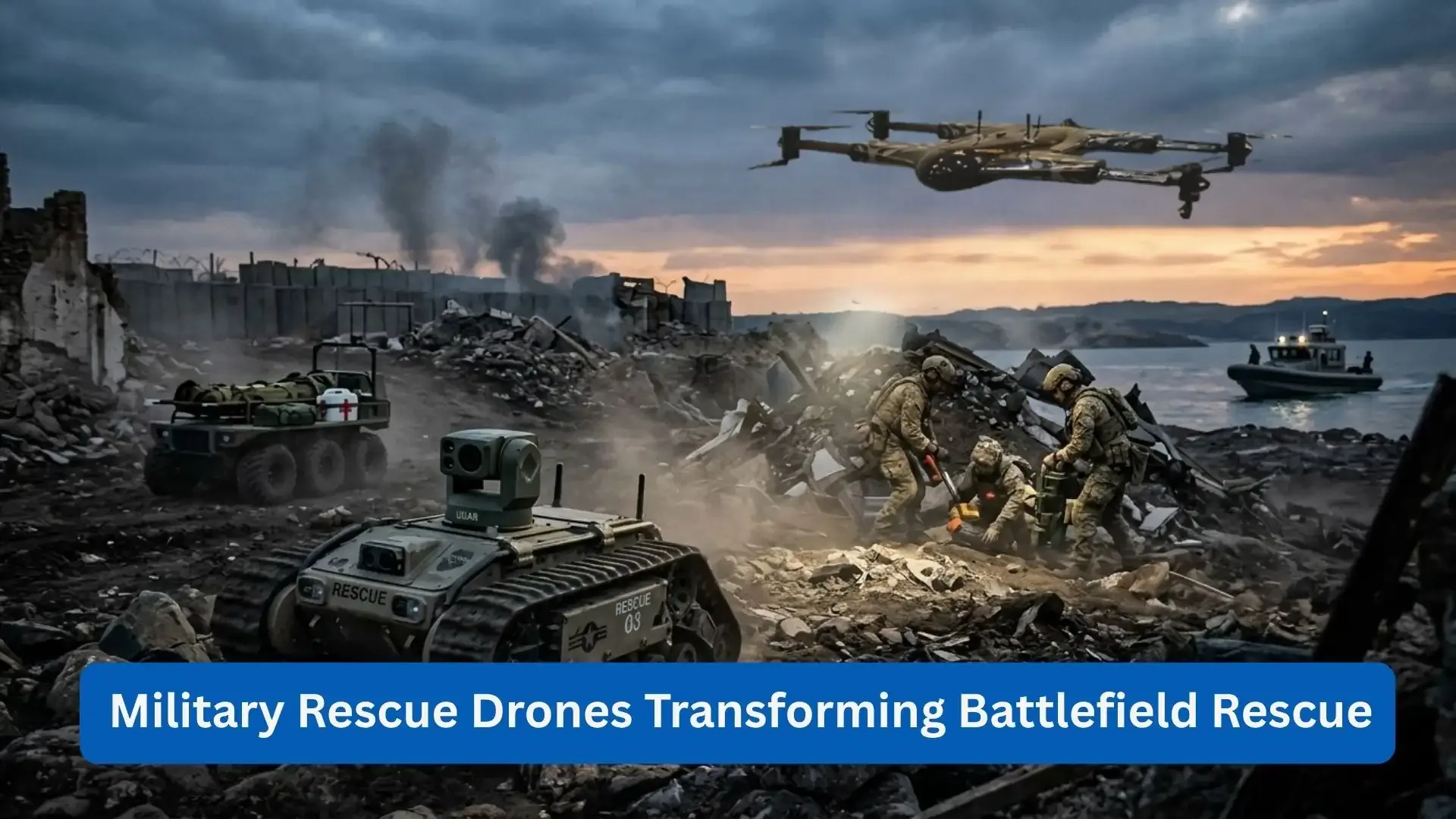
Military rescue drones can support searching, recovery, logistics, and casualty evacuation. They are helpful since they can be used to enter dangerous areas without directly exposing the rescuers to the same risks that are faced by conventional teams.
These systems are composed of aerial drones, unmanned ground vehicles, and maritime vessels that are used to locate personnel, deliver emergency supplies, assess areas that are deemed hazardous, and support evacuation. Military drones for rescue operations do not necessarily replace the conventional rescue assets but provide another option for responding to emergencies in combat zones, maritime incidents, and disaster situations.
What Are Military Rescue Drones?
Military rescue drones are unmanned aerial, ground, or maritime systems that are used for personnel recovery, casualty evacuation, search operations, and, emergency response. Military drones for rescue operations are able to carry cameras, thermal sensors, equipment relevant for communication, medical supplies, and other rescue equipment in order to support personnel in either dangerous or difficult areas.
How Military Rescue Drones Differ From Combat Drones
The main difference between the two is the mission purpose. Combat drones may be designed for surveillance, targeting, or strike missions, while rescue platforms are designed for purposes like locating, supporting, or recovering people. However, the distinction is not always absolute.
A military drone equipped for surveillance can also locate a person considered as injured. A logistics drone can deliver medical supplies. A tactical unmanned vehicle can transport a casualty.
Remotely Operated vs. Autonomous Rescue Drones
Remotely operated systems rely on human operators for control, although some functions may be automated. On the other hand, the autonomous systems are able to do tasks just like waypoint navigation, avoidance of obstacles, route following, and return-to-base with limited direct operator input.
Both are still in need of human oversight for the approval of a mission, unexpected situations that might occur, and medical decisions.
Why Military Forces Use Drones for Rescue Operations
Drones for military rescue have the capability to lessen the need to immediately send personnel into hazardous environments. They can also provide information before a crewed rescue team arrives. A drone may determine whether a route is accessible, identify the location of casualties, or assess surrounding conditions.
This makes military rescue a potential application for unmanned systems along with the traditional helicopters, ambulances, and rescue boats.
Types of Military Rescue Drones
Different rescue environments require different types of unmanned platforms.
· Aerial Search-and-Rescue Drones: Small aerial drones can cover large areas with the use of electro-optical and thermal cameras to locate people, vehicles, or damaged structures. They are useful for initial military rescue assessments without sending large teams into danger.
· Battlefield Casualty Evacuation Drones: Some platforms can transport injured personnel from exposed areas to medical teams. Military drones for rescue operations must account for patient weight, restraints, stability, communications, and available medical support.
· Unmanned Ground Rescue Vehicles: Ground vehicles are capable of carrying casualties, medical supplies, and equipment. The U.S. Marine Corps has tested autonomous vehicles for casualty evacuations. This shows how battlefield rescue drones along with ground systems, are able to support casualty evacuation when aerial transport is difficult.
· Autonomous Maritime Rescue Drones: Unmanned surface vessels can support maritime search, surveillance, logistics, and personnel recovery. They can approach people in the water without immediately exposing a crewed rescue boat to the same conditions.
· Large Military Copter Drones for Rescue: Large unmanned helicopters and heavy-lift multicomputer can carry more payload than smaller drones. Large military drones for rescue operations may support the medical logistics or the casualty transport. This depends on both their design and safety requirements.
How Military Drones Support Rescue Operations
Locating Missing or Injured Personnel
Thermal and electro-optical sensors can help locate personnel during daylight or darkness. AI-assisted detection can also help operators identify potential people in large amounts of imagery, although human confirmation remains important.
Delivering Medical Supplies and Survival Equipment
Rescuing doesn’t mean moving a person. Drones can be used to deliver first aid, water, medicine, blood, communications gear, and other supplies that are needed for emergencies while evacuation is arranged.
Restoring Communications in Contested Areas
Communications may be affected by terrain, damaged infrastructure, distance, or interference.
An unmanned aircraft can potentially act as a temporary communications relay, helping connect the personnel with either the command centers or medical teams.
Extracting Casualties From Dangerous Locations
Battlefield rescue drones can provide another method of moving injured personnel when conventional vehicles cannot safely reach them.
An unmanned ground vehicle may approach through difficult terrain, while an aerial platform can bypass physical obstacles.
Supporting Maritime Search and Rescue
At sea, unmanned systems can search areas that are large without immediately placing a crew’s life at risk. They can help identify people, life rafts, or debris and potentially support recovery operations.
How Drone Casualty Evacuation Works
Drone casualty evacuation involves several stages, from finding the casualty to transferring the person to medical personnel.
Casualty Detection and Identification
Sensors can help locate casualties, even in difficult conditions. Thermal cameras can spot heat in the dark, while electro-optical cameras provide a clearer visual view.
Mission Planning and Route Selection
The system needs a route that accounts for terrain, obstacles, weather, communications, navigation, and available energy.
Safe Approach and Patient Loading
Patient loading is one of the most important challenges. The casualty must be secured properly, while the platform must remain stable during loading and transportation.
Remote Medical Monitoring During Transport
Larger platforms may carry systems that transmit patient information to medical personnel. However, remote monitoring does not automatically replace an onboard medic or other qualified medical professional.
Transfer to a Medical Facility
The casualty may be delivered directly to a medical facility or transferred to another evacuation platform. This makes military casualty evacuation drones part of a larger medical evacuation chain rather than an isolated technology.
Battlefield Rescue Drones vs. Traditional Evacuation
Rescue Drones vs. Crewed Helicopters
Crewed helicopters can transport patients, medical personnel, and equipment. Their major limitation is that aircrew are exposed to the operating environment.
An unmanned aircraft can reduce that personnel exposure but may have less payload capacity and limited onboard medical capability.
Rescue Drones vs. Ground Ambulances
Ground ambulances provide a space for medical personnel and equipment but it really depends on usable routes.
Battlefield rescue drones can potentially operate where damaged roads, debris, terrain, or other obstacles prevent conventional ambulances from reaching casualties.
Rescue Drones vs. Crewed Rescue Boats
Crewed boats do provide both substantial equipment and human expertise but expose their crews to maritime hazards.
An unmanned surface vessel may provide an alternative for certain search and recovery situations.
Benefits and Limitations of Each Method
Drones for military rescue can provide rapid access along with reducing the exposure of the personnel. On the other hand, traditional systems can provide human judgment, medical capabilities, and, of course, greater flexibility.
Technologies Used in Military Rescue Drones
Thermal Imaging and Electro-Optical Sensors
Thermal sensors have the ability to detect heat signatures. On the other hand, electro-optical cameras are providers of visual information. Combining these sensors is important since it can improve situational awareness during searches.
Artificial Intelligence and Object Detection
AI can help with the detection of potential people or objects in video feeds. It can lessen the amount of imagery operators need to review but it shouldn’t be deemed and treated as perfectly reliable identification.
GPS-Denied Navigation
Satellite navigation may be unavailable or unreliable in some environments. Alternative systems can include inertial navigation, visual navigation, terrain mapping, and sensor fusion.
Secure Military Communications
A rescue drone may depend on communications for control, video, navigation, and coordination. As a result, systems should incorporate appropriate authentication, encryption, redundancy, and resilience.
Collision and Obstacle Avoidance
Autonomous systems that are operating around buildings, trees, vehicles, ships, or people require reliable detection of obstacles and avoidance. Cameras, radar, lidar, and other sensors can contribute to this capability.
Remote Medical Monitoring Systems
Larger evacuation platforms may carry equipment for monitoring patient information. The system should be designed according to the medical requirements of the intended mission.
Autonomous Route Planning
Autonomous route planning can reduce operator workload by allowing the platform to follow routes and respond to obstacles. Human operators should still have appropriate authority to intervene.
Large Military Copter Drones for Rescue
Large unmanned aircraft can bridge the gap between small drones and crewed helicopters.
Heavy-Lift Multicopter vs. Unmanned Helicopter Designs
Heavy-lift multicopters do use multiple rotors. On the other hand, unmanned helicopters use rotorcraft configurations with different characteristics of performance. The appropriate design depends on the payload, endurance, range, environment, and the requirements of the mission.
Payload and Casualty Capacity
Maximum payload alone does not determine whether an aircraft is suitable for evacuation. Buyers should consider useful payload at the required range, including the stretcher, restraint system, medical equipment, and other necessary equipment.
Range, Endurance, and Flight Stability
A rescue aircraft must have sufficient endurance to reach the casualty, perform the recovery, and reach its destination with an appropriate reserve. The performance can change based on payload, the weather, altitude, and the temperature.
Patient Loading and Restraint Systems
A casualty platform needs both a secure loading and restraint system. The system should minimize the unnecessary movement of patients when loading and transport’s happening.
Operational Limitations
Large unmanned aircraft require appropriate infrastructure, trained personnel, maintenance, communications, and launch or recovery areas. They may also be affected by weather and electronic interference.
Case Study: A Military Sea Drone Used for Aircrew Rescue
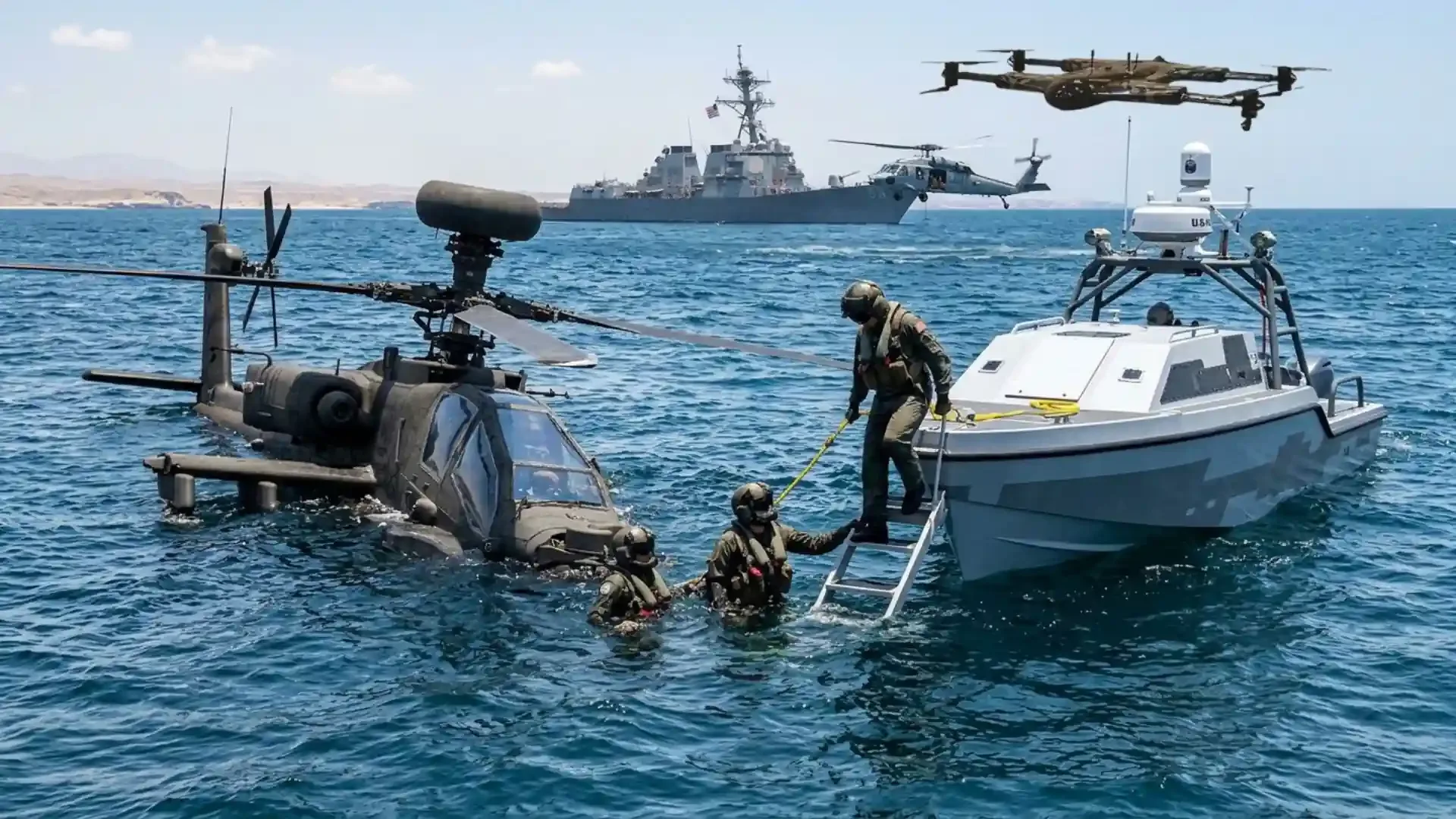
In June 2026, the U.S. Army AH-64 Apache helicopter went down near Oman, leaving two crew members in the water. A U.S. Navy unmanned surface vessel reportedly reached them before they were transferred for further evacuation. Reports identified the vessel as a Saronic Corsair, an autonomous surface vessel designed to operate without a crew.
The operation demonstrates how, if used together, unmanned and crewed systems work during a military rescue. The vessel supported the recovery while operating inside of a broader military command structure. This also illustrates that an autonomous vessel can operate within a broader human-led military command structure. However, an individual rescue done successfully does not indicate that unmanned vessels can replace conventional rescue assets. There are further tests that should be considered just like rough seas, communication disruptions, multiple casualties, severe injuries, and limited navigation signals.
U.S. Military Deployment of Sea and Autonomous Drones
The Role of Unmanned Maritime Systems
The U.S. Navy established Task Force 59 in 2021 to accelerate the integration of unmanned systems and artificial intelligence into maritime operations.
Task Force 59 and Sea-Drone Operations
Task Force 59 has experimented with unmanned aerial, surface, and underwater systems. The Navy later established Task Group 59.1 to focus on operational deployment of unmanned systems and their integration with human operators.
Search, Surveillance, Logistics, and Rescue Missions
US military sea drones deployment demonstrates how maritime unmanned systems can support multiple mission categories. A platform used for surveillance or logistics may also contribute to emergency response.
Human-Machine Teaming
Unmanned maritime operations generally remain connected to human command and decision-making. This is particularly important during rescue because medical and operational decisions can require human judgment.
Potential Roles for U.S. Marine Autonomous Drones
The Marine Corps has experimented with autonomous aircraft and ground systems. During an August 2025 exercise in Okinawa, Marines tested unmanned technology for casualty evacuation. These exercises demonstrate potential roles for autonomous drones in Marine Corps tactical mobility and casualty recovery.
Benefits of Drones for Military Rescue
Reduced Risk to Rescue Personnel
An unmanned platform can enter an uncertain environment before sending additional personnel.
Access to Contested or Hazardous Areas
Battlefield rescue drones can potentially reach areas that are difficult for conventional vehicles. However, drones remain vulnerable to environmental and operational threats.
Persistent Search and Surveillance
Small drones can remain over an area and provide repeated imagery while rescue teams prepare an extraction.
Rapid Delivery of Medical Supplies
Medical supplies can often be transported by smaller drones even when the aircraft cannot carry a casualty.
Faster Response Across Large Operational Areas
Aircraft can reach distant locations faster than ground vehicles in many circumstances.
Coordination Between Multiple Unmanned Systems
Future missions could combine aerial, ground, and maritime systems. One platform could locate the casualty, another could deliver medical supplies, and another could support evacuation.
Operational and Medical Limitations
Recovering Unconscious and Seriously Injured Casualties
Unmanned casualty evacuation becomes more difficult when the patient cannot assist with loading. A human recovery team may still be necessary.
Safe Patient Loading and Unloading
A technically capable vehicle may still be unsuitable if patients cannot be safely loaded or removed.
Lack of Onboard Medical Personnel
Most unmanned systems do not carry medical professionals. Seriously injured patients may therefore require medical personnel at the point of injury or receiving facility.
Weather, Terrain, and Sea-State Restrictions
Wind, rain, dust, extreme temperatures, rough seas, and terrain can affect performance. Testing should reproduce expected operating conditions.
Communications Disruption and Electronic Warfare
Loss of communications can affect control, video, navigation, and coordination. Systems should have appropriate fail-safe behaviors.
Cybersecurity Risks
A compromised rescue platform could become unavailable or behave unpredictably. Security should cover software, communications, authentication, updates, and access control.
Maintenance and Logistics Requirements
A fleet requires spare parts, batteries or fuel, trained operators, maintenance personnel, and software support. Procurement should consider the entire lifecycle.
Ethical and Legal Issues in Unmanned Casualty Evacuation
Human Control Over Rescue Decisions
People should retain appropriate authority over critical rescue and patient-handling decisions.
Responsibility When an Autonomous System Fails
Contracts and operating procedures should identify responsibility for system failures, software problems, communications loss, and other incidents.
Patient Consent and Dignity
Patients should be treated with dignity during loading, transport, monitoring, and transfer.
Medical Data Privacy and Security
Remote monitoring can involve sensitive medical information and therefore requires appropriate data protection.
Prioritizing Multiple Casualties
When multiple people need assistance, rescue organizations need clear triage procedures and human oversight.
Dual-Use Rescue and Combat Capabilities
Some platforms may support both rescue and military operations. Their configuration, authorization, and identification should therefore be clearly managed.
What Makes the Best Search-and-Rescue Drone?
There is no single best platform for every rescue mission.
Mission Suitability: The platform should match the environment, casualty type, distance, terrain, and expected response time.
Payload and Casualty Capacity: Buyers should examine useful payload under realistic operating conditions rather than relying only on maximum specifications.
Range and Endurance: Range should be evaluated with the intended payload and environmental conditions.
Sensor Performance: Sensors should be tested under realistic visibility and weather conditions.
Communications Resilience: The platform should maintain reliable communications or demonstrate safe behavior when communications are degraded.
Level of Autonomy: Buyers should define exactly what autonomous functions are required.
Patient-Safety Features: Platforms designed for evacuation should have secure restraints, appropriate loading systems, and emergency procedures.
Cybersecurity and Reliability: Security requirements should include authentication, encryption, software updates, access control, and incident response.
Interoperability With Existing Systems: The platform should integrate with relevant command, medical, communications, and logistics systems.
How to Evaluate a Search-and-Rescue Drone Company in the USA
Organizations researching a search and rescue drone company in the USA should focus on evidence rather than marketing claims.
Operational and Industry Experience: Evaluate the provider’s experience with the required type of platform and operating environment.
Demonstrated Rescue Capabilities: Ask whether the provider has demonstrated the system with realistic payloads, distances, the weather, and also the communications conditions.
Testing and Performance Evidence: It’s important that the performance claims should be supported by documented testing along with the defined conditions.
Manufacturing Capacity: A prototype does not necessarily demonstrate how ready the production is. Review the capacity of manufacturing, quality control, supply chains, and also the component availability.
Cybersecurity and Software Practices: Check how the software is developed, how it’s tested, how it’s secured, how it’s updated, and how it’s managed when there are vulnerabilities found.
Training and Technical Support: Make sure that the contracts cover the operator training, maintenance training, clear documentation, and the ongoing technical support.
Maintenance and Spare-Parts Availability: Reliable access to spare parts and repair services are important because it’s useful to keep the system ready for long-term use.
Contracting Readiness: Government suppliers should be ready to meet required documentation, quality, security, testing, and delivery standards.
Military Rescue Drone Procurement Checklist
Mission Requirements
Procurement documents should define:
Search area
Response time
Operating environment
Payload
Casualty capacity
Range
Endurance
Communications
Launch and recovery requirements
Technical Requirements
Specify requirements for sensors, navigation, communications, obstacle avoidance, power, environmental resistance, and payload integration.
Medical and Patient-Safety Requirements
Define patient weight limits, restraint systems, loading procedures, medical equipment compatibility, and monitoring requirements.
Cybersecurity Requirements
Address authentication, encryption, access control, software updates, vulnerability reporting, and incident response.
Testing and Acceptance Criteria
Acceptance tests should reproduce realistic mission conditions and use measurable performance requirements.
Training and Maintenance Obligations
Specify training, documentation, maintenance schedules, spare parts, repair procedures, and technical support.
Software Updates and Data Rights
Contracts should establish responsibilities for software updates and clarify data ownership, access and permitted uses for mission and sensor data.
Incident Reporting and Liability
Define procedures for reporting crashes, cybersecurity incidents, equipment failures, and patient-related incidents.
The Future of Military Casualty Evacuation Drones
The future of military rescue drones may carry heavier payloads and operate for longer periods as both propulsion and energy technologies will face improvements. Aside from that, military drones for rescue operations could also connect with battlefield medical systems for purposes just like monitoring, for logistics, communications, and planning of evacuations. Both better sensor fusion as well as alternative navigation may assist the battlefield rescue drones in order for it to be operated in environments where GPS is unavailable or unreliable.
Future military casualty evacuation drones and unmanned casualty evacuation systems may work with aerial, ground, and maritime platforms when there are complex military rescue missions. Additionally, improved communications could provide remote medical support during transport, while battlefield medical evacuation technology may improve both the coordination and, of course, the patient care. These technologies may also support the coast guards, the emergency services, the disaster response teams, and especially the civilian drones used for search and rescue.
Conclusion
Military rescue drones are becoming an additional tool for purposes like searching, recovering personnel, medical logistics, and casualty evacuation. They can access the areas that are hazardous while lessening the immediate exposure of rescue personnel. However, they are not automatic replacements for helicopters, ambulances, rescue boats, or medical teams. They are useful depending on the payload, range, endurance, navigation, communications, cybersecurity, safety of the patients, maintenance, and integration along with the existence of rescue procedures.
The 2026 rescue near the coast of Oman provides a real-world example of how an unmanned surface vessel can support the recovery of military personnel. Other military experiments have also examined unmanned aircraft as well as ground vehicles for casualty evacuation. The future of rescue technology is likely to include cooperation between crewed and unmanned systems, with procurement organizations which focus on the measurable requirements, realistic testing, human oversight, and lifecycle support.
Frequently Asked Questions
What Are Military Rescue Drones?
Military rescue drones are unmanned aircraft, ground vehicles, or maritime platforms supporting search, personnel recovery, medical resupply, and casualty evacuation.
How Are Drones Used for Military Search and Rescue?
Drones used for search and rescue can locate personnel, provide imagery, deliver supplies, and support communications and recovery.
Can a Drone Evacuate an Injured Soldier?
Yes. Some larger unmanned platforms can be designed or configured to transport casualties, depending on payload, patient-handling systems, medical requirements, and operating conditions.
Are Battlefield Rescue Drones Fully Autonomous?
Not necessarily. Battlefield rescue drones may perform navigation and other functions autonomously while remaining under human supervision.
Can Sea Drones Rescue Military Personnel?
Yes. In June 2026, a U.S. Navy Corsair unmanned surface vessel reportedly assisted in rescuing two U.S. Army aircrew members after their Apache helicopter went down near the coast of Oman.
What Makes the Best Search-and-Rescue Drone?
Key factors include payload, range, endurance, sensors, communications, autonomy, safety, cybersecurity, reliability, and interoperability.
What Is a Large Military Copter Drone Used For?
A large military copter drone can support heavy-lift logistics, medical delivery, personnel recovery, and casualty evacuation.
How Should Military Rescue Drones Be Evaluated for Procurement?
Buyers should assess mission, technical, medical, cybersecurity, testing, training, maintenance, software, data, and liability requirements.
Contact Us
This site is protected by reCAPTCHA and the Google Privacy Policy and Terms of Service apply.