



Agricultural Drone Surveying for Higher Crop Yields
Agriculture has existed for 10,000 to 12,000 years. Before, it helped early humans attain their daily sustenance and survive. Today, aside from providing us with healthy daily sustenance, it also contributes to the foundations of our modern society, just as our economy does. Our approach to agriculture has become more advanced than what our ancestors had before. It is evolving rapidly. One of the reasons for its fast evolution is the assistance given by advanced digital tools and automation.
What we know today as agriculture drone surveying allows our farmers to monitor their crops easily, analyze the state of the land’s soil, manage irrigation, and improve productivity with greater precision than the farming methods that farmers usually practice.
Drone technology’s rise in the farming field has changed how the farms operate in small and large agricultural landscapes. From UAVs used to monitor the crops to agricultural spray drones, they are helping the farmers lessen the cost of labor, improve the efficiency, and especially make decisions that are based on real-time data. It is important to consider that smart farming technology expands continuously, agricultural drones are also turning into a core component of precision farming solutions globally.
In this blog, you will learn about smart farming technology, specifically on how precision farming drones improve crop yield.
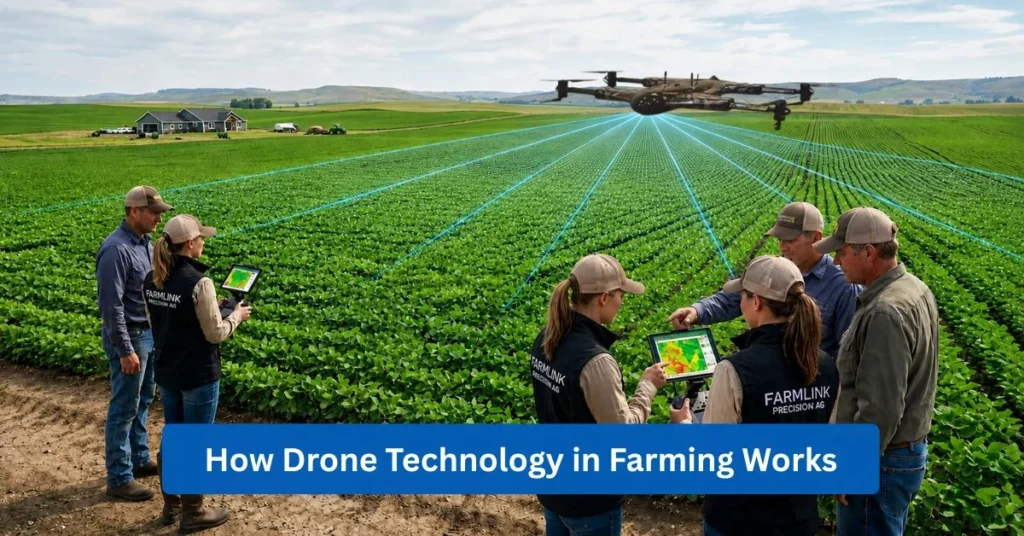
How Drone Technology in Farming Works
In farming, drone technology combines advanced hardware and software systems that can gather and process agricultural data in real time. With the help of drones in farming, farmers can perform mapping, spraying, surveillance, crop analysis, and precision irrigation.
Components of Farming Drones
Agricultural drones are equipped with several integrated systems, including:
- The farming technology that functions with the support of GPS
- High-resolution RGB cameras
- Multispectral drone imaging sensors
- Thermal imaging systems
- Agriculture software that’s powered by artificial intelligence (AI)
- Automated flight controllers
- Real-time crop analytics platforms
These components are helpful for the drones to gather accurate aerial data while flying autonomously across farmland.
GPS, AI, and Sensor Integration
The use of GPS and agriculture tools that are powered by AI in modern agricultural drones is important since it is advantageous to automate flight paths and collect field information.
When autonomous farming drones are used, they cover things like identifying crop stress and issues in terms of irrigation, nutrient deficiencies, and pest infestations with accuracy that we can deem as exceptional. In addition, AI-driven systems process the collected information as well as provide recommendations that support the agricultural automation and digital agriculture practices.
UAV Crop Monitoring Systems
UAV crop monitoring systems are designed to scan fields from above and generate actionable reports. Farmers use UAV crop monitoring to:
- Detect crop diseases early
- Monitor the growth of a plant
- Track soil moisture
- Analyze the density of a crop
- Improve yield forecasting
This makes drone-assisted crop monitoring one of the most valuable applications in modern farming.
Types of Agricultural Drones
- Agricultural drones come in various forms and are best suited for specific applications. Below are the types of agricultural drones:
- Crop Monitoring Drones: Crop health monitoring drones assist farmers in efficiently scouting crops in large farms. These drones will collect data from the air, which will be useful for optimizing farm productivity and precision farming.
- Agricultural Spray Drones: Aerial spraying of pesticides, fertilizers, and herbicides is done with agricultural spray drones. Agricultural spray drones can spray an extensive area in a short time, and the amount of wasted chemicals is much less.
- Drone Mapping Systems: Drone mapping in agriculture generates detailed topographic maps, which can be used to understand the conditions of the fields. Drone mapping aids in optimizing planting plans and resource allocation.
- Fertilizer Drones: Variable rate application technology is a technology that makes fertilizer drones an effective way to apply nutrients evenly to crops. This improves the efficiency and minimizes fertilizer inputs.
- Crop Dusting Drones: Crop dusting drones will increase the safety of the workers since they automate tasks that involve chemical spraying that are traditionally handled by tractors or aircraft operated by humans. This not only increases safety but also reduces the labor requirements.
Precision Agriculture Drones and Smart Farming
Precision agriculture drones are central to the future of smart farming and agricultural innovation.
- Precision Agriculture Explained: In precision agriculture, technology is leveraged to make better decisions about farming based on data. The precision agriculture drones collect field information to optimize irrigation, fertilization, planting, and harvesting.
- Data-Driven Farming Decisions: Drone technology is now helping farmers make informed decisions on operations based on the farm surveillance and crop analysis that is provided. Agricultural drone surveying is a method of data collection that is accurate and efficient, which can lead to increased profitability.
- Real-Time Field Analysis: Real-time monitoring helps farmers to act quickly when problems like pest infestations, water shortages, or nutrient depletion occur. This approach keeps sustainable farming tech on track, and it leads to lasting agricultural success for the future.
Drone-Assisted Crop Monitoring
Drone-assisted crop monitoring has become one of the most important uses of agricultural drones.
Crop Health Monitoring Drones: Crop health monitoring drones can capture aerial imagery that can be used to identify unhealthy plants before visible damage occurs. As a result, farmers will have the power to intervene as early as possible, and the crop losses will be reduced.
Multispectral Imaging: Multispectral drone imaging measures light reflectance from plants. This technology reveals hidden crop stress and helps optimize crop management.
NDVI Analysis: NDVI crop monitoring uses vegetation indexes to assess plant health and growth patterns. Farmers use NDVI analysis to:
- Detect drought stress
- Measure crop vigor
- Identify disease outbreaks
- Improve fertilizer distribution
Detecting Crop Stress Early: The reason why drones are a big help to monitoring crops is through the rapid aerial inspection and remote sensing in agriculture. Early detection is essential because it allows the farmers to prevent widespread crop damage, and it also maintains higher yields.
Drone Mapping for Agriculture: Drone mapping solutions for agriculture are giving farmers a clearer, real-time view of their fields without the guesswork. By using aerial images and smart data, farmers can quickly spot crop stress, poor irrigation, pest problems, and uneven growth early, helping them make faster decisions, reduce waste, and improve harvest quality with less time and effort.
Agricultural Drone Mapping: Agricultural drone mapping gives farmers a much clearer picture of what’s really happening across their fields. It covers all, from spotting areas with weak crops and drainage to early noticing uneven growth.
3D Field Mapping: 3D agricultural field mapping helps farmers really “see” their land in a way that isn’t obvious from the ground, showing small changes in elevation that affect how water moves across the field. With that kind of detail, they can fine-tune irrigation so water goes where it’s needed most, avoiding dry patches and flooded spots, and ultimately keeping crops healthier without wasting water or effort.
Soil Analysis and Terrain Mapping: Agricultural drone surveying allows the farmers to see differences in the condition of the soil and areas where erosion might be occurring even before becoming visible on the ground. This makes them easily step in early with better soil care and simple proactive measures, keeping their farming land healthier.
Agricultural Drone Surveying: Agricultural drone surveying allows farms to collect accurate geospatial data efficiently. Farmers use agricultural drone surveying for:
- Farm planning
- Crop analysis
- Land assessment
- Irrigation management
- Yield optimization
Benefits of agricultural drone mapping include improved operational efficiency, lower resource waste, and enhanced productivity.
Agricultural Drone Sensors Explained
Agricultural drone sensors play a big role in how farmers understand what’s happening in their fields because they quietly collect detailed data as they fly over crops. Below is the technology considered helpful for the farmers?
- Thermal Sensors: Thermal sensors can pick up changes of temperature across a field that aren’t visible through our eyes. This helps the farmers to quickly see where there are plants that are too dry, stressed, or possibly affected by disease.
- RGB Cameras: RGB cameras capture clear, everyday images of fields that help farmers visually inspect crops from above and keep an eye on overall farm conditions. This makes it easier to notice changes like uneven growth discoloration or damage early on so farmers can respond quickly and manage their land with more confidence and less guesswork.
- Multispectral Sensors: Multispectral sensors give farmers information about their crops and their situation that cannot be observed from the ground. It’s helpful in revealing which of the plants are doing well and which are not.
- LiDAR Technology: LiDAR technology helps create very detailed 3D maps of farmland by measuring the shape and structure of the ground with high accuracy. LiDAR technology allows farmers to have a better understanding of elevation changes and field layout, making it easier for them to plan about planting, manage the water flow, and especially improve the overall farming decisions with much more precision.
Crop Spraying and Agricultural Spray Drones
The use of crop-spraying drones is changing the face of today’s farming.
- How Agricultural Spray Drones Work: Agricultural spray drones are equipped with automated flight systems and precision nozzles, which ensure precise application of chemicals in agriculture.
- Drones for Spraying Pesticides: Drones used for spraying pesticides are making farming safer and more efficient by lessening the workers’ exposure to chemicals while also applying treatments more accurately across the field.
- Herbicide Drone Applications: Herbicide drones are directly targeting weeds instead of spraying the whole field. This is safer since it helps protect the environment and it also reduces chemical waste.
- Fertilizer Drone Systems: Fertilizer spraying drones are helpful for farmers to feed their crops equally, ensuring that every part of the field gets the right and even amount of nutrients instead of many in one place and lacking in another.
How to Use Drones for Crop Spraying
Farmers typically follow these steps:
- Plan the spraying route
- Upload field coordinates
- Fill the drone tank
- Set spray parameters
- Launch automated spraying operations
- Monitor coverage through software dashboards
How to use drones for crop spraying effectively depends on drone calibration, weather conditions, and proper flight planning.
Benefits of Drones in Precision Agriculture
Drones play a major role in precision agriculture by allowing farmers to have access to aerial crop inspection, multispectral drone imaging, and detailed agricultural field mapping. Considering these, the benefits of drones in precision agriculture continue to reshape global farming operations. The benefits include:
- Increased Crop Yield: Precision agriculture drones turn farming into something more responsive and less like guesswork. This is through helping the farmers notice if there’s an issue as early as possible and use water, fertilizer, and any other resources more wisely.
- Reduced Labor Costs: Agricultural automation minimizes manual labor requirements and increases operational efficiency.
- Better Resource Management: Drone irrigation systems and aerial crop inspection tools improve water, fertilizer, and pesticide usage.
- Sustainable Farming Practices: Sustainable farming technology supported by drones helps reduce environmental impact while maintaining strong agricultural output at the same time.
- Improved Farm Monitoring: Drone-based farm surveillance allows farmers to spot crop problems quickly, including issues with the equipment to be used, or even security risks. It keeps them more aware of what’s happening and makes managing the farm easier day to day.
- Faster Decision-Making: Real-time crop analytics help farmers to decide quickly regarding the changes in their fields, in order for them to fix issues early and to maintain the health of the crops with less guesswork and more control.
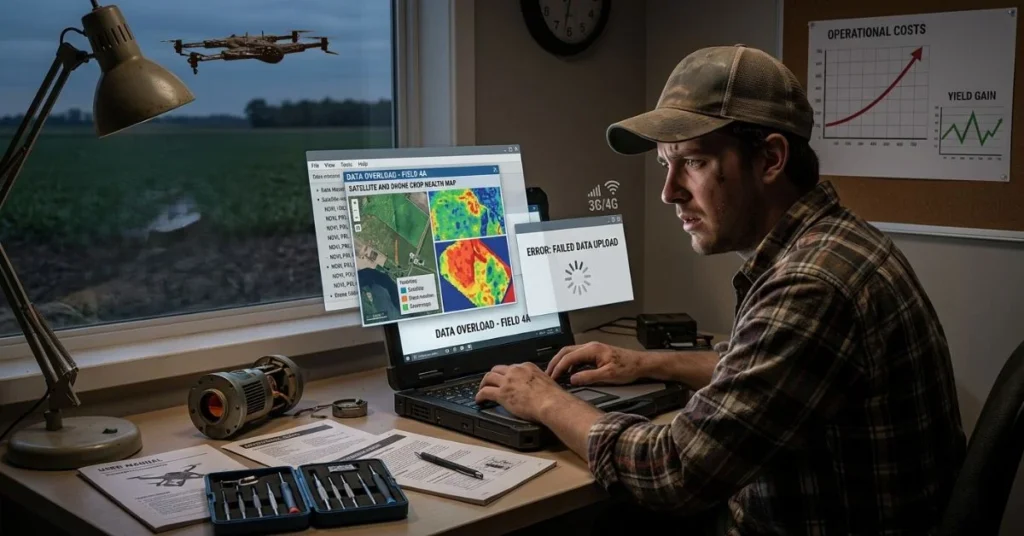
Challenges of Using Drones in Agriculture
Despite their advantages, agricultural drones still present several challenges. The challenges included are the following:
- Regulations and Licensing: Many countries require drone operators to follow aviation regulations and licensing requirements.
- Battery Limitations: Battery life, as always, limits flight duration, especially for farms that have a large space and extensive aerial survey operations.
- Weather Dependency: Flight safety and the performance of the drone also depend on the weather. If the weather is bad, just like heavy rain or strong winds, both safety and performance can be affected badly.
- High Initial Investment: Some farmers may struggle with the upfront cost of precision farming solutions and advanced agricultural imaging solutions.
How to Choose an Agriculture Drone Service
Choosing the right agriculture drone service is important for achieving reliable results.
Key Features to Evaluate
Farmers should evaluate:
- Flight time
- Quality of the camera
- Mapping accuracy
- Automation capabilities
- Maintenance support
Drone Payload Capacity: Payload capacity determines how much liquid or equipment a drone can carry.
Sensor Compatibility: Different agricultural drone sensors are used for different jobs. These jobs are mapping fields, checking the health of the crops, and handling spraying tasks.
Software Integration: Farm management systems and agriculture software powered by AI should integrate smoothly with drone operations. This will make farmers make more informed decisions quickly without juggling different tools.
Affordable Agriculture Drone Services: Farms that are, by area, considered small should compare pricing models and operational support before farmers invest in agricultural UAV solutions.
Future Trends in Agricultural Drone Technology
The future of agricultural drones is focused on greater automation, AI integration, and advanced analytics.
- AI-Powered Autonomous Drones: AI drones for precision agriculture will increasingly operate with minimal human intervention while improving efficiency and scalability.
- Swarm Farming Drones: Multiple autonomous drones may work together simultaneously to monitor and spray large agricultural fields.
- IoT-Enabled Agriculture: IoT-connected sensors and drones will support real-time communication between farm equipment and digital agriculture systems.
- Machine Learning in Crop Analysis: Machine learning algorithms will improve crop analysis technology and help predict disease outbreaks, irrigation needs, and harvest timing.
- Autonomous Drones for Agriculture Monitoring: Autonomous drones for agriculture monitoring will continue improving aerial survey accuracy and operational speed.
Conclusion
We can’t deny the fact that agriculture drone surveying is changing the industry of agriculture. This change is occurring because of the combination of precision agriculture drones, agriculture systems powered by AI, and advanced agricultural drone sensors, making them this very single smart farming solution. Our dear farmers can now improve efficiency, reduce waste, and maximize their level of productivity with the help of drone-assisted monitoring of crops, agricultural drone mapping, and precision crop spraying technologies.
The continuous movement of digital agriculture and sustainable farming technology is the reason why drones will become even more essential for farm management, aerial crop inspection, remote sensing in agriculture, and real-time crop analytics. Drones are truly flexible and can be used by the farmers to fulfill tasks, from drones for monitoring the health of the crops to fertilizer and agricultural spray drones. Drone technology is indeed helpful in creating a more efficient, productive, and sustainable future for modern agriculture.
FAQs on Drone Technology in Agriculture
What are drones used for in agriculture?
Agricultural drones are used for crop monitoring, aerial surveying, agricultural drone mapping, crop spraying, irrigation management, and livestock monitoring.
How do precision agriculture drones improve crop yield?
Precision agriculture drones improve crop yield by identifying crop stress early, optimizing irrigation, reducing chemical waste, and supporting data-driven farming decisions.
What sensors are used in agricultural drones?
Common agricultural drone sensors include RGB cameras, thermal sensors, multispectral sensors, and LiDAR technology.
Can drones spray pesticides and fertilizers?
Yes, agricultural spray drones can distribute pesticides, herbicides, and fertilizers accurately across agricultural fields.
What is UAV crop monitoring?
UAV crop monitoring is the use of drones to inspect crops, collect aerial imagery, and analyze field conditions using remote sensing in agriculture.
How accurate is drone mapping for agriculture?
Drone mapping for agriculture is highly accurate and can generate detailed 3D field maps and geospatial data for farm management.
Are agricultural drones cost-effective for small farms?
Yes, affordable agriculture drone services and scalable drone solutions make precision farming more accessible for small and medium-sized farms.
What are the benefits of crop health monitoring drones?
Crop health monitoring drones help detect disease early, improve fertilizer management, reduce crop loss, and increase overall farm productivity.
How do fertilizer drones work?
Fertilizer drones use automated spraying systems and GPS-guided farming technology to distribute nutrients evenly across crops.
What is the future of drone technology in farming?
The future includes AI-powered agriculture, autonomous farming drones, swarm drone systems, IoT-enabled agriculture, and advanced machine learning for crop analysis.
Contact Us

Thank you for your message. It has been sent.