


 Deutsch
 Português

AI and Autonomous Systems Are Reshaping the Future of Military Tech
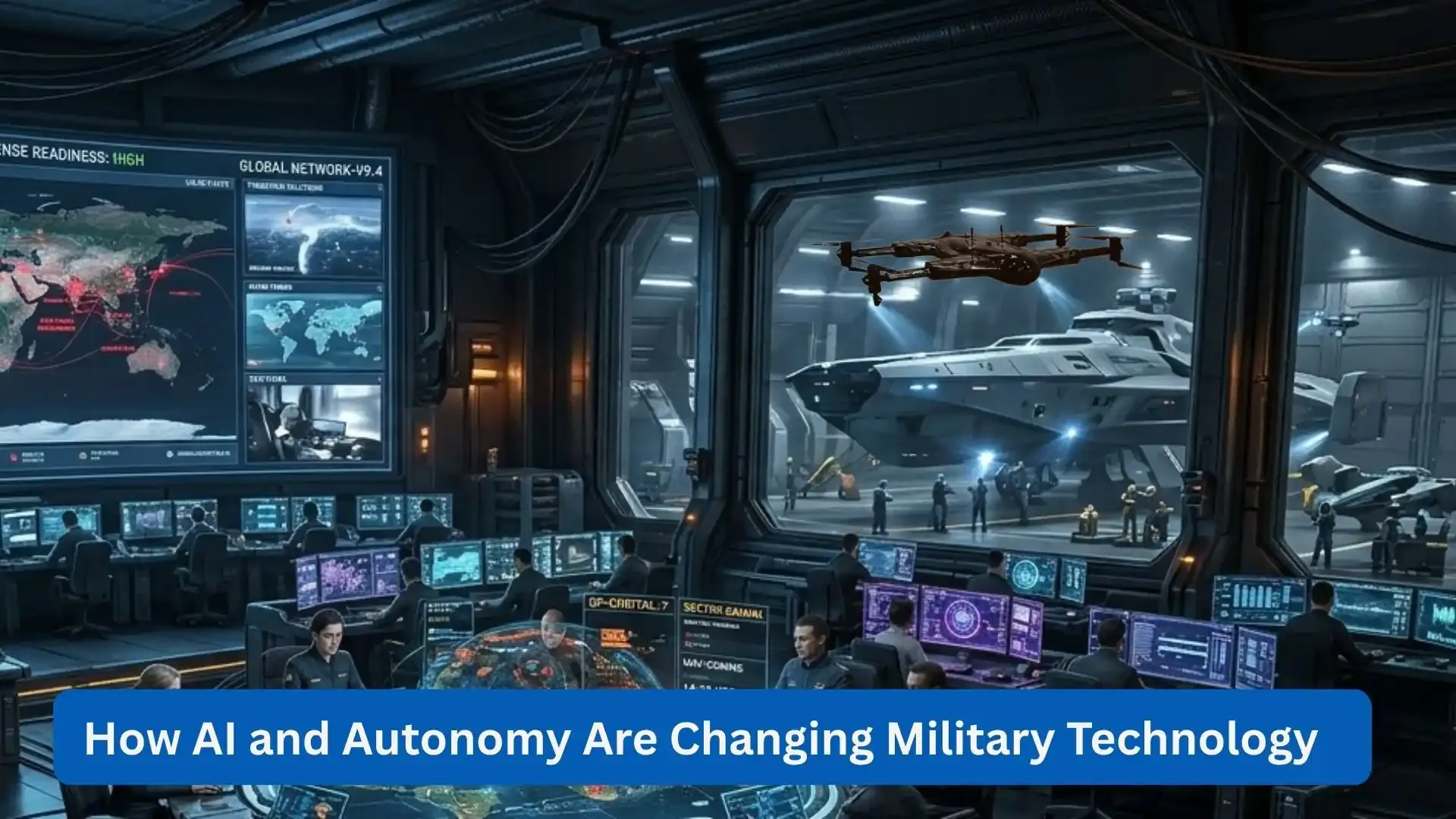
Military technology is moving forward on a hardware that relies on direct human control. AI and autonomous military systems combine software, sensors, data, communications, and varying levels of autonomy. This shift is a catalyst that would shape the future of military technology by improving information processing, situational awareness, decision-making, and mission support, while at the same time reducing personnel exposure to danger. It also gives an artificial intelligence in defense a role that’s practical enough to do data-heavy operations.
In this blog, you will learn about how AI and autonomous systems are reshaping the future of military technology as well as how important to remember that AI does not remove humans from important decisions. AI in military technology rather helps the people process information, manage redundant tasks, and respond to changing conditions. It’s less about replacing people and more about supporting human-machine teamwork.
How AI and Autonomy Are Changing Military Technology
AI and autonomous military systems allow the different platforms to connect, share information, and work together rather than operating on their own. Additionally, autonomous systems in defense can combine sensors, communications, navigation, data processing, and human supervision to complete defined tasks.
From Remote Operation to Mission-Level Autonomy
Remember that uncrewed systems aren't all autonomous, and not every autonomous system depends on advanced AI. The level of control varies. This just means that AI in military technology can support both human-assisted as well as autonomous operations.
Remotely operated ones are directly controlled by a human.
Automated follows rules or instructions that are predefined.
Semi-autonomous performs tasks that are under human supervision.
Mission-level autonomous carries out the objectives that are approved within the set limits.
Military autonomy technology covers this range of capabilities. There’s an advancement of autonomous systems in defense, and along with it is the ability of AI to both support faster data analysis and task execution with less continuous human input.
From Individual Platforms to Connected Systems
Autonomous operations depend on more than one vehicle or machine. They need sensors, secure communications, data-processing platforms, navigation technology, ground-control systems, and trained human operators. When these components are together, they can form intelligent defense systems.
Technologies Enabling Autonomous Defense Systems
Several technologies support the development of AI and autonomous military systems and more capable autonomous defense systems. These technologies work together rather than operating as separate features.
Artificial Intelligence and Edge Computing
AI is capable of analyzing information close to where it is collected. Edge computing can lessen the delays in communication, filter the large amounts of sensor data, and support operations where there is limited connectivity. This is especially useful when the systems are collecting more data than operators can reasonably view in real time. Edge AI in defense can help in identifying relevant information before sending it through a network. This allows personnel to put the focus on the information that matters most.
Multi-Sensor Data Fusion
A single sensor can provide useful information, but combining multiple sources can create a fuller picture. Cameras, thermal imaging, multispectral sensors, LiDAR, and positioning data can be brought together through multi-sensor data fusion.
Autonomous Navigation and Mission Planning
Autonomous navigation systems are able to support preplanned routes, obstacle avoidance, terrain-aware navigation, route adjustments, communication-loss procedures, and repeatable missions. These are the capabilities that can reduce the need for the constant manual control while doing routine tasks. At the same time, both mission rules and human supervision are both still important, especially when the conditions change or a system encounters something outside its expected operating environment.
Secure and Resilient Communications
Reliable ways are still relevant for the autonomous systems in order to exchange information. Encrypted data transmission, communication redundancy, protection against jamming and spoofing, reliable command links, and software security can help maintain the operations. Resilient military communications are particularly important because autonomous functions can become less useful if systems cannot safely receive, share, or process information.
Modular and Interoperable Design
Modular autonomous platforms are able to support different sensors, software, and mission equipment without requiring an organization to replace an entire platform. This can make the systems easier to adapt as the requirements change. Interoperability is also important because a system that can't work with other platforms, networks, or software can result in creating communication gaps even if its individual components perform well. This just proves that interoperability remains central to intelligent defense systems.
Human-Machine Teaming in Defense Operations
Rather than replacing the personnel, AI and autonomous military systems are more likely to support them. Human-machine teaming in defense allows the people to focus more on the objectives of the mission and the important decisions while the machines handle either data-heavy or repetitive work.
Supporting Human Decisions
Artificial intelligence in defense can help operators organize sensor data, detect unusual conditions, prioritize information, identify possible risks, and reduce repetitive workloads. AI-enabled defense technology can therefore act as a decision-support layer rather than an independent decision-maker.
Improving Situational Awareness
Autonomous systems are capable of collecting information from remote, dangerous, or inaccessible locations as well as provide it to the assigned people to decide. This can give the personnel a better understanding of the conditions without requiring them to enter the environment. AI-enabled defense technology can support AI-powered situational awareness by organizing information so that the important changes are easier to identify.
Reducing Personnel Exposure
Safety of the personnel is important to consider. The autonomous systems can support operations in damaged infrastructure, hazardous terrain, contaminated locations, disaster areas, and severe weather conditions. Their ability to either collect information or complete repeatable tasks remotely can lessen the need to put the personnel in an unnecessary danger.
Military Functions Being Transformed by Autonomous Systems
Intelligence and Situational Awareness
Autonomous systems can support area observation, mapping, environmental-change detection, and real-time data collection. These functions can help organizations understand changing conditions and identify areas that require further attention.
Logistics and Resupply Support
Automated route planning as well as supply movement can support logistics in difficult locations. Autonomous systems may lessen the exposure by handling repeatable transportation tasks while, at the same time, helping to maintain the movement of essential supplies.
Infrastructure and Damage Assessment
Autonomous systems can inspect roads, bridges, facilities, and hazardous areas after an incident. They can collect visual, thermal, mapping, or other sensor data that helps teams assess damage before sending personnel into potentially unsafe locations.
Base and Perimeter Operations
Scheduled monitoring, incident verification, and repeatable patrol routes can be supported by autonomous technology. These systems can perform routine tasks while allowing personnel to focus on events that require human judgment.
Search, Rescue, and Humanitarian Support
Autonomous systems can support thermal detection, disaster mapping, missing-person searches, and first-response activities. Their ability to enter difficult areas can help responders gather information before a larger operation is organized.
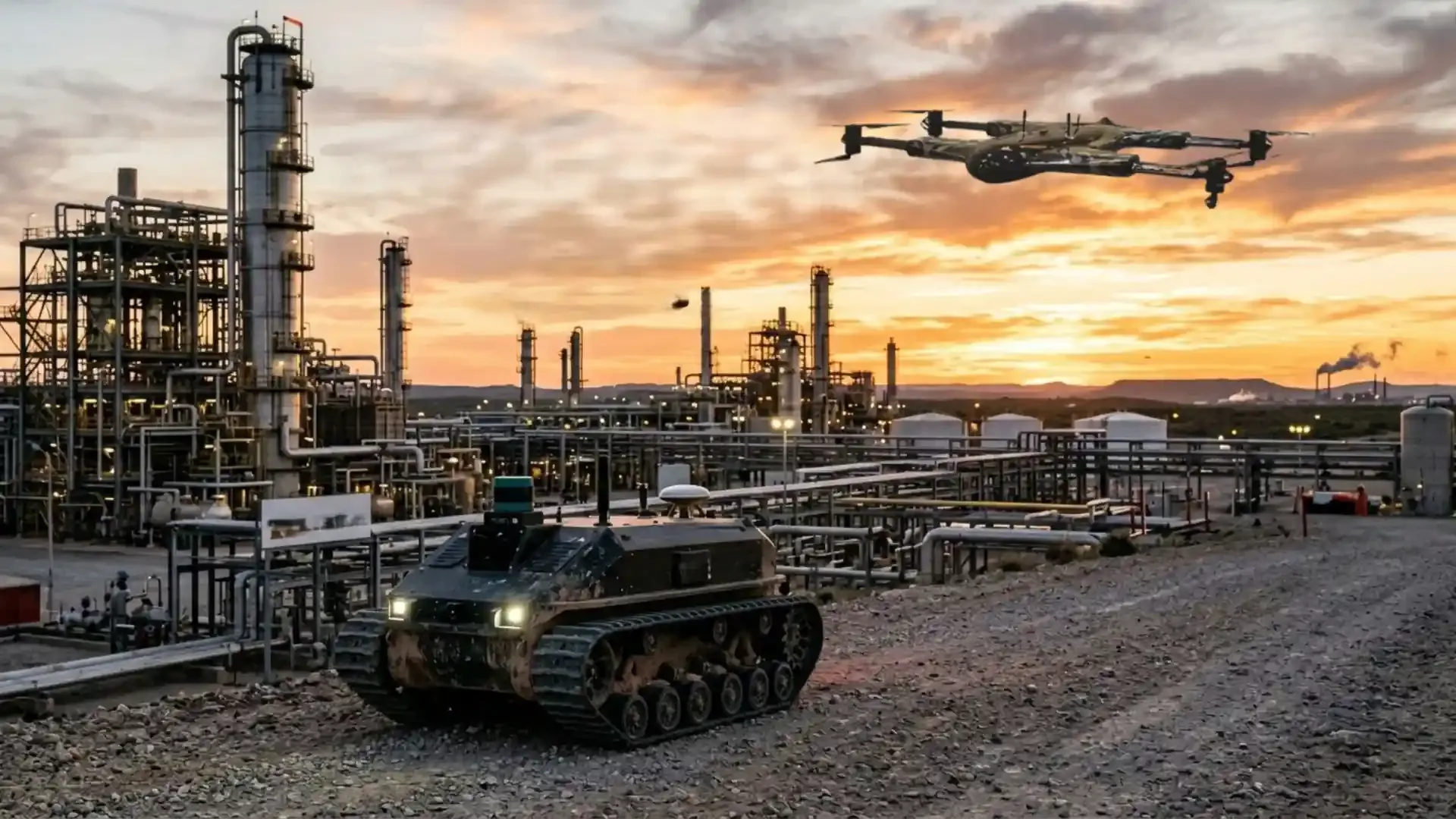
How Defense-Driven Autonomy Supports Commercial Industries
Technologies that are developed for demanding places can also support both the civilian and industrial operations. This has led to why dual-use autonomous technology is becoming increasingly relevant in different sectors.
Security and Critical Infrastructure
Industrial autonomous systems can support automated perimeter monitoring, intrusion detection, remote facility observation, thermal monitoring, and incident verification.
Critical infrastructure monitoring can benefit from systems that repeatedly collect information without requiring workers to inspect every location manually. It’s important because this can support an earlier process of identifying unusual conditions as well as reducing the exposure to difficult environments.
Energy and Utilities
Energy and utility organizations can use autonomous systems for power-line inspection, pipeline monitoring, renewable-energy inspection, thermal anomaly detection, and storm-damage assessment.
Mining, Oil, and Gas
Mining, oil, and gas operations often involve hazardous environments and large areas. Autonomous systems can support hazardous-area inspection, terrain mapping, equipment monitoring, environmental data collection, and reduced worker exposure.
Emergency Services
Autonomous technology can be used by emergency services in emergencies just like monitoring of wildfires, search and rescue, for flood assessment, structural damage mapping, and first-response situational awareness.
Construction and Property Management
Autonomous systems can be used by both construction and property teams to progress the mapping, site monitoring, structural inspection, safety-zone observation, and repeatable project surveys.
Challenges Affecting AI and Autonomous Systems
The future of military technology will depend not only on what autonomous systems can do, but also on how reliably and responsibly they operate.
Cybersecurity and Communication Interference
Autonomous systems can be affected by cyber threats, jamming, spoofing, and communication failures. Security must therefore be considered across hardware, software, networks, and data.
Reliability in Unpredictable Environments
Real-world environments can change quickly. Weather, terrain, unexpected objects, damaged infrastructure, and other conditions may challenge a system that performs well under controlled testing.
Data and Algorithmic Limitations
AI depends on both data and algorithms may have some limitations. System outputs can be affected by unexpected conditions, poor-quality data, or incomplete information. This is the reason why testing and validation are essential.
Integration and Interoperability
A new autonomous system may need to work with existing equipment, software, communications networks, and organizational procedures. The absence of interoperability can affect even capable technology, making it difficult to use at scale.
Ethical and Legal Responsibilities
Responsible military AI requires attention to human oversight, privacy, data ownership, accountability, aviation regulations, and appropriate use of AI. Organizations must understand not only what a system can do, but also when and how it should be used.
How ZenaDrone Supports Autonomous Operations
ZenaDrone shows its support to military autonomy technology by combining artificial intelligence (AI) and machine learning with programmable flight, onboard sensors, LiDAR, multispectral cameras, modular hardware, and autonomous charging. These capabilities allow the systems to collect aerial data, follow pre-scheduled routes, map terrain, and perform repeatable monitoring with less direct human control.
The Future of AI and Autonomous Military Technology
The future of AI and autonomous military systems will focus on better cooperation between humans as well as machines. Next-generation military technology may use onboard processing, the modular platforms, stronger cybersecurity, and better interoperability. These systems will still need humans, especially human oversight, testing, and, of course, clear accountability.
Frequently Asked Questions
What are AI and autonomous military systems?
AI and autonomous military systems use AI, sensors, software, and varying levels of autonomy to support military tasks such as navigation, monitoring, and logistics.
How is AI changing military technology?
AI helps process data, identify patterns, improve situational awareness, and support faster decisions.
What is the difference between automated and autonomous systems?
Automated systems follow set rules, while autonomous systems can make decisions and perform tasks with less direct human input.
Will autonomous systems replace military personnel?
Human-machine teaming in defense allows machines to handle repetitive tasks while people remain responsible for key decisions.
How can military autonomy benefit commercial industries?
Dual-use autonomous technology can support infrastructure inspection, energy, mining, construction, emergency response, and security.
What are the main risks of autonomous systems?
Key risks include cybersecurity threats, communication failures, unreliable performance, data limitations, and ethical or legal concerns.
Contact Us
This site is protected by reCAPTCHA and the Google Privacy Policy and Terms of Service apply.