


 Deutsch
 Português
Defense Autonomous Warfare Group: DAWG, Military Autonomy, and Opportunities for Drone Companies
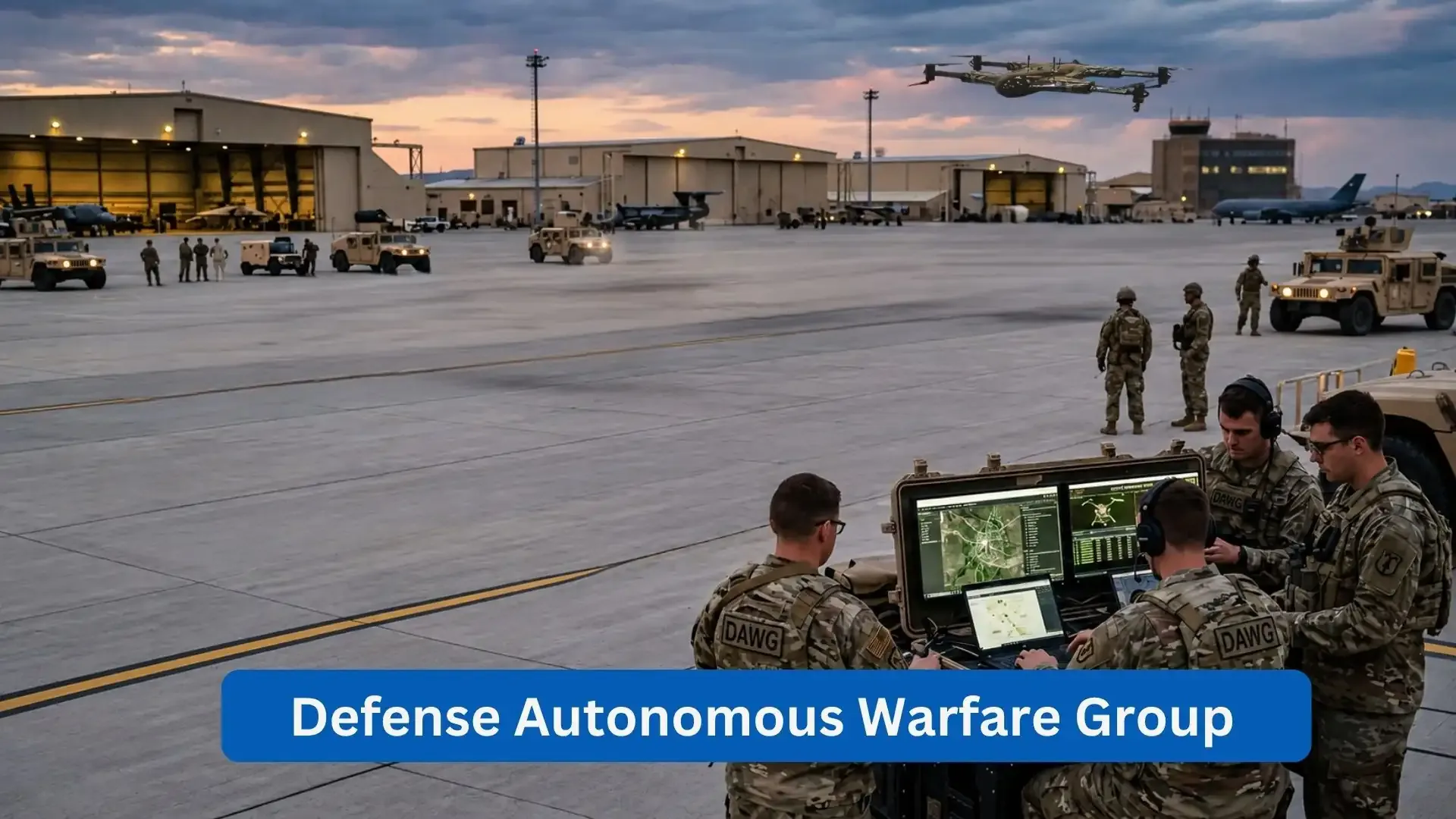
The Defense Autonomous Warfare Group or also known as “DAWG” is a U.S. Department of War organization focused on advancing autonomous and unmanned systems across air, land, maritime, and undersea domains. It brings together operators, software, vehicles, sensors, communications, and command systems to support the development and deployment of autonomous capabilities. The DAWG Defense Autonomous Warfare Group which was established in 2025 is important to autonomous UAVs, AI-enabled systems, mission software, modular payloads, and of course, dual-use technologies.
Its FY2027 request includes a proposed $53.6 billion RDT&E line, along with a broader DAWG-related funding that’s reported at approximately $54.6 billion. These are the proposed figures and not an awarded or an enacted funding, making autonomy, interoperability, rapid prototyping, and also the commercial technology integration key areas to be watched by the companies.
What Is the Defense Autonomous Warfare Group?
The Defense Autonomous Warfare Group DAWG was established to coordinate U.S. efforts in autonomous warfare and unmanned systems by connecting operational demand, technical innovation, and industrial capacity. In practice, the DAWG military program is broader than a single military drone program or aircraft acquisition. Its focus is to integrate autonomous vehicles along with AI-enabled systems, mission software, sensors, communications, and command-and-control technologies.
The Pentagon DAWG program and broader Pentagon autonomous warfare program concept emphasize moving autonomous capabilities from development to operational use. FY2026 documents describe DAWG as providing centralized leadership for the rapid development, integration, and fielding of unmanned aerial systems. However, DAWG autonomous warfare is not limited to drones. Its broader multi-domain focus includes autonomous systems, vehicle coordination, mission software, communications, and unmanned-systems integration, while SOUTHCOM's Autonomous Warfare Command has also stated it will work with DAWG on relevant capabilities.
What Does DAWG Stand For in the Military?
DAWG stands for Defense Autonomous Warfare Group. Current official materials use this name, while earlier terminology may still appear in historical references. The organization is part of the broader Department of War effort to accelerate autonomous and unmanned capabilities, including Defense Department autonomous systems, autonomy software, commercial technology, and rapid capability development.
The term Department of War autonomous systems describes this broader organizational context, but it should be distinguished from individual service programs, commands, solicitations, and contracts.
What Types of Autonomous Systems Fall Within DAWG's Scope?
The DAWG Defense Autonomous Warfare Group work extends beyond aircraft and includes multiple types of autonomous and unmanned systems.
The broader autonomy ecosystem can include:
Uncrewed ground vehicles
Autonomous surface vessels
Uncrewed underwater systems
Mission autonomy software
Fleet-level orchestration
Command-and-control systems
AI-enabled perception
Navigation technologies
Communications infrastructure
Human-machine interfaces
This creates opportunities for companies developing DAWG unmanned systems in software, navigation, edge computing, sensors, communications, and payload integration, expanding the military autonomous systems program landscape beyond traditional defense manufacturers while enabling autonomous military drones to operate as part of connected networks.
Autonomous Aerial Systems
Aerial systems include autonomous UAVs, AI-enabled perception, navigation, mission planning, communications, and modular payloads. However, aircraft must also operate reliably in their environment and integrate with other systems.
Ground, Surface, and Undersea Systems
Autonomy also includes the ground vehicles, surface vessels, and underwater platforms. Unlike conventional military drone programs, broader autonomy efforts can involve multiple platforms connected through shared mission software and command systems.
Mission Autonomy and Orchestration
Another key category is autonomy software, which can translate operator intent into tasks, coordinate vehicles, monitor missions, and return information to operators. This was the focus of the DIU and DAWG Autonomous Vehicle Orchestrator Prize Challenge, launched in January 2026 to develop market-ready technology for understanding, tasking, and coordinating autonomous systems at fleet level.
How DAWG Differs From a Traditional Military Drone Program
The difference between DAWG autonomous warfare and a conventional acquisition program can be summarized through several distinctions.
Traditional Approach | DAWG-Oriented Autonomy Approach |
Individual Platform | Distributed system |
Centered on aircraft | Multi-domain |
Emphasizes the hardware | Both hardware plus software |
Single-vehicle control | Fleet coordination |
Long development cycles | Rapid prototyping and iterative testing |
Platform-specific systems | Vehicle-agnostic technologies |
Has a fixed technology | Has an adaptable autonomy |
Platform-focused procurement | Both integration and capability development |
A military drone program focuses on specific platforms, while DAWG emphasizes integration. It’s important that autonomous warfare drones are in coordination with communications, sensors, navigation, and mission systems. This makes integration an important consideration for companies pursuing opportunities related to DAWG drone program and military autonomy.
How Military Autonomous Systems Move From Concept to Fielding
The development of Defense Department autonomous systems typically involves several stages.
· Identify an Operational Problem: Technology development should begin with a specific operational need. The question is not simply, "Can this vehicle fly autonomously?" Instead, the question is whether autonomy can solve a meaningful operational problem.
· Evaluate Commercial and Defense Technologies: Do remember that before investing in extensive custom development, the government can evaluate existing technologies. This is important as it creates potential DAWG opportunities for drone companies, particularly the companies with mature commercial systems that can be adapted to the requirements of the government.
· Prototype and Demonstrate: Prototype activities allow developers and military users to evaluate technical performance. A prototype agreement or prize challenge is not the same as a production contract.
· Test with Operators: Operator feedback can reveal limitations that laboratory testing does not identify. This is particularly important for AI-powered military drones, where system behavior, interface design, reliability, and human supervision all matter.
· Integrate Existing Systems: A successful platform must work with other systems. This is where military UAV interoperability becomes critical.
· Scale Production: A promising prototype still needs manufacturing capacity, supply-chain resilience, maintenance support, training, and sustainment. Consequently, companies pursuing autonomous systems defense contracts need to demonstrate more than technical novelty.
What the DIU Orchestrator Challenge Reveals About DAWG's Approach
One clear example is the Autonomous Vehicle Orchestrator Prize Challenge, launched by the Defense Innovation Unit (DIU), DAWG, and the U.S. Navy in January 2026. The $100 million challenge sought vehicle-agnostic technology that could translate human intent into machine tasks and coordinate autonomous systems at fleet level. DIU and DAWG Autonomous Vehicle Orchestrator Prize Challenge This provides a useful case study for understanding the Pentagon autonomous warfare program and the growing role of human-machine teaming.
The approach emphasizes open architecture military drones, multi-vehicle coordination, communications, data exchange, and mission management across different platforms. The challenge also highlights how DIU drone competitions can use progressive testing to identify promising technologies. However, companies should distinguish between an announced challenge, prototype activity, and potential production opportunity; the Orchestrator Challenge should not be presented as a currently open competition.
Military UAV Integration Requirements Explained
Exact military drone technology requirements vary by solicitation and mission. There is no single checklist that automatically makes a UAV suitable for every military application. However, companies should expect several areas of evaluation.
· Command-and-Control Compatibility: A UAV needs to operate within the intended command architecture. This includes communication with operators, ground systems, and potentially other autonomous vehicles.
· Software and Data Interfaces: Interoperable software interfaces can make it easier to exchange information between systems. This is an important component of unmanned systems integration requirements.
· Payload and Sensor Integration: Military missions can require different sensors. A modular platform may support electro-optical, infrared, thermal, multispectral, or other payloads depending on the mission.
· Secure Communications: Communications must be appropriate for the operational environment. Requirements can include resilience, encryption, authentication, bandwidth management, and protection against interference.
· Navigation Resilience: Military systems may need to operate when satellite navigation is degraded or unavailable. GPS-denied navigation can therefore become an important consideration for autonomous UAVs.
· Cybersecurity: Cybersecurity is particularly important because autonomy introduces additional software and network dependencies.
· Environmental Reliability: Commercial systems may need additional testing before deployment in harsh operational environments.
· Operator Controls: Even highly autonomous systems require clear interfaces for human supervision, intervention, and mission management.
· Documentation: Technical documentation, interfaces, maintenance information, cybersecurity documentation, and system specifications can all influence integration. The key point is that military UAV interoperability and compliance requirements depend on the individual solicitation.
Why Military UAV Interoperability Matters
A modern autonomous system rarely operates alone.
Military UAV interoperability allows different platforms and software systems to exchange information and coordinate activities.
This can support:
Multiple UAV platforms
Different sensor packages
Shared mission data
Military networks
Crewed and uncrewed systems
Updated mission software
Fleet-level coordination
For commercial drones for military applications, interoperability can determine whether a system is operationally ready. Open architecture military drones can improve integration through standardized interfaces and adaptable software, but security, compliance, and network interoperability must still meet applicable military requirements.
The Role of Modular Autonomous UAV Platforms
The role of modular autonomous UAV platforms is to allow the operators to swap sensors, payloads, computing components, and the mission configurations without replacing the aircraft. Modular designs are there to support interchangeable payloads, configurable sensors, adaptable mission software, standardized hardware interfaces, and of course, both easier maintenance and upgrades. However, a modular autonomous UAV platform is not a certification but a design characteristic. Because of this, they must still meet applicable military requirements.
Can Commercial Drones Be Adapted for Military Applications?
Yes, commercial drones for military applications can potentially be adapted, but they may need some upgrades to communications, cybersecurity, navigation, environmental durability, data protection, and the supply-chain security. Additionally, manufacturers must also deem the capacity of the production and the long-term sustainment. In terms of pursuing military opportunities, you must consider the following key considerations. Key considerations for defense autonomous systems vendors include technical maturity, manufacturing scalability, cybersecurity, supply-chain resilience, and lifecycle support.
AI-Powered Military Drones and Human Control
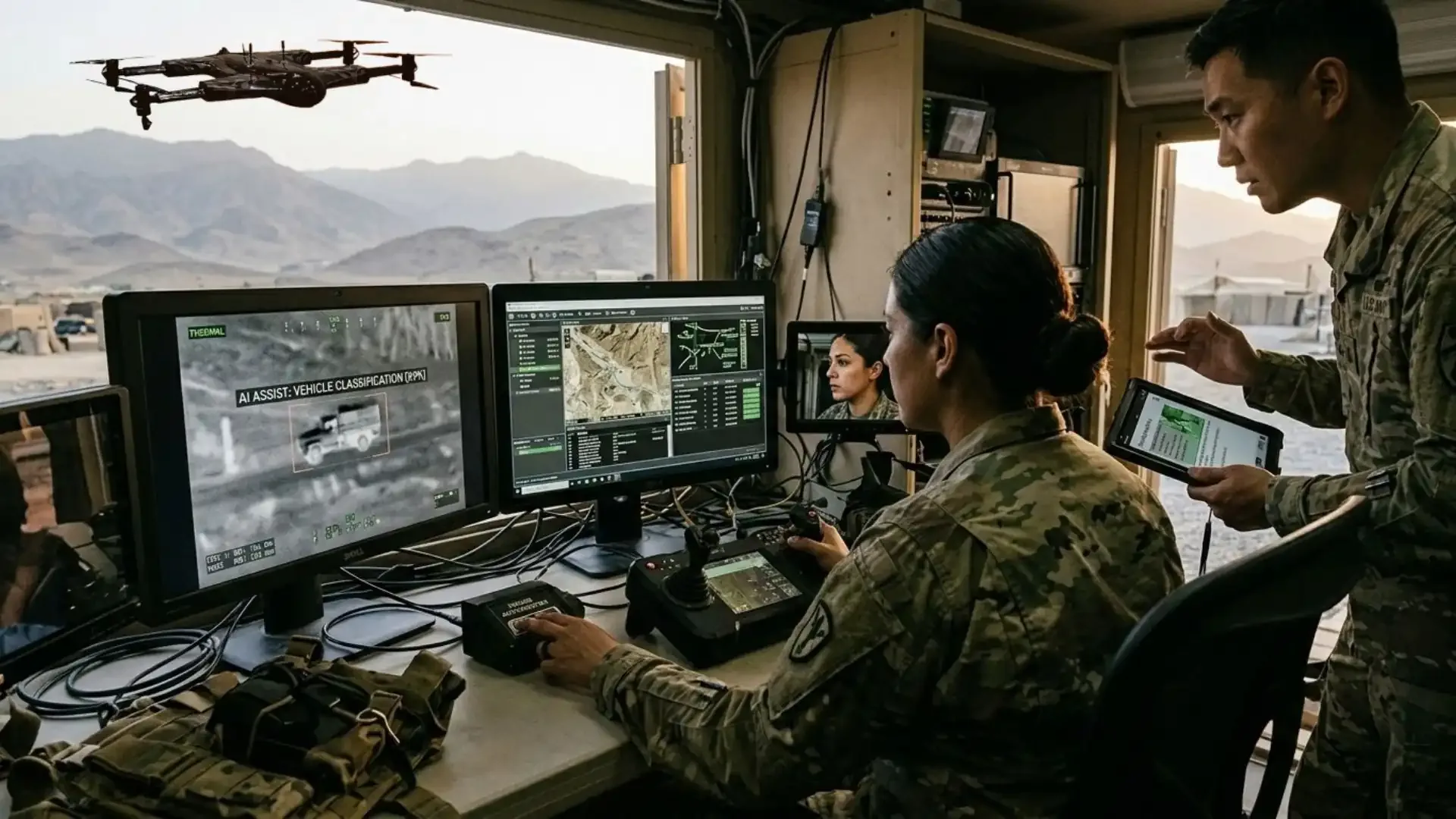
AI-powered military drones can use AI for perception, classification, navigation, planning, and decision support, while autonomy allows systems to perform tasks with reduced human control. Capabilities may include onboard AI processing, object classification, autonomous navigation, mission planning, and multi-vehicle coordination. However, autonomous warfare drones do not necessarily independently operate. It’s important to remember that a human’s authorization, oversight, including the failure-recovery controls can still be essential, specifically when there’s a failure in communications, sensors, or navigation.
How Autonomous Systems Are Tested Before Deployment
A capable prototype still needs rigorous evaluation.
Testing can include:
Laboratory validation
Simulation
Controlled flight testing
Environmental testing
Multi-system demonstrations
Operator evaluations
Safety and failure testing
Operational suitability assessments
For AI-powered military drones, testing should assess AI performance, sensor limitations, communications, edge cases, and human-machine interfaces under realistic operating conditions. Systems proven in controlled commercial environments may require further validation before military deployment.
Defense Procurement Pathways for Autonomous Systems
Companies that are doing research for defense drone procurement opportunities should have an understanding regarding how the government acquisition does not follow one universal path. Potential pathways include:
DIU competitions
Prize challenges
Prototype solicitations
Service-specific requirements
Operational demonstrations
Competitive evaluations
Follow-on production
Prime-contractor partnerships
Integration partnerships
A DIU drone competition opportunity can be useful for demonstrating technology, but winning a challenge does not necessarily mean receiving a large production order. Similarly, military autonomy solicitations may be structured around specific technical objectives rather than complete aircraft procurement.
Companies should distinguish carefully between:
A challenge is a competitive mechanism for evaluating or developing solutions.
A solicitation is a formal government request for purposes like proposals or other responses.
A prototype agreement is an arrangement that’s focused on developing or demonstrating a capability.
Production contract is a considered agreement to both manufacture and deliver an operational capability.
These distinctions help companies seeking autonomous UAV government contracts avoid misleading assumptions about revenue and procurement timelines.
DAWG Opportunities for Drone Companies
The growth of autonomous systems creates several potential areas for DAWG opportunities for drone companies.
These include:
· UAV Platforms: Manufacturers may provide airframes and flight systems.
· Autonomy Software: Software companies can develop navigation, mission planning, or orchestration technologies.
· Payloads: Sensor manufacturers can provide specialized payloads.
· Communications: Companies can develop resilient communication systems and networking technologies.
· AI and Edge Computing: AI companies can provide onboard processing and perception capabilities.
· Integration: Systems integrators can connect aircraft, payloads, software, networks, and command systems. The Drone Dominance program is a separate acquisition initiative that also creates opportunities for drone companies beyond DAWG. Companies should therefore monitor military drone contracts, DIU opportunities, service-specific acquisition programs, and other government procurement channels.
What Drone Companies Working With the Pentagon Should Prepare
For drone companies working with the Pentagon, technical performance is only one part of readiness.
A practical preparation checklist includes:
· Technical Readiness: Can the system perform consistently under expected operating conditions?
· Integration Readiness: Can it connect with external software, sensors, and command systems?
· Cybersecurity Readiness: Can the company document security controls and protect sensitive information?
· Manufacturing Readiness: Can production increase if the system is selected?
· Supply-Chain Readiness: Can critical components be sourced reliably?
· Documentation: Are interfaces, maintenance procedures, technical specifications, and test results documented?
· Sustainment: There are factors to be considered that are particularly relevant to defense autonomous systems vendors that are competing against established defense companies. Considerations like, can the company provide maintenance, replacement parts, training, and long-term support?
Common Misunderstandings about DAWG
Several misconceptions can create confusion around the Defense Autonomous Warfare Group.
· DAWG Is Not Limited to Aerial Drones: Its broader mission includes autonomous and unmanned systems across multiple domains.
· A Proposed Budget Is Not an Awarded Contract: The FY2027 figures currently discussed are budget requests and legislative funding actions can differ from initial proposals. Recent congressional analysis shows different authorization and appropriation figures associated with the DAWG request.
· Autonomous Does Not Mean Fully Independent: Autonomous systems can still operate under human supervision.
· Commercial Availability Does Not Equal Military Readiness: A commercially successful UAV may require additional testing, security, integration, and sustainment.
· Modularity Does Not Guarantee Interoperability: A modular aircraft still needs appropriate interfaces and validation.
· Prototype Success Does Not Guarantee Production: A demonstration or challenge result does not automatically lead to a production contract. These distinctions are essential when evaluating the Pentagon DAWG program and related procurement opportunities.
What DAWG Could Mean for the Future of Military Autonomy
The direction of the defense autonomous warfare group DAWG towards the future remains uncertain, so the companies should consider these trends as possibilities instead of guaranteed outcomes. The military autonomous systems program landscape may see a greater multi-domain coordination across air, land, sea, undersea, and also the cyber environments, alongside vehicle-agnostic autonomy, faster prototype evaluation, increased use of commercial dual-use technology, stronger system integration, and greater emphasis on scalable production.
Human operators will likely remain central to mission planning, supervision, and oversight as SOUTHCOM’s Autonomous Warfare Command works with DAWG to integrate autonomous, semi-autonomous, and unmanned platforms across domains. This shift suggests that the future military autonomous systems program environment will extend beyond aircraft procurement to include software, interoperability, data infrastructure, cybersecurity, orchestration, and sustainment.
Conclusion
The Defense Autonomous Warfare Group is a reflection of a broader U.S. effort to advance autonomous as well as unmanned technology by integrating vehicles, software, sensors, communications, operators, and also the command systems. Additionally, it’s important for progressing companies that are developing autonomous military drones, AI-powered military drones, autonomy software, modular payloads, and other dual-use technologies, as it creates many potential opportunities. Success rate depends on technical and organizational readiness, including interoperability, cybersecurity, resilient communications, modularity, testing, scalability, and sustainment.
Remember that DAWG's FY2027 figures are not guaranteed funding or an awarded contract but rather a representation of a significant proposed investment. If your company is pursuing defense autonomous warfare group opportunities, instead of focusing on a program label, they should focus on meeting real operational requirements. The official Drone Dominance Program is another channel for the purpose of monitoring the current drone acquisition opportunities and prototype opportunities.
Frequently Asked Questions
Is DAWG's proposed budget the same as approved funding?
No. A proposed budget is not enacted funding. Requested, authorized, and appropriated amounts can differ.
Does DAWG manage every U.S. military autonomous-systems program?
No. The Defense Autonomous Warfare Group is part of a broader defense ecosystem, while individual services and commands may run their own programs.
Are remotely operated drones classified as autonomous systems?
Not necessarily. Remote operation requires direct human control, while autonomous systems can perform defined functions with reduced control.
Can one operator supervise multiple autonomous military vehicles?
Potentially. The DIU-DAWG Autonomous Vehicle Orchestrator Challenge focused on technologies that could help translate human intent into tasks and coordinate autonomous systems at the fleet level. DIU and DAWG Autonomous Vehicle Orchestrator Prize Challenge
What happens when an autonomous UAV loses communication?
It depends on the system. Possible responses include returning to a predefined location, holding position, or entering a safe mode.
What is the difference between autonomy software and flight-control software?
Flight-control software manages aircraft stability and flight behavior. Autonomy software operates at the mission level, helping determine what the vehicle should do.
Does modular architecture guarantee military interoperability?
No. A modular autonomous UAV platform can simplify integration, but interoperability still depends on communications, interfaces, cybersecurity, and testing.
Is a DIU prize challenge the same as a government contract?
No. A prize challenge evaluates and encourages solutions; it does not automatically represent a production contract.
Does DAWG maintain a public list of approved vendors?
Companies should not assume that participation creates DAWG-approved vendor status. Specific qualification requirements should be verified through official sources.
Where can current autonomous-systems solicitations be verified?
Check official government procurement channels, the Defense Innovation Unit, military services, and program websites. Official announcements should take precedence over third-party sources.
Contact Us