


 Deutsch
 Português
Blue UAS Cleared List Building a Secure U.S. Drone Supply Chain
There are big responsibilities behind building, owning, and flying drones. The use of unmanned aircraft systems in different operations is constantly growing. Because of this growth and expansion of usage, agencies that use drones for operations must not only consider the flight performance but also cybersecurity, software security, component provenance, communications, and supply chain risks. The Blue UAS Cleared List helps address these concerns by identifying commercial small unmanned aircraft systems that have undergone security and performance assessments for government use.
The Defense Innovation Unit, also known as “DIU” created this, then the initiative transitioned to the Defense Contract Management Agency, commonly known as “DCMA” in the year 2025 and supports efforts to strengthen the U.S. drone ecosystem and enable more secure, scalable government procurement. In this blog, you will learn about the Blue UAS Cleared List, the Blue UAS Program, and why these initiatives matter for government drone procurement.
What Is the Blue UAS Cleared List?
The Blue UAS Cleared List is a government-focused list of commercial unmanned aircraft systems that have undergone security and performance assessments for use by the Department of Defense and other government organizations.
Additionally, the Defense Innovation Unit (DIU) created a program called The Blue UAS Program that helps the agencies access the trusted commercial drone technology at the same time, addressing both cybersecurity and supply chain risks. Aside from listing approved drones, The Blue UAS Program also provides a trusted pathway for government agencies to evaluate and acquire UAS based on factors such as component origin, software security, data protection, communications, and supply chain integrity.
Who Manages the Blue UAS Cleared List?
The Blue UAS Program was originally managed by DIU. They also developed the initial cleared list, but in December 2025, management of the Blue UAS Cleared List and related assets formally transitioned to the Defense Contract Management Agency (DCMA). The program continues to evolve, with DIU's 2025 modernization introducing a two-tier approach just to expand access to secure and compliant drone systems while, at the same time, maintaining government security requirements.
How Does the Blue UAS Cleared List Work?
Looking beyond a single certification test is important to understand how a drone reaches the Blue UAS Cleared List. The evaluation process has historically considered both security and operational performance. In DIU, Blue UAS work has involved cybersecurity assessments, NDAA compliance considerations, operational testing, and pathways to authorization for government use.
-
Drone Evaluation: A UAS seeking government adoption may need to demonstrate that its architecture, components, software, and supply chain satisfy applicable government requirements. Evaluation can involve examination of the aircraft, ground control systems, communications equipment, software, firmware, and other elements that form part of the complete UAS.
-
Security Testing: Cybersecurity is central to the Blue UAS Program, with evaluations considering data protection, communications security, software, firmware, access controls, updates, and potential supply chain vulnerabilities. NDAA-related requirements have also been incorporated in the program, along with DIU stating in 2025 that the qualifying systems could also aim for the third-party assessments, as well as potentially enter the expanded pathway of the program.
-
Performance Validation: Security alone does not make a drone useful. Government operators also need systems capable of performing their missions reliably. Performance considerations can include flight capabilities, payload integration, communications, endurance, reliability, autonomy, and mission-specific functionality.
-
Software and Configuration Verification: Software is another important component because modern UAS platforms depend heavily on firmware, applications, flight-control systems, ground-control software, and cloud-connected services. A secure aircraft therefore requires attention to both physical components and the digital systems controlling them. The resulting evaluation process helps distinguish Blue UAS approved drones from commercial aircraft that may be capable but have not completed the applicable government evaluation pathway.
Why Operational Transparency Matters
For government and enterprise buyers, operational transparency means being able to understand how a drone is designed, manufactured, supported, updated, and supplied.
A secure drone cannot be evaluated only by looking at the finished aircraft. The organization behind it must also understand the systems and suppliers that contributed to the final product.
-
Supply Chain Visibility: A secure drone supply chain requires visibility into important components and suppliers. This can include the flight controllers, communications, hardware, processors, cameras, navigation equipment, batteries, radios, and other critical systems. Manufacturers may experience a difficulty in identifying whether a component introduces cybersecurity, geopolitical, or procurement risks without visibility.
-
Manufacturing Accountability: Trusted manufacturing requires documented processes and controls. Manufacturers should be able to demonstrate where products are assembled, how components are managed, and how changes to hardware and software are controlled.
-
This is one reason operational transparency has become increasingly important for companies seeking government customers.
-
Supplier Verification: A manufacturer should maintain processes for evaluating suppliers and verifying critical components. This is especially important when a drone contains components sourced through multiple tiers of suppliers. A supplier that appears low-risk at the direct purchasing level may have its own upstream dependencies that require review.
-
Component Traceability: Component traceability allows manufacturers to associate both hardware and software with specific suppliers, production batches, configurations, and revisions. This will strengthen the secure drone supply chain by making it easier to identify the affected components if there are vulnerability and compliance issues discovered.
-
Secure Manufacturing: Secure manufacturing combines physical security, cybersecurity, quality controls, access management, documentation, and configuration control. For manufacturers, operational transparency can therefore become a competitive advantage rather than simply a compliance obligation.
NDAA Compliance and the Blue UAS Framework
Both NDAA compliance and the Blue UAS Framework are related to each other but they’re not interchangeable. NDAA requirements are the ones that establish federal procurement restrictions, including the limitations on a certain UAS that’s linked to covered foreign entities. In addition, FAR 40.202 also implements restrictions that are under the American Security Drone Act for prohibited UAS manufactured or assembled by covered foreign entities.
FAR 40.202 establishes federal restrictions on certain UAS procurements, while the Blue UAS Framework provides a separate government pathway for assessing drone security and performance. Therefore, buying NDAA compliant drones does not automatically mean that they are Blue UAS-cleared; agencies must deem the specific procurement, security, funding, and mission requirements that apply.
Blue UAS vs NDAA Compliance
A useful way to understand the difference is:
-
NDAA compliance addresses applicable legal and procurement restrictions.
-
Blue UAS evaluation provides a government-oriented pathway for assessing and identifying qualifying UAS capabilities.
-
A drone can be marketed as NDAA compliant without necessarily being included on the Blue list.
-
Blue UAS approved drones have gone through the relevant government evaluation pathway associated with the list.
The distinction is important for procurement teams comparing NDAA compliant drones.
Government buyers should therefore avoid treating a statement of NDAA compliance as automatically equivalent to Blue UAS status.
The Blue UAS Program has increasingly incorporated NDAA compliance into its expanded approach. In 2025, according to DIU’s announcement, its two-tiered model would allow the companies to obtain NDAA compliance assessment through the trusted partners, with qualifying systems potentially eligible for DIU certification and inclusion in the applicable Blue UAS pathway.
Blue UAS Cleared List vs Other Government Drone Standards
The Blue UAS Cleared List should be viewed as one element of a larger government procurement and security environment.
|
Standard or Initiative |
Primary Purpose |
What Buyers Should Understand |
|
Blue UAS Cleared List |
Identifies evaluated UAS for government use |
Focuses on security and performance evaluation |
|
Blue UAS Framework |
Provides the broader structure for evaluating and scaling trusted UAS |
Has evolved as government needs have changed |
|
NDAA requirements |
Establish statutory procurement and security restrictions |
Compliance depends on applicable legal requirements |
|
DIU initiatives |
Accelerate adoption of commercial technology |
Can create pathways for government adoption |
|
Traditional procurement standards |
Establish contract, technical, security, and acquisition requirements |
Requirements vary by agency and contract |
The Blue UAS Program has historically been closely associated with DIU, but the cleared-list management function transitioned to DCMA in 2025. DIU's current Blue UAS page directs users to the DCMA Blue List as part of that transition.
Blue UAS vs NDAA Compliance
The simplest distinction is that NDAA compliance addresses legal requirements, while the Blue UAS process is a government evaluation and procurement-enablement mechanism.
For example, a company may conduct an assessment demonstrating that its aircraft satisfies applicable NDAA requirements. That does not by itself mean the aircraft should be described as appearing on the Blue list.
Procurement teams should verify current status rather than relying solely on manufacturer marketing language.
Building a Secure U.S. Drone Supply Chain
The growth of government drone procurement makes the secure drone supply chain increasingly important.
Modern UAS platforms depend on global electronics, software, sensors, communications equipment, processors, batteries, and manufacturing partners. Each dependency can create potential security or availability risks.
-
Trusted Manufacturers: Government customers increasingly need trusted drone manufacturers that can demonstrate control over their products and supply chains. A trustworthy manufacturer should be able to explain how it sources critical components, manages suppliers, controls software, handles security updates, and responds to vulnerabilities.
-
Domestic Production: S. drone manufacturing can contribute to greater domestic control over important portions of the supply chain. It’s important to remember that domestic manufacturing is not the only thing that can automatically establish security. A U.S.-assembled drone can still contain components or software originating elsewhere. That's the reason why supply chain verification must have an extension beyond what’s the final assembly location.
-
Component Verification: Manufacturers should identify critical components and maintain documentation regarding their origin and configuration. Component verification supports procurement teams that need to understand whether a platform complies with applicable requirements.
-
Cybersecurity Protections: A modern secure drone supply chain must incorporate cybersecurity throughout product development. This includes secure development practices, vulnerability management, software-update controls, identity and access management, encryption where appropriate, and protection of sensitive operational data.
-
Supply Chain Resilience: Resilience needs both the alternative suppliers as well as traceable configurations to manage disruptions or compromised components. Federal procurement restrictions also affect UAS made or assembled by entities covered under the control of American Security Drone Act. Their role is to reinforce the need for both trusted drone manufacturers and transparent sourcing.
Common Challenges in Achieving Blue UAS Compliance
It’s challenging to meet the requirements for drones, especially for the manufacturers that are transitioning from commercial markets to government procurement. Here are some of the challenges:
-
Component Sourcing: One of the biggest challenges is maintaining complete visibility into component suppliers. A manufacturer may control final assembly while relying on a complex network of third-party suppliers. Establishing traceability across that network requires time, documentation, and supplier cooperation.
-
Cybersecurity Requirements: Aircraft become increasingly connected as well as autonomous along with it is the higher demand of drone cybersecurity. It’s also important for the manufacturers to consider the threats to the flight-control systems, communications, applications, firmware, cloud services, and ground control infrastructure. Aside from manufacturers considering the threats, companies must also understand the specific legal and contractual requirements that are relevant to the intended customer for NDAA compliant drones.
-
Documentation: Government procurement frequently requires more documentation than conventional commercial transactions. Manufacturers may need records covering components, suppliers, testing, software versions, security controls, manufacturing processes, and corrective actions.
-
Compliance Costs: Investment is required for security testing as well as the compliance assessments. Smaller manufacturers can face particular challenges when they need to establish documentation and controls that larger defense contractors may already have.
-
Regulatory Changes: Government drone requirements continue to evolve. The transition of the Blue list to DCMA and the 2025 changes to the Blue UAS model demonstrate why manufacturers should continuously monitor government requirements rather than treating compliance as a one-time project.
Best Practices for Blue UAS Readiness
Organizations that are preparing for government procurement should treat compliance as an ongoing operational capability.
-
Strengthen Supply Chain Transparency: Maintaining current records for the critical suppliers as well as should be practiced by the manufacturers to create a secure drone supply chain. Aside from this, it’s also helpful in making an easier response to procurement inquiries, security reviews, or component changes.
-
Maintain Documentation: Documentation should be organized and continuously updated. This includes supplier information, component records, software versions, security testing, manufacturing controls, and configuration changes.
-
Improve Cybersecurity Controls: Drone cybersecurity should be integrated throughout the development lifecycle rather than adding immediately before doing an assessment. Security should cover the development environments, firmware, communications, applications, cloud services, and operational data.
-
Perform Regular Compliance Audits: It’s important for the compliance to be reviewed periodically. Moreover, internal audits perform a helpful and important job which is early identification of gaps before they become problems when there’s a government evaluation.
-
Verify Suppliers Continuously: Supplier verification should not stop after the initial onboarding process. It’s important for the manufacturers to monitor supplier changes, ownership changes, component substitutions, security incidents, and regulatory developments. These practices help trusted drone manufacturers maintain their readiness even as procurement requirements evolve.
Benefits of the Blue UAS Cleared List
The benefits of the Blue UAS Cleared List include:
-
Faster Procurement: A government buyer can use the list. It will serve as a starting point when identifying UAS platforms that have already undergone government assessments. This is helpful in reducing the uncertainty during the acquisition process.
-
Reduced Security Risks: Security evaluation can help government organizations identify systems that have undergone greater scrutiny than an ordinary commercial drone. However, buyers should still perform mission-specific security and procurement reviews.
-
Greater Customer Confidence: Manufacturers that meet as well as satisfy the demanding requirements of the government can demonstrate stronger security practices to the potential customers. This is considered as valuable for trusted drone manufacturers that are used in serving defense, public safety, critical infrastructure, emergency response drones, and enterprise markets.
-
Increased Market Opportunities: Government qualification can expand opportunities in federal and public-sector markets. It may also help manufacturers establish credibility with organizations that require strong supply chain and cybersecurity controls.
-
Competitive Advantage: Manufacturers should remember that demonstrating robust operational transparency is important since it can differentiate a platform from the competitors that provide a lacking information regarding their supply chain aor security and surveillance drones architecture. Additionally, the list can also support broader adoption of Blue UAS approved drones across government-related applications, although the agencies are still responsible for determining whether a specific platform satisfies their own procurement, mission, and authorization requirements.
How ZenaDrone Supports Secure Government Drone Programs
ZenaDrone supports secure government autonomous military drones programs by developing enterprise unmanned aircraft systems that are focused on autonomy, data collection, payload capability, and operational reliability. Its approach supports organizations seeking to navigate NDAA compliant drones, strengthen enterprise drone security, adopt secure development practices, and deploy mission-specific UAS solutions.
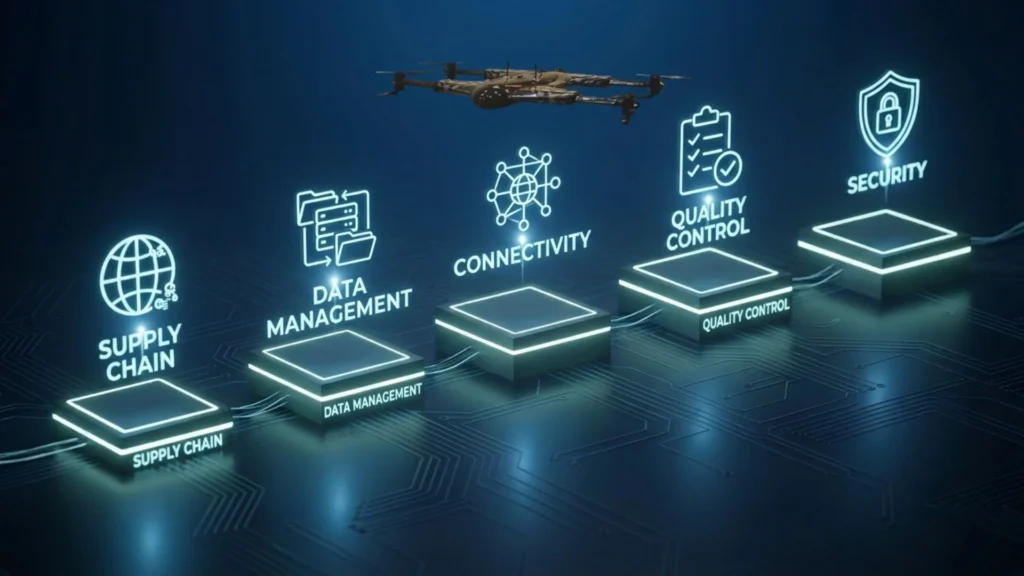
In addition, ZenaDrone emphasizes the importance of security, data management, supply chain visibility, and operational controls for government procurement. However, it’s important to remember that aligning with security requirements does not automatically mean that a platform is Blue UAS cleared. For this matter, buyers should verify the current government list and the applicable requirements before procurement.
The evolution of U.S. drone manufacturing is continuous hence secure development, cybersecurity, traceability, and transparent supply chains remain important for government and enterprise applications.
Future of the Blue UAS Cleared List
The future of secure drone procurement will likely bring together cybersecurity, supply chain verification, autonomous systems, and procurement compliance. The Blue UAS Program is already expanding its approach on evaluation through third-party assessments and direct government review. As drone technology advances, the manufacturers will need a cybersecurity that’s stronger along with a more transparent supply chain, secure autonomous systems, and better compliance monitoring.
Additionally, AI may also assist in tracking the supplier records, component changes, vulnerabilities, and documentation. At the same time, growth in U.S. drone manufacturing could strengthen supply chain resilience and domestic capabilities. Ultimately, the trusted drone manufacturers are required to treat the compliance as not a one-time certification only but an ongoing process.
Conclusion
The Blue UAS Cleared List helps government agencies identify trusted commercial drone systems by addressing cybersecurity, supply chain security, performance, manufacturing, and procurement concerns. Aside from this, it also highlights how important secure development, component traceability, and compliance documentation are for manufacturers.
In addition, agencies must evaluate the requirements based on their acquisition, funding, mission, and agency since NDAA compliant drones are not automatically Blue UAS-listed. Lastly, it’s essential for the trusted drone manufacturers to prioritize a secure drone supply chain, cybersecurity, supplier management, and operational transparency to support government and critical infrastructure inspections. All of these should be considered because of the fact that the market continues to evolve.
Frequently Asked Questions
How can a drone manufacturer qualify for the Blue UAS Cleared List?
Manufacturers must follow the applicable government evaluation process, which may include cybersecurity, NDAA compliance, testing, documentation, and authorization requirements.
Is the Blue UAS Cleared List the same as NDAA compliance?
No. NDAA compliance addresses statutory and procurement requirements, while the Blue UAS process evaluates UAS for government use. NDAA compliance does not automatically mean a drone is on the cleared list.
Can commercial companies purchase Blue UAS-approved drones?
Yes, where commercially available. However, commercial buyers should still evaluate cybersecurity, regulatory, operational, and data requirements.
How often is the Blue UAS Cleared List updated?
The list can change as systems are evaluated, added, removed, or transitioned. Buyers should check the current official list for the latest status.
What happens if a drone no longer meets Blue UAS requirements?
A drone's status may change due to security findings, software or hardware changes, authorization issues, or updated government requirements. Buyers should verify its current status before use.
Why is operational transparency important for drone manufacturers?
It helps customers understand how drones are manufactured, where components come from, how suppliers are managed, and how hardware and software changes are controlled.
What industries benefit from Blue UAS-approved drones?
Defense, public safety, emergency response, infrastructure, utilities, energy, transportation, environmental monitoring, and other government and enterprise operations can benefit.
What should government agencies consider when selecting a Blue UAS-approved drone?
Agencies should evaluate list status, mission needs, cybersecurity, supply-chain risks, NDAA requirements, performance, payloads, data handling, support, and lifecycle costs. List inclusion should complement, not replace, agency-specific procurement review.
Contact Us