


 Deutsch
 Português

How Corporate Ecosystems Accelerate Defense Innovation

Defense technology moves rarely from an idea to an operational capability through the work of one organization alone. Modern requirements can include government agencies, military users, established contractors, startups, universities, investors, software companies, manufacturers, and specialized suppliers. All of these defense ecosystem stakeholders can form a defense innovation ecosystem where different skills, as well as resources, can link a shared problem together.
This blog is all about the corporate ecosystems and how it accelerates defense innovation. Specifically, how the corporate ecosystems bring together companies, government, academia, investors, and other partners to accelerate defense technology development, testing, and adoption.
What Is a Defense Innovation Ecosystem?
A defense innovation ecosystem is a network of both public and private organizations that do the following things: to develop, test, adopt, and improve defense and national security technologies. Additionally, a corporate defense ecosystem has the capability to connect the large companies with startups, universities, investors, government agencies, laboratories, and suppliers. This military corporate ecosystem allows the participants to offer their different capabilities, including research, software, and funding, testing, manufacturing, and operational expertise.
This creates a broader defense technology ecosystem that connects the needs in the military along with commercial innovation. For example, the U.S. defense innovation ecosystem and NATO show how different organizations can connect military, industry, academia, investors, laboratories, and other innovation partners.
Who Participates in the Corporate Defense Ecosystem?
A functioning ecosystem includes participants with responsibilities. These participants are:
Government and Military Organizations
Government and military organizations identify capability gaps, define operational requirements, provide funding, and establish standards, and conduct testing and evaluation.
Defense and Technology Companies
The military corporate ecosystem is relying on the firms that connect different capabilities. For example, large defense firms bring engineering, infrastructure, production, and systems expertise. Technology or tech companies add AI, software, cybersecurity, cloud systems, and also sensors.
Startups and Commercial Innovators
Startups can support private-sector defense innovation by the new ideas, specialized expertise, rapid testing, and the commercial technologies that can be able to complement the existing systems.
Investors, Suppliers, and Industry Partners
Investors can finance development, while suppliers provide components and specialist services. Together, these relationships create defense industry partnerships. Stronger defense industry partnerships can also help connect specialist capabilities.
How Corporate Ecosystems Support Defense Innovation
The practical value of a defense innovation ecosystem is its ability to connect an operational problem with the organizations that can help solve it.
Identifying Defense Capability Requirements
Innovation starts with a clear understanding of the problem. Military users can describe operational constraints, environmental conditions, interoperability needs, and desired outcomes. After that, companies can determine whether an existing commercial technology can be adapted or whether it’s necessary to have a new development.
Combining Commercial and Defense Expertise
Commercial technology can move quickly, while the organizations, on the other hand, understand the requirements for a mission, the security constraints, testing, and the operational integration. This makes commercial technology in defense beneficial when a commercial capability addresses a validated requirement. Adaptation, testing, cybersecurity review, and integration may still be needed.
Supporting Research, Testing, and Technology Development
Universities can contribute scientific expertise, companies can build prototypes, and government organizations can provide test environments as well as user feedback. These defense research and development partnerships can connect the research with practical applications. Strong defense research and development partnerships have the ability to assist the research teams to understand the operational constraints.
Moving Technology toward Operational Readiness
The ecosystem must support testing, integration, training, cybersecurity, and user evaluation. Effective military technology collaboration includes more than developing a technically impressive product. Sustained military technology collaboration is also dependent on user feedback and integration.
The Role of Public-Private Partnerships in Defense
Public-private partnerships in defense create structured relationships between government organizations and private companies. They can give public institutions an access to commercial activities while offering a better understanding of defense requirements to the companies.
Sharing Technical Knowledge and Infrastructure
The laboratories owned by governments, test ranges, research institutions, and private facilities can provide complementary resources. Additionally, companies may bring both specialized engineering and software expertise, while the government organizations can provide operational data, testing environments, or mission context.
Supporting Dual-Use Technology Development
Dual-use technology innovation can serve both commercial and defense applications. AI, sensors, robotics, communications, cybersecurity, and advanced manufacturing are examples of areas where commercial investment can contribute to capabilities relevant to national security.
Connecting Emerging Companies with Defense Stakeholders
A major challenge for smaller companies is understanding how to engage with defense organizations. Innovation hubs, challenge programs, research agreements, and other structured mechanisms can create entry points.
DIU says its OnRamp Hubs are designed to connect funders, founders, talent, academia, and mission partners, while its commercial programs are intended to help move commercial solutions toward defense adoption. These mechanisms illustrate how structured partnerships can reduce some barriers between emerging technology companies and government users and better understand defense needs.
Accelerating Responsible Technology Adoption
Since speed alone is not enough, technology must also be evaluated for security, reliability, interoperability, safety, legal requirements, and appropriate human oversight. The true meaning of a responsible adoption is moving quickly while maintaining both the appropriate evaluation and governance.
Technologies Connecting the Modern Defense Ecosystem
The defense innovation ecosystem is increasingly connected by technologies that support information sharing, automation, and integration.
Artificial Intelligence and Data Platforms
AI is helpful for organizations in terms of processing large datasets, identifying patterns, supporting an analysis, and automated selected workflows. On the other hand, data platforms are capable of helping the teams to organize and share information when access controls, cybersecurity, data quality, and governance are addressed.
Secure Communications and Cybersecurity
Connected systems are dependent on reliable communications as well as protection against unauthorized access or disruption. Cybersecurity needs to be considered throughout the development.
Sensors, Autonomy, and Digital Integration
Sensors are capable of both feeding analytics and decision-support systems. Moreover, autonomous functions can lessen the continuous manual control in selected tasks. On the other hand, the appropriate level of human supervision is dependent on the application and risk.
Advanced Aerospace and Defense Manufacturing
Advanced manufacturing can support prototyping, customized components, and flexible production. If these technologies work together, they can illustrate defense industry innovation as an interconnected process instead of a collection of isolated products.
Building a Resilient Defense Industrial Ecosystem
In terms of a resilient defense industrial ecosystem, it needs more than a large number of supplies. Relationship and contingency are also as important since they both maintain operations when the technology changes, markets shift, and a critical supplier becomes unavailable.
Diverse and Reliable Industry Partnerships
Organizations can lessen the concentration risks by developing relationships with multiple partners that are qualified where appropriate. The goal is to have an understanding of the dependencies and maintain options for critical capabilities.
Shared Standards and Interoperability
Interoperability allows systems from different organizations to exchange information and operate together. The open interfaces, common data structures, and agreed technical standards can make the integration easier.
Workforce and Specialized Expertise
The resilience of the ecosystem can be achieved by the contributing engineers, software developers, cybersecurity specialists, researchers, operators, program managers, and technicians.
Responsible Data and Technology Governance
To build trust, organizations need clear rules for data access, privacy, cybersecurity, intellectual property, testing, and responsible use.
Challenges Facing Defense Innovation Partnerships
A defense innovation ecosystem also creates coordination challenges because its participants operate under different priorities and constraints.
Coordination across Multiple Stakeholders
More participants can mean more expertise, but also more coordination. Projects need defined roles, decision-making authority, and objectives.
Different Commercial and Government Timelines
Commercial companies may move in months, while government programs often take much longer to plan, test, and approve. DIU has described efforts to connect commercial technology with government needs at more commercial speeds, but faster processes do not remove the underlying requirements for evaluation and accountability.
Technology Integration and Interoperability
A promising product may still be difficult to integrate with existing systems. Compatibility, cybersecurity, data formats, communications, maintenance, and training can determine whether a technology becomes useful beyond a demonstration.
Ethical, Security, and Regulatory Responsibilities
Collaborative defense innovation must account for legal obligations, operational safety, cybersecurity, responsible data use, and human oversight.
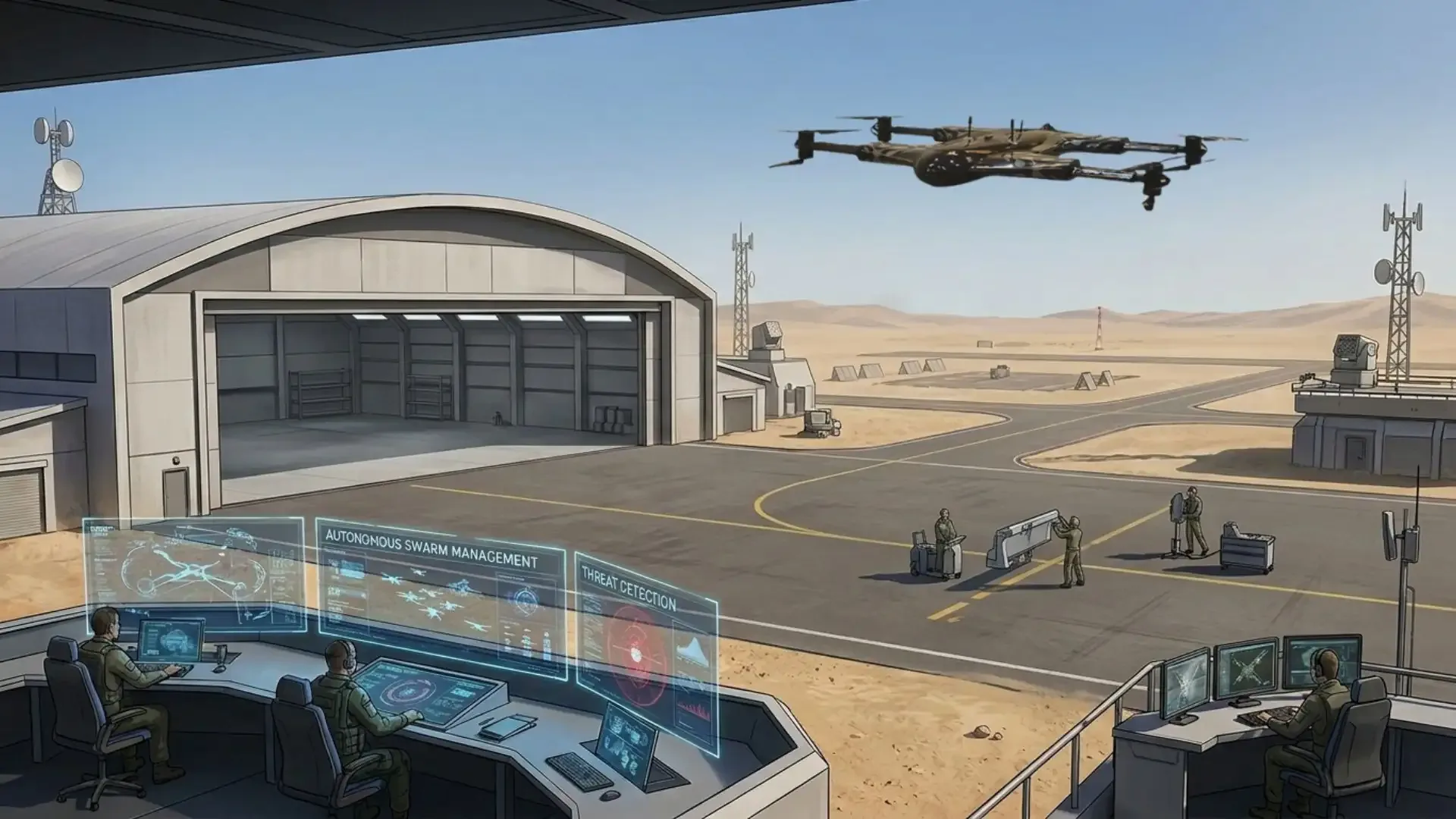
How ZenaDrone Contributes to the Defense Innovation Ecosystem
ZenaDrone contributes to the defense innovation system through AI-enabled technology, machine learning, autonomous flight, data collection, and configurable sensors. Their ZenaDrone 1000 incorporates relevant features to work well, just like AI and machine learning capabilities, autonomous flight functions, and configurable sensor as well as hardware options for applications across multiple industries, including the selected defense-related uses.
The company also joins in the defense technology ecosystem through their engagement with both defense and security organizations, including the DSEI 2023. ZenaDrone's participation in DSEI 2023 shows how the commercial technology companies can both present their capabilities and engage with stakeholders across the defense sector.
The Future of Corporate Collaboration in Defense
The collaboration among commercial companies, researchers, government organizations, and the defense firms is helping connect the defense innovation ecosystem. Greater commercial participation is a catalyst for new ideas. Both research development cycles and modular technologies, on the other hand, can support quicker testing as well as integration.
Industry-academia-government’s collaboration can strengthen research, workforce development, and knowledge sharing. It’s important to have a connected defense technology ecosystem that can bring these groups together. These help the defense innovation ecosystem to grow through stronger partnerships along with responsible technology development.
Frequently Asked Questions
What is a defense innovation ecosystem?
A defense innovation ecosystem connects government, military, commercial, academic, and research organizations to develop, test, and improve defense technologies.
Who participates in a corporate defense ecosystem?
A corporate defense ecosystem includes defense companies, startups, universities, investors, suppliers, and government organizations that contribute expertise, funding, research, and technology.
How do public-private partnerships support defense innovation?
Public-private partnerships in defense connect government needs with private-sector expertise, supporting research, testing, development, and technology adoption.
What role do private companies play in military innovation?
Private companies contribute technologies such as AI, software, sensors, communications, manufacturing, and data platforms to support defense capabilities.
How does commercial technology contribute to defense capabilities?
Commercial technology in defense can provide useful capabilities, but technologies may require testing, adaptation, security measures, and integration before use.
Contact Us
This site is protected by reCAPTCHA and the Google Privacy Policy and Terms of Service apply.