


 Deutsch
 Português
NATO Counter-Drone Defense: How Counter-UAS Technologies Are Shaping Modern Military Operations
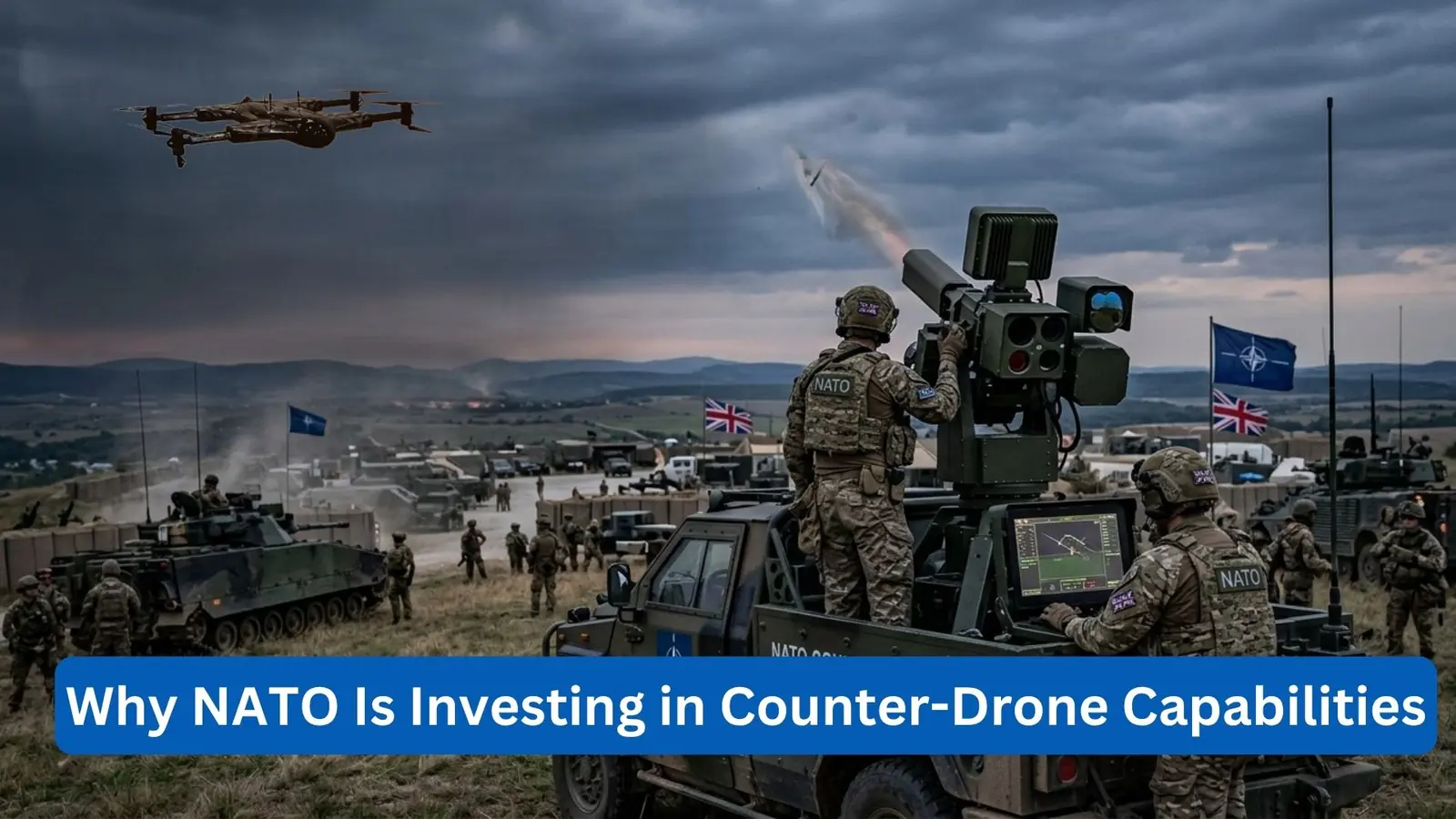
Drones in modern warfare have made low-cost reconnaissance, surveillance, targeting, and attacks but their growing use of drones has risks for security for military borders, transportation hubs, and critical infrastructure. Furthermore, NATO allies announced that they will invest over $40 billion in Counter-drone capabilities over five years through NATO Drone Edge initiative, alongside plans to increase trained drone operators fivefold by the end of 2027.
This initiative would strengthen the NATO counter-drone defense through faster drone detection, identification, tracking, and response. Along with these, it also highlights the Counter-UAS technology’s growing importance, combining sensors, AI, communications, command systems, and response platforms to address evolving drone threats.
To improve the airspace security and make effective responses, modern counter-drone operations should use layered capabilities rather than relying on a single defensive method. In this blog, you will learn how Counter-UAS technology detects and mitigates evolving drone threats using AI, sensors, and layered defense systems.
Understanding Counter-UAS Technology
Counter-UAS technology is the system that is designed to detect, identify, track, and mitigate unmanned aircraft systems.
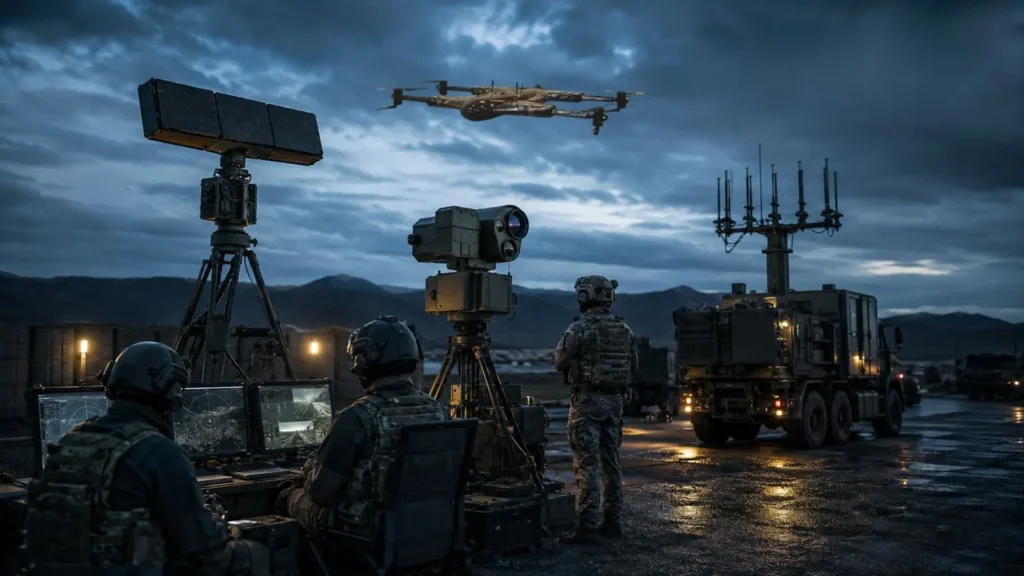
Rather than a single device, Counter-UAS, and C-UAS, encompasses multiple technologies. These can include radar, radio-frequency sensors, electro-optical and infrared cameras, and acoustic sensors. These are reliable when used in detecting and tracking drones when they are together.
Command and control systems then combine sensor data to give the operators a clearer view of the airspace. NATO’s July 2026 C-UAS procurement initiatives reflect this layered approach, combining radar, direction finding, EO/IR, acoustic sensors, electronic warfare, and optional interceptors.
It’s important to remember that depending on the threat and operating environment, counter-drone capabilities can use electronic warfare, physical interception, or other mitigation methods.
-
Drone Detection: Detection establishes that an unmanned aircraft may be present. One of radar’s advantages is that it can provide information about the location as well as the object’s movement, while RF sensing can identify emissions associated with some remotely operated systems.
-
Drone Identification: Identification attempts to determine what the detected object is. EO/IR cameras can provide visual or thermal information that helps operators distinguish a drone from birds, aircraft, or other objects.
-
Drone Tracking: Tracking is a good way to maintain awareness of both the position and movement of an aircraft over time. It’s also important to remember that if sensor data is combined, it can improve situational awareness and help operators understand whether a drone is approaching a protected area.
-
Drone Mitigation: Mitigation is the response stage of the defensive process. Depending on the system and authorization, responses can include electronic warfare and physical interception. There are factors that must be considered to make an appropriate response just like the threat, location, rules of engagement, and potential consequences.
This layered model is central to modern C-UAS architectures because no individual sensor or response method can likely address drone threat. Remember that effective drone defense systems depend on coordinated detection as well as response.
Why NATO Is Investing in Counter-Drone Capabilities
NATO is investing in counter-drone capabilities because inexpensive drones can create significant security threats while forcing defenders to spend more resources detecting and responding to them. Recent conflicts, particularly in Ukraine, have shown how quickly drone warfare is evolving.
As a result, NATO drone defense now goes beyond interceptors. It requires integrated surveillance, command and control, communications, electronic warfare, training, and Drone defense systems capable of handling multiple threats at once.
For NATO counter-drone defense, this creates several priorities:
-
Detecting small and difficult-to-observe aircraft
-
Processing large amounts of sensor data
-
Coordinating systems across different countries
-
Reducing response times
-
Supporting interoperability
-
Scaling procurement and production
-
Training enough personnel to operate increasingly complex systems
NATO's new counter-drone marketplace is intended to support faster procurement by making NATO-tested and NATO-compatible systems easier for Allies to acquire.
The emphasis on interoperability is particularly important. NATO operates across multiple national forces, technologies, communication architectures, and procurement systems. Effective defense therefore, requires systems that can exchange information rather than operate as isolated platforms.
The Technologies behind Modern Counter-Drone Systems
Instead of relying on one detection method, modern counter-drone platforms typically combine several technologies
-
AI-Powered Drone Detection: Artificial intelligence is helpful in processing sensor information and identifying patterns that may be difficult for human operators to recognize quickly. Computer vision can assist with classification of an object, while machine-learning models are helpful in distinguishing potential drone activity from background objects. Moreover, the main goal of AI is to help prioritize information and reduce the amount of repetitive monitoring required rather than eliminating the need for human operators.
-
Radar: Radar is used to provide information regarding the objects in the airspace, including the position, movement, and potentially other characteristics. By its essential role, it can support early detection and tracking, particularly when visual conditions are poor.
-
RF Sensing: RF systems can monitor radio-frequency activity that’s associated with certain remotely controlled drones. They are useful depending on the drone's communications architecture and operating environment.
-
EO/IR Cameras: Electro-optical and infrared sensors can provide both visual and thermal information. EO cameras are useful in daylight identification, infrared systems, on the other hand, support observation in darkness and conditions where the light is low.
-
Acoustic Sensors: Acoustic systems listen for characteristic sounds that are associated with aircraft. They can complement other sensors when particularly used as part of a larger sensor network.
-
Electronic Warfare: Electronic warfare can provide a non-kinetic response against some drone systems by affecting their communications or navigation. This makes Anti-drone technology an important part of layered protection. Its effectiveness varies according to the aircraft, environment, frequency spectrum, and defensive system.
-
Autonomous Surveillance: Autonomous systems are carrying out predefined surveillance tasks and continuously collecting information. Through these, these systems can support persistent monitoring. Defense drone technology is increasingly moving toward systems that can combine autonomous operation with human oversight.
NATO’s 2026 Technical Interoperability Exercise includes over 60 commercial systems as well as 40 command-and-control applications. This just proves the Alliance’s focus on making different technologies work together.
The result is an increasingly integrated approach in which NATO counter-drone defense can draw information from multiple sources before responding appropriately. Additionally, drone defense architectures can also support Military surveillance drones.
Drone Operator Training: Why Human Expertise Still Matters
Human expertise still matters hence technology does not replace trained personnel. Drone operator training is still essential because it is used in understanding sensors, mission objectives, airspace conditions, and system limitations proving that drones become more autonomous. NATO plans to increase trained drone operators fivefold by the end of 2027. This just emphasizes how important human expertise is in modern military drone defense.
Simulations are part of the training as it helps the operators practice decision-making and respond to different scenarios without operational risks. It’s important that the personnel know when to trust automation, verify the information, and intervene even with autonomous systems. This human-machine collaboration remains critical to effective NATO drone defense and modern Drone defense systems.
Challenges in Countering Modern Drone Threats
There are several challenges that Counter-UAS technology faces as unmanned systems become more diverse.
-
Counter-UAS technology must adapt as drone threats become more diverse.
-
Drone swarms can quickly overwhelm defenses.
-
For Small UAVs, detection is harder because of their size and low altitude
-
GPS-denied environments disrupt systems that are relying on satellite navigation.
-
Anti-drone technology must handle more autonomous aircraft with limited direct communication.
Counter-Drone Platforms vs. Traditional Air Defense
Always remember that there are differences that can be observed between the traditional air defense and counter-drone platforms. The key differences outlined below are important.
|
Factor |
Counter-Drone Platforms |
Traditional Air Defense |
|
Cost |
Designed to address low-cost drones without relying only on expensive interceptors |
Often uses high-value systems suited to larger, more costly threats. |
|
Response Time |
Uses automated detection and rapid processing to respond to small drones quickly. |
Designed for threats that are both larger and faster, with established engagement processes. |
|
Detection Capability |
Uses radar, RF, EO/IR, and acoustic sensors. |
Uses radar and other traditional sensors. |
|
Operational Flexibility |
Can protect fixed sites, mobile units, and forward locations. |
Built typically around broader air-defense networks and protected areas. |
AI Advantages
AI can help prioritize sensor information and support classification. It can also help operators manage a larger number of simultaneous tracks. This does not mean conventional air defense is becoming obsolete. Instead, military drone defense is becoming one layer within a broader integrated air-defense architecture.
For NATO counter-drone defense, the long-term direction is likely to be layered protection in which different systems address different threat categories.
How Modern Interceptor Drones Support Counter-UAS Missions
Interceptor aircraft represent one category of defensive response within the broader C-UAS architecture. Rather than relying exclusively on fixed systems or expensive conventional aircraft, interceptor drones can provide another option for responding to certain aerial threats.
-
Autonomous Interception: Autonomous systems can follow a predefined flight logic and navigation instructions. Take note that automation can reduce the workload associated with routine flight operations depending on the platform as well as the authorization framework.
-
AI Navigation: AI-assisted navigation can help an aircraft interpret its environment and maintain an intended flight path. This can be particularly relevant where rapid response is required.
-
Aerial Threat Response: An interceptor drone may provide a mobile defensive layer that can respond to the threat detected. Its role is dependent on its sensors, communications, performance of the flight, and integration with the wider command-and-control architecture.
-
Rapid Deployment: Small autonomous aircraft can potentially be deployed from locations where larger defensive assets would be impractical. This can make them relevant to distributed protection models.
-
Mission Flexibility: Drone defense systems can be configured for different operational environments. Remember that interceptor platforms may complement the fixed sensors, mobile units, and also other response mechanisms.
The development of Counter-UAV solutions reflects this shift toward combining multiple defensive technologies instead of just depending on a single response method. Counter-UAV solutions can support flexible responses across different operating environments.
You must remember that modern interceptors just like the Interceptor Drone P-1 use AI. AI is helpful to support faster responses, autonomous interception, and flexible counter-UAS operations. Interceptor Drone P-1 | Counter-UAS Interceptor System
How AI Is Transforming Counter-UAS Operations
AI is transforming and improving Counter-UAS technology by processing sensor data faster as well as supporting drone detection and classification. AI military drones can coordinate sensing and surveillance across multiple platforms. Aside from these, they can also support edge-based processing. Furthermore, AI helps operators manage threats while keeping humans in control of critical decisions for NATO counter-drone defense.
Industry Impact of NATO's $40 Billion Investment
It’s expected that NATO’s $40 billion investment will boost demand for sensors, command-and-control systems, electronic warfare, communications, interceptors, and AI technologies. Creating opportunities is also one of its benefits. These benefits are for secure, scalable Counter-drone systems and AI military drones that work with NATO networks.
The investment could further strengthen the Defense drone technology ecosystem, from drone manufacturers and software developers to sensor companies and system integrators. The continuous growth of procurement will make Counter-UAV solutions and Anti-drone technology become more important to defense modernization.
What NATO's Investment Means for the Future of Military Drones
The investment of NATO that’s worth $40 billion just proves that both drones and counter-drone systems are becoming a permanent part of modern defense. Additionally, in order to support an AI-enabled battlefield where sensors along with autonomous platforms, communications, and command systems work together, the Drone Edge initiative combines counter-drone investment, expanded operator training, and procurement.
Military surveillance drones will support both the intelligence and situational awareness, while the autonomous systems handle routine monitoring. NATO drone defense will rely on collaborative networks, the swarm defense, and also interoperable systems. It is still essential to do drone operator training because they supervise more autonomous platforms. This means that defense drone technology will depend on connected people, platforms, software, sensors, and data.
Counter-Drone Technology beyond the Battlefield
Counter-drone technology is not limited to military operations. The same detection and response principles can be relevant to environments where unauthorized drones create security, safety, or operational risks.
-
Critical Infrastructure Protection: Power facilities, industrial sites, ports, energy installations, and other critical infrastructure may need tools to identify unauthorized aircraft.
-
Airport Security: Airports require reliable awareness of nearby airspace because an unauthorized drone can create significant safety risks.
-
Border Surveillance: Border agencies can use drone detection technologies to improve awareness of unauthorized aerial activity.
-
Public Safety: Police, emergency responders, and other public-safety organizations may require temporary drone detection around major events and sensitive locations.
-
Smart Cities: As urban airspace becomes more active, cities may need technologies that support airspace awareness and security.
-
Industrial Security: Industrial facilities can integrate sensors and command systems to monitor protected airspace around sensitive sites.
Even with advanced detection systems in place, most of these sites still depend on licensed personnel to respond on the ground — control-room CCTV operators, door supervisors, and SIA-badged security guards who complete formal SIA security training courses covering surveillance, access control, and incident response.
These applications show why NATO counter-drone defense developments can have implications beyond military bases. Counter-UAV solutions can also support protected-site monitoring. The same underlying technologies can contribute to broader airspace security.
The growing use of Counter-UAS technology in civilian and industrial contexts will depend heavily on local regulations, privacy requirements, safety considerations, and appropriate authorization.
The Future of Counter-UAS Technology
The future of Counter-UAS technology will focus on greater automation, interoperability, and sensor integration. AI-powered systems and Edge AI can process sensor data faster, while collaborative drone networks can share information across multiple platforms. Counter-swarm technology will also become increasingly important as operators deploy larger numbers of drones.
NATO counter-drone defense is moving toward integrated systems that connect sensors, AI, communications, command platforms, and autonomous defenses. Stronger interoperability and Drone operator training will remain essential as systems become more automated. Ultimately, Defense drone technology and Drone defense systems will need to work as coordinated networks rather than isolated platforms.
Frequently Asked Questions
What is NATO counter-drone defense?
NATO counter-drone defense covers the Alliance's efforts to detect, track, identify, and neutralize hostile drones. NATO's Drone Edge initiative includes over $40 billion in investment.
What are Counter-UAS systems?
Counter-UAS systems detect, track, identify, and mitigate drones using technologies such as radar, RF sensors, EO/IR cameras, acoustic sensors, and electronic warfare.
Why is NATO investing $40 billion in counter-drone capabilities?
The investment aims to strengthen NATO's readiness against the growing use of small, inexpensive, and increasingly advanced drones.
How do AI-powered counter-drone systems work?
AI analyzes sensor data to classify objects, detect threats, identify unusual activity, and support faster operator decisions.
What technologies are used to detect drones?
Common technologies include radar, RF sensing, EO/IR cameras, acoustic sensors, and command-and-control systems.
What is the difference between drone detection and drone mitigation?
Detection identifies and tracks a potential drone. Mitigation uses measures such as electronic or physical responses to address the threat.
How do drone swarms challenge military defense?
Large numbers of drones can overwhelm conventional defenses, requiring scalable detection, tracking, and response capabilities.
Can counter-drone technology protect critical infrastructure?
Yes. It can help protect airports, energy facilities, industrial sites, ports, and other sensitive locations, subject to applicable regulations.
How does drone operator training improve defense readiness?
Drone operator training helps personnel operate aircraft, interpret sensor data, plan missions, and manage automated systems safely and effectively.
What role does AI play in modern counter-UAS systems?
AI supports sensor fusion, object classification, anomaly detection, image analysis, and faster threat assessment.
How can autonomous drones improve military surveillance?
Military surveillance drones can provide persistent observation and data collection with less continuous manual control.
What industries benefit from counter-drone technology?
Military, aviation, energy, infrastructure, industrial, public-safety, and security organizations can benefit from counter-drone technology.
Contact Us
This site is protected by reCAPTCHA and the Google Privacy Policy and Terms of Service apply.