



Drone Detection Systems: How They Work and Why They Matter
Drones have become increasingly powerful instruments with numerous Applications. They can carry products to your door, provide beautiful aerial pictures and possibly assist security operations. But the increasing sophistication of drone technology also raises risk factors. Drones could be misused by criminals for illegal operations such as surveillance, smuggling and breaching restricted locations. These threats provide real security challenges for sensitive locations including industrial plants, private sector, airports, correctional facilities and major public venues such as stadiums and concert halls.
Drone Detection system is required to control these dangers. Identify, locate and respond to unlawful drones. These Systems let enterprises to protect people, property and essential infrastructure
What Is Drone Detection?
Advanced Drone detection system is the process of identifying and tracking UAV in restricted areas such as airspace. Detection systems can judge the type of drone, its source and whether it poses a potential threat. This capability is critical, as unauthorized drones can break privacy, destroy public gathering, cause accidents or even target critical areas such as power grids and data centers. In the defense environment, response drone detection systems are essential for national security and military protection. Drones are small, quiet and frequently operate inside normal visibility. It is very difficult to detect with the naked eye, or standard cameras. This is why advanced, multi-layered detection technologies are vital for effective monitoring and security.
Why Drone Detection Is Becoming Essential
The rapid increase in commercial and recreational drone activities is transforming the way industries view airspace security. Drones are a great tool for photography, inspections, mapping and logistics – but they may also be a hazard if used without permission.
Illegal drone activity can interrupt airport operations, threaten sensitive facilities, interfere with public events and cause safety issues near critical infrastructure. As drones becoming cheaper and more powerful, companies need dependable ways to monitor low-altitude airspace and identify possible hazards before they escalate.
Drone detection systems provide this visibility by constantly monitoring the surrounding airspace, so security professionals can know what’s flying around, where it came from, and if it needs attention or a response.
Drone Detection vs Counter-UAS Systems
Drone detection and counter-UAS are terms frequently use synonymously, while they are different.
This paper develops a drone detection system that detects, tracks and analyzes drone activity in a protected zone. The main aim is to give situational awareness by identifying the locations, movements and features of surrounding flying drones.
A Counter-UAS (C-UAS) system takes a step further, integrating detecting technologies with authorized response capabilities. These features may include tracking, graphical verification, incident reporting, and authorized mitigation procedures as required by local regulations. Since companies cannot successfully respond to a drone danger until they know it exists, drone detection is the core of any airspace security strategy.
Types of Drone Detection Systems
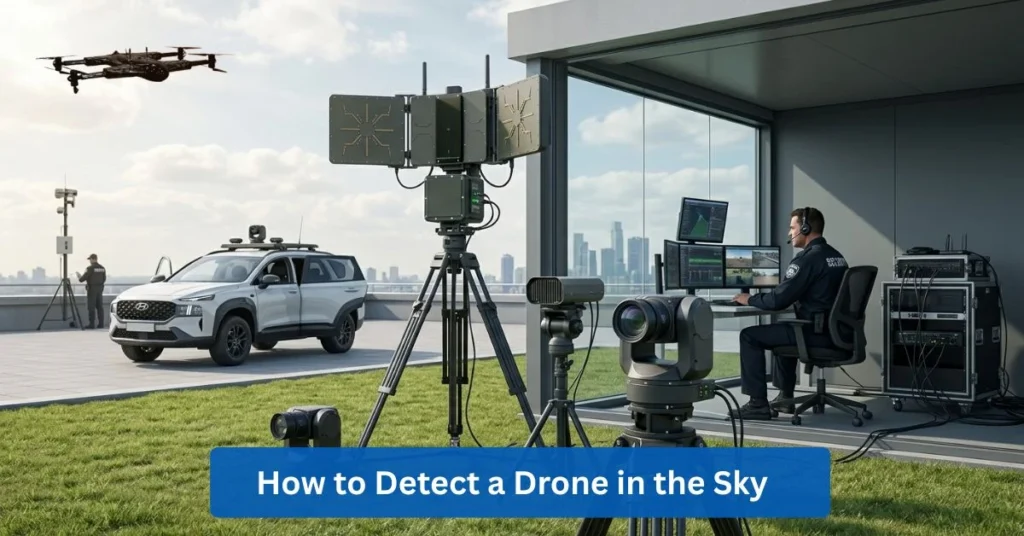
A drone detection system relies on multiple technologies to provide comprehensive security. Since no single method can catch every drone, a layered approach is the most effective way to identify and track unauthorized aircraft.
Radio Frequency (RF) Detectors
- Most commercial drones communicate with their operators using RF signals.
- RF sensors scan frequency ranges (typically 70 MHz to 6 GHz) for these transmissions.
- They can detect the drone pilot link, identify the drone’s location, path, and manufacturer, and even whitelist authorized drones.
Acoustic Sensors
- Function like highly sensitive “ears” that recognize drones by their propeller sounds.
- Directional acoustic arrays with machine learning can track drone type fixed-wing or rotary.
- Helpful for covering gaps when RF or radar detection is blocked.
Radar Systems
- Radar sensors spot small airborne objects by sending out radio waves and analyzing reflections.
- Advanced method differentiate drones from birds or debris.
- Specifically effective for autonomous drones or swarms that bypass RF detection.
Optical & Thermal Cameras
- PTZ (pan-tilt-zoom) cameras provide visible confirmation once other sensors detect a drone.
- AI powered tracking helps zoom in on the target and capture witness, including payloads.
- While visual tracking can be challenging, it’s crucial for real-time monitoring and Evidence

Why Multi-Sensor Detection Delivers Better Results
No single detection technology can identify every drone under all operating conditions. Different drones use different communication methods, flight patterns, and navigation systems, which means relying on one sensor type can create blind spots.
A multi-sensor approach combines several technologies into a unified detection platform. For example, radar can detect physical drone movement, RF sensors can identify communication signals, acoustic sensors can recognize drone sound signatures, and optical cameras can provide visual confirmation.
By combining multiple sources of information, organizations gain greater detection accuracy, improved tracking performance, and fewer false alarms. This layered approach provides a more complete understanding of airspace activity and allows security teams to respond with greater confidence.
Challenges in Drone Detection
Drone detection has become an essential component of modern security strategies as organizations seek to protect critical infrastructure, public spaces, and sensitive facilities from unauthorized drone activity. By combining technologies such as RF detection, radar, acoustic sensors, and optical or thermal tracking, organizations can establish a comprehensive airspace monitoring capability that delivers early warning and enhanced situational awareness. While challenges such as RF congestion, environmental conditions, terrain obstacles, and evolving drone technologies continue to impact detection efforts, advances in sensor fusion, artificial intelligence, and integrated security platforms are helping improve accuracy and response capabilities. As drone adoption continues to grow, investing in flexible and scalable drone detection solutions is critical for maintaining airspace security, protecting valuable assets, and preparing for future aerial threats.
Frequently Asked Questions (FAQ’s)
How to Detect Drones?
Drones can be detected using several technologies, including radio frequency (RF) sensors, radar systems, acoustic sensors, and optical or thermal cameras. RF sensors identify communication signals between a drone and its controller, while radar detects physical objects in the air. Acoustic sensors recognize drone sound signatures, and cameras provide visual confirmation. Modern drone detection systems often combine multiple technologies to improve accuracy and reduce false alarms.
How to Detect a Drone in the Sky?
Detecting a drone in the sky can be challenging because drones are often small, fast, and difficult to see from a distance. Professional drone detection systems use radar, RF detection, thermal imaging, and AI-powered cameras to identify and track drones in real time. These technologies can detect drones beyond the range of human vision and provide continuous airspace monitoring.
How to Detect Drones Nearby?
To detect drones nearby, organizations typically deploy RF sensors, radar systems, or multi-sensor drone detection platforms. RF sensors can identify communication signals transmitted by nearby drones, while radar detects their physical presence in the air. Advanced systems combine these technologies with cameras and analytics software to provide real-time alerts and tracking information whenever an unauthorized drone enters a protected area.
How Do Drones Find Their Target?
Drones can find their targets using a combination of GPS navigation, onboard sensors, cameras, and pre-programmed flight paths. Some drones are manually controlled by operators who guide them using live video feeds, while others use autonomous navigation systems to follow specific coordinates or waypoints. Advanced drones may also use computer vision and artificial intelligence to identify and track objects during flight.
How to Detect Drones at Night?
Detecting drones at night requires technologies that do not rely solely on visible light. Thermal imaging cameras are commonly used because they detect heat generated by drone motors and electronics. Radar and RF detection systems can also operate effectively in darkness, helping security teams identify and track drone activity 24/7 regardless of lighting conditions.
How to Detect Drone Frequency?
Drone frequency detection is typically performed using radio frequency (RF) sensors that monitor wireless communication bands commonly used by drones and their controllers. These sensors analyze signals across various frequency ranges and can often identify the drone type, manufacturer, and direction of the signal source. RF detection is one of the most widely used methods for identifying drone activity in real time.
How to Check Drone Airspace Restrictions?
Drone airspace restrictions can be checked using official aviation authority resources and drone flight planning applications. In the United States, operators can use FAA-approved tools such as B4UFLY and LAANC services. Other countries provide similar platforms through their civil aviation authorities. These tools help users determine whether a location is within restricted, controlled, or no-fly airspace before operating a drone.Top of Form
Contact Us

Thank you for your message. It has been sent.