


 Deutsch
 Português
Global UAV Market Size and the Rise of Military Drone Technology
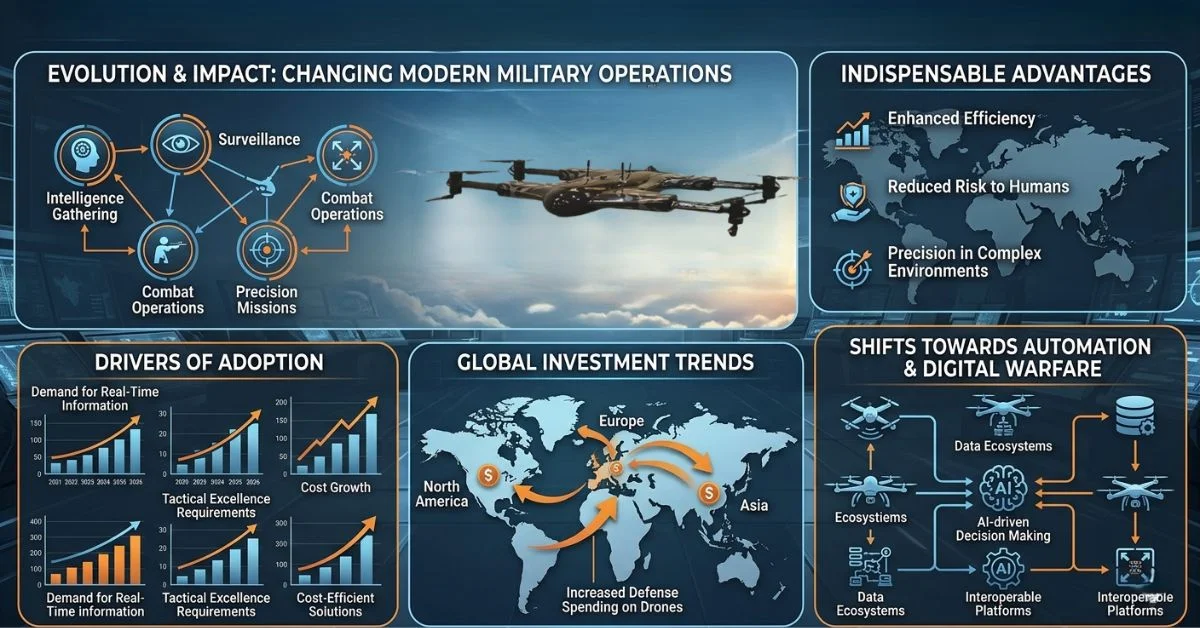
The global UAV military market has evolved rapidly into becoming one of the most dynamic sectors within the defense industry. Unmanned Aerial Vehicles (UAVs), also known as drones, have changed how modern militaries operate, gather intelligence, and execute missions. From surveillance to combat operations, drones for military use are the tools deemed to be indispensable in terms of enhancing efficiency, lessening risk to humans, and allowing precision in complex environments.
The cause of the increasing adoption of UAVs in military operations is because of the importance of having real-time information, tactical excellence, and cost-efficient solutions.
Governments in the world are also investing a lot in military drones to realize their potential in transforming modern warfare. In addition, the growing reliance on UAV drones in military platforms signals a broader shift to automation and digital warfare ecosystems. To understand what military drones are used for, begin with their versatility. The goal of this blog is to provide sufficient information about the market size of UAVs globally and the reasons why there is a rise of military drone technology use.
Military Drone Market Size and Growth Forecast (2025–2035)
The UAV military market is set to flourish in the years 2025-2035 due to the technological developments and the rising defense spending. The analysts predict a stable compound annual growth rate (CAGR) fueled by the need to find next-generation drones for the military.
This growth trend can be attributed to a number of factors:
- The increasing complexity of international conflicts has intensified the demand for UAV military use systems that can be deployed to contested environments.
- The use of artificial intelligence, sensors, and communication technologies have advanced drone capabilities, making them more reliable and effective.
The future of drones in the military is closely tied to the developments of autonomy and swarm technology. The developments enable several drones to plan their movements in real time, which improves the results of missions. Consequently, defense agencies are now giving more importance to investments in scalable UAV systems capable of accommodating the various operational requirements.
Furthermore, the affordability of UAVs as compared to conventional aircrafts continues to drive adoption. Governments are realizing that how the military uses drones not just ends in combat but also in training, logistics, and disaster response and border security.
Key Drivers Accelerating the Military Drone Market
Rising Global Defense Budgets
The unremitting growth of defense expenditure in the world is one of the main factors driving the UAV military market. Countries are allocating budgets to modernize their armed forces with a strong focus on military drone technology. This tendency can be seen as an indication of increasing prominence of UAVs in the preservation of strategic advantage.
With nations investing in drones for military use, there is a growing preference to use systems with increased endurance, payload capabilities, and operational flexibility. These are not solely investments to enhance the defense capability, but also to enhance innovation in the industry.
Geopolitical Conflicts and Security Needs
The presence of ongoing geopolitical tensions and the conflicts within the region have affected the adoption of UAV in military operations. UAVs allow surveying and making precise strikes without endangering people's lives.
Understanding how drones are used in the military becomes clearer in conflict scenarios. UAVs are deployed during conflicts because of its intelligent way of gathering data, target identification, and real-time monitoring of a battlefield.
Additionally, the emergence of asymmetric warfare has heightened the need to have flexible and scalable UAV military use solutions. From the term "asymmetric”, asymmetric warfare describes a conflict where the opposing sides are not matched (asymmetrically) fairly in terms of military power, resources, or strategy. These systems are able to adjust to unconventional threats, making them essential for modern defense strategies.
Increasing Demand for Surveillance (ISR)
The main role of UAVs is Intelligence, Surveillance and Reconnaissance (ISR). In fact, what is often the primary use of a military drone is often answered with ISR operations. Real-time situation awareness and decision-making are improved by UAVs because they offer continuous data.
The need to have ISR increased since the military requires continuous and precise information to make quick and safe decisions. This pushed developers to design more sophisticated sensors with high-resolution cameras, can operate under any condition, and transmit real-time information. Such inventions have greatly enhanced the performance of UAV drones military platforms. As a result, ISR still serves as the key growth driver in the UAV military market, with defense agencies heavily investing in systems that can be deployed in various environments.
Integration of AI and Autonomous Systems
Military drone technology is transforming with the incorporation of artificial intelligence. The artificial intelligence allows the drones to analyze large volumes of data, make independent decisions, and respond to changing situations in real-time.
This has increased the scope of military drone technology so that more complicated and synchronized operations can now be conducted. Additionally, the UAVs can be flown autonomously, with little human intervention, the response time decreases, and efficiency is amplified. FPV drones military applications are also evolving with the innovation of AI-powered systems, which allow a greater range of control, navigation, and targeting.
Drone Market Segmentation and Industry Breakdown
By Type: Fixed-Wing, Rotary-Wing, and Hybrid Drones
The types of drones in the military can be broadly categorized into fixed-wing, rotary-wing, and hybrid systems.
- Fixed-wing drones are known for their long endurance and are commonly used in ISR missions.
- Rotary-wing drones have the advantage of vertical takeoff and landing capabilities, which is why they are used in the tactic in small areas.
- Hybrid drones have the advantages of both systems and provide versatility and efficiency in various mission-related situations.
These varied designs emphasize the versatility of UAV military applications to varied operational needs.
By Application: ISR, Combat, and Logistics
There are three main purposes that can be identified in order to understand what military drones are used for. These are the ISR, combat, and logistics.
ISR is still the most commonly used one, and it serves to make important strategic decisions. The combat drones have weapons systems to make precision attacks and the logistics drones are deployed to deliver supplies and equipment. The growth of such applications shows how drones are used in the military beyond conventional applications, such as their versatility and strategic value.
By Region: North America, Asia-Pacific, and Others
The UAV military market is geographically diverse, being actively operating in North America, Asia-Pacific, among other regions.
North America is the most innovative and deployed technology and Asia-Pacific is rapidly growing as investments in defense are rising. UAVs are also being embraced by other parts of the world in order to improve their security. This local diversification reflects the need of drone technology by the military on the global stage and the widespread use of these UAV technology.
Drone Market Share by Company and Key Industry Players
The UAV military market is very competitive with a number of major players ruling the market. These companies are actively involved in research and development to improve their military drone technologies.
The major defense contractors and new technology companies are in a race to invent new sophisticated UAV systems capable of supporting the emerging demands of the modern armies. They are particularly concerned with innovation, reliability, and scalability hence fueling the general market development. With the increased competition, firms are looking into alternative ways to be able to distinguish themselves, such as incorporation of AI, sophisticated sensors, and self-driving functions.
Role of AI in Transforming Military Drone Technology
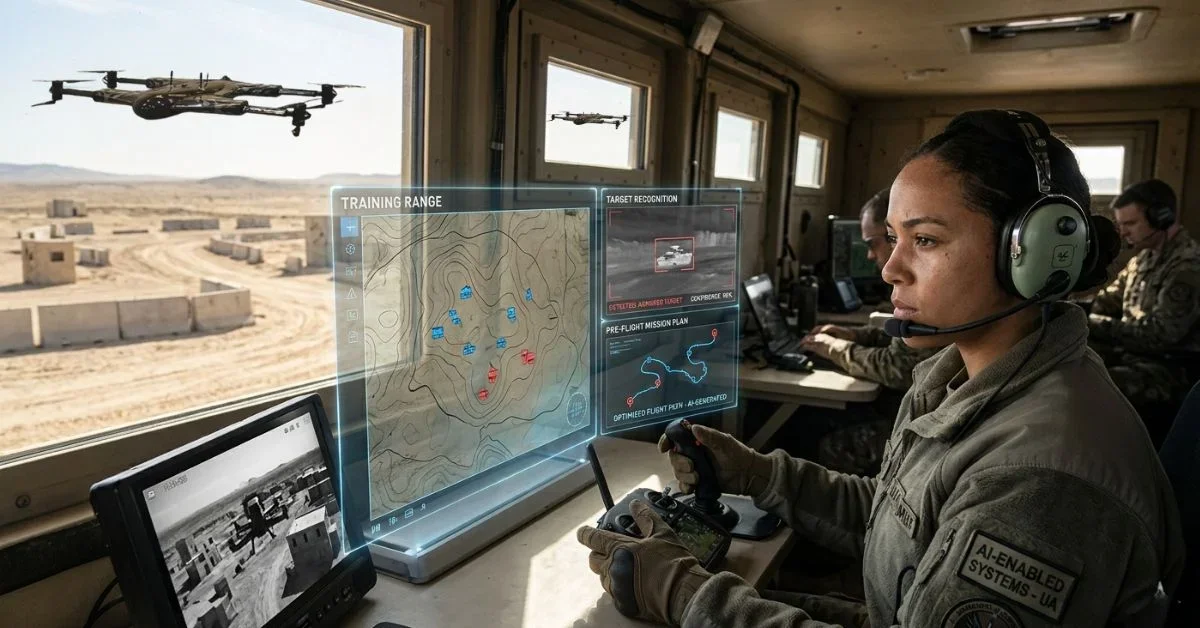
Artificial intelligence is at the forefront of transforming UAV military capabilities. With AI-driven solutions, drones can analyze information, recognize patterns, and make decisions on the fly.
This change has greatly expanded the ways in which the military utilizes drones, giving it the ability to execute more advanced and well-coordinated missions. UAVs are more efficient and effective due to the power of AI in improving navigation, identifying targets, and planning missions.
It is also important to know that AI also contributes to the development of FPV drones in the military sphere, allowing it to give real-time control and also enhance situational awareness. These innovations are transforming the future of military drones and redesigning the role of UAVs in modern warfare.
Commercial UAV Market vs Military Drone Market
Although the technologies used in both areas are similar, the commercial UAV market and the UAV military market have different purposes.
Agriculture, delivery, and photography are the most frequent uses of commercial UAVs, but the drones employed in the military context are supposed to be utilized in defense and security operations. Military drone requirements are much more intricate and require such sophisticated features like stealth, endurance, and precision targeting.
Having a knowledge about the dissimilarities of the different given markets provides insight into what military drones are used for , exceptional challenges, and prospects in the defense industry.
How ZenaDrone Fits into the Evolving UAV Market
- AI Innovation and Autonomous Systems: ZenaDrone is becoming a new powerhouse in the UAV military industry, using AI and autonomous systems to generate innovative UAV solutions. Its innovative orientation can be attributed to the increased need of intelligent and adaptive UAV military use platforms.
- Proprietary Drone Technologies: The proprietary technologies that the company possesses provide better abilities of its UAV systems to work in the field that needs surveillance, data collection, and operation efficiency. These innovations are part of the overall development of military drone technology.
- Competitive Positioning in the Market: The strategic positioning of ZenaDrone in the market is the dedication to innovations and its capability to meet the evolving needs of the modern military. With its emphasis on innovative solutions, the company can be regarded as being well-positioned to take advantage of the UAV military market expansion.
Future Trends in the Military Drone Market
Several emerging trends determine the future of drones in the military. These are the creation of autonomous systems, integration of AI, and the growth of drone swarm technology. Some of the trends that can be identified include the increasing popularity of FPV drones military application, which has increased control and real-time feedback. These systems come in handy especially within dynamic and high-risk settings.
The emphasis on sustainability and energy efficiency is another trend, and manufacturers have been experimenting with alternative energy sources and lightweight materials. With further advancement of technology, UAVs will become increasingly important in military operations, which will only further solidify their significance in contemporary defense strategies.
Conclusion: The Expanding Role of UAVs in Global Defense
The UAV military market has a great potential to grow because of the developments in technology and the growing defense spending that is encouraging innovation. The UAVs have become an inseparable part of the modern military, providing opportunities in surveillance, combat and logistics.
The application of drones in the military shows its flexibility and military significance. UAVs are transforming the future of warfare, whether it is ISR operations or autonomous missions.
As the industry continues to evolve, AI and autonomous systems will have a significant influence on the future of military drone technology. The continuous growth of UAV’s role emphasizes its significance in the global security and effectiveness of its operation.
Contact Us
This site is protected by reCAPTCHA and the Google Privacy Policy and Terms of Service apply.