


 Deutsch
 Português
Perimeter Security Drone: How Drone-Based Site Security Works
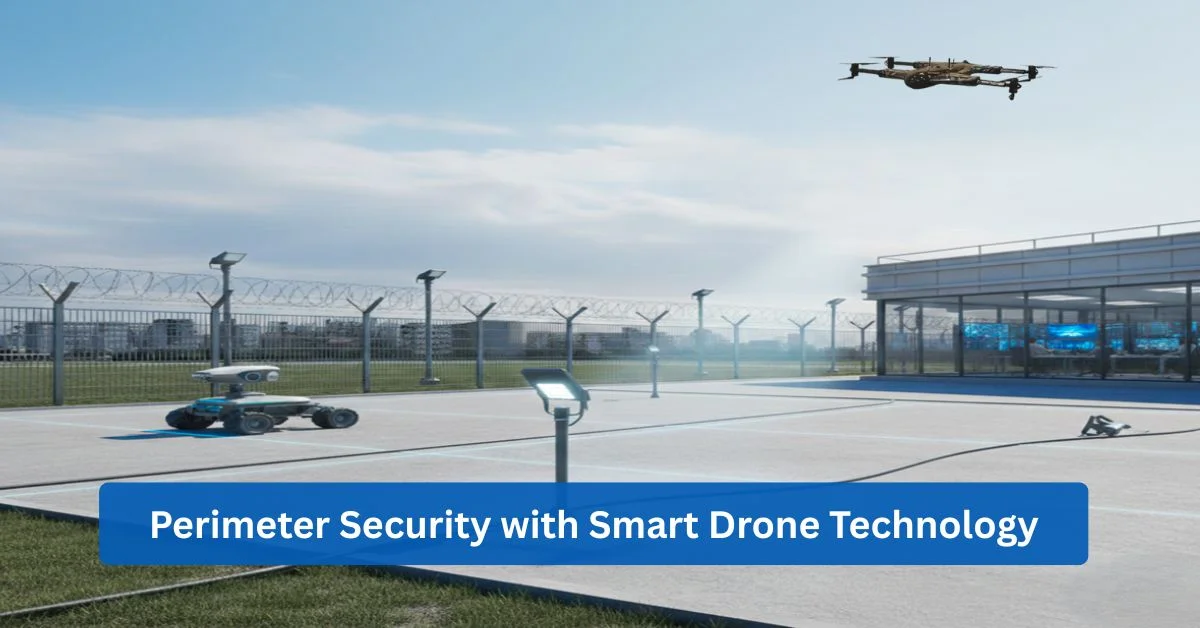
A perimeter security drone gives security teams a mobile aerial view of large and difficult-to-monitor properties. Instead of relying only on fixed cameras, fences, motion sensors, access control systems, and ground patrols. Organizations can use drones to inspect perimeter areas, investigate alarms, and provide live video to security personnel.
This approach can be particularly useful for industrial facilities, warehouses, solar farms, construction sites, utilities, data centers, logistics centers, airports, and other large properties where fixed surveillance may leave blind spots and where reaching an alarm location by ground takes time.
A perimeter security drone does not replace traditional security infrastructure. Its value comes from adding a mobile surveillance layer that can work alongside cameras, sensors, alarms, and trained security personnel.
What Is a Perimeter Security Drone?
A perimeter security drone is an unmanned aerial vehicle (UAV) used to monitor and inspect the outer boundary and other security-sensitive areas of a protected site.
Depending on the system and applicable regulations, a security drone may follow scheduled patrol routes and be dispatched when another security system generates an alarm.
For example, if a perimeter sensor detects movement near a remote fence line, security personnel may use a drone to obtain an aerial view of the area. The video can help operators determine whether the activity involves a person, vehicle, animal, employee, and another event requiring investigation.
A typical drone-based perimeter security system may include:
- An unmanned aerial vehicle (UAV)
- RGB or electro-optical (EO) camera
- Thermal imaging camera
- Drone docking or charging station
- Flight management software
- Video management system (VMS)
- Alarm or security management platform
- Secure communications
- A remote pilot or trained operator
The exact configuration depends on the site, security requirements, operating environment, and aviation regulations.
How Does Drone Perimeter Security Work?
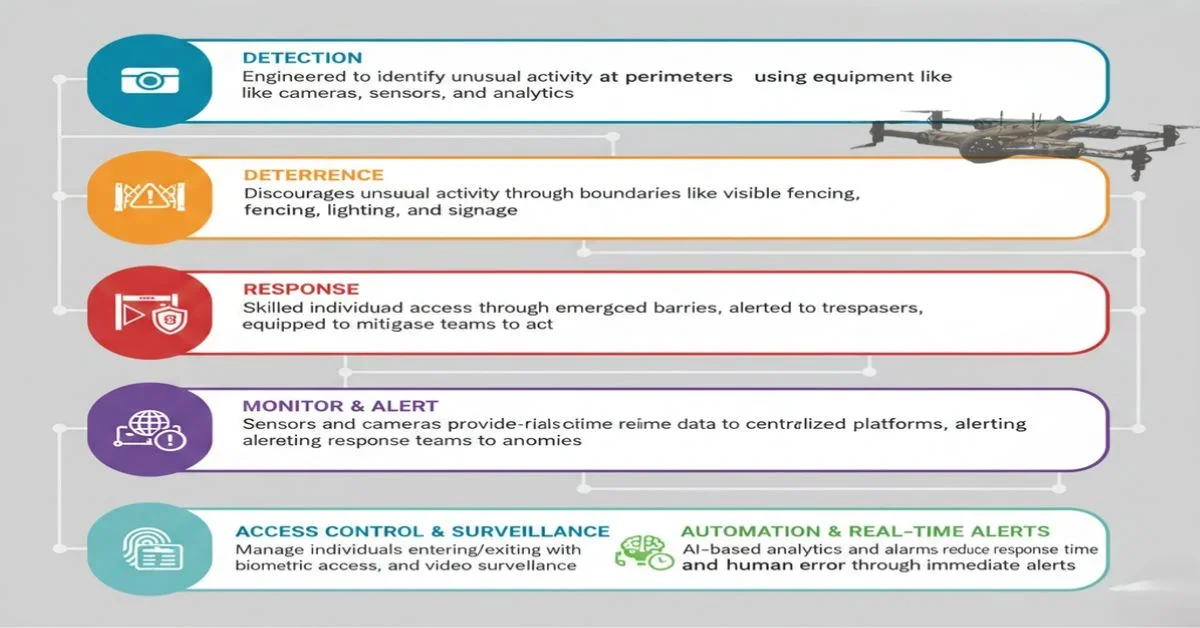
Drone perimeter security combines aerial surveillance with existing physical security systems.
The initial alert may come from a fence sensor, CCTV analytics, radar, access control system, motion detector, or another perimeter intrusion detection technology.
Instead of immediately sending personnel across a large property, the security team can use a drone to obtain additional visual information about the affected area.
Scheduled Perimeter Patrols
Security drones can be used for scheduled patrols around fences, gates, storage areas, access roads, restricted zones, and other important parts of a property.
Preplanned waypoints can define the drone's route and the areas its camera should observe.
This is particularly useful for large sites where routine ground patrols may require significant time. A drone can provide an aerial perspective of multiple sections of the perimeter while security personnel continue monitoring the wider operation.
Scheduled flights can also help teams inspect the same locations repeatedly, making it easier to identify changes such as fence damage, open gates, unexpected vehicles, or activity in restricted areas.
Alarm Verification
Alarm verification is one of the most practical applications of a perimeter security drone.
Traditional security systems can generate alerts because of people, vehicles, animals, weather, vegetation, and other environmental conditions. An alert alone may not provide enough information to determine what is happening.
A drone can be dispatched toward the alarm location and provide live aerial imagery to security personnel. Operators can then use that additional information to assess the situation and determine an appropriate response.
Drone-based verification does not eliminate false alarms, but it can provide another source of visual information before personnel are sent into an area.
Autonomous Drone Operations
Some perimeter security systems use a drone-in-a-box or automated docking station.
The drone remains inside a protected station between missions, where the aircraft may recharge and prepare for another flight.
Depending on the system, an approved mission can allow the drone to launch, follow a predefined route, collect imagery, return to the docking station, and land.
Automation, however, does not remove regulatory responsibilities. Operator supervision, airspace requirements, operational approvals, and other aviation rules vary by jurisdiction and type of operation. Organizations should evaluate these requirements before deploying autonomous or remotely operated security drones.
Key Technologies Used in Perimeter Security Drones
The effectiveness of a perimeter security drone depends on more than the aircraft itself. Cameras, navigation, communications, software, analytics, and integration with existing security systems all contribute to the overall solution.
EO and RGB Cameras
Electro-optical (EO) and RGB cameras provide visual imagery during daylight and suitable lighting conditions.
They can help security teams inspect people, vehicles, gates, fences, buildings, storage areas, and other parts of a site from an aerial perspective.
Camera zoom and stabilization capabilities can also help operators examine an area without positioning the aircraft unnecessarily close to the object being observed.
Thermal Imaging for Night Surveillance
A drone with a thermal camera detects differences in heat rather than relying entirely on visible light.
Thermal imaging can help security personnel locate people, vehicles, and other heat-producing objects in darkness or certain low-visibility conditions.
This capability can be useful around remote fence lines, substations, industrial facilities, solar farms, utility infrastructure, and other areas requiring nighttime monitoring.
Thermal imagery should still be interpreted by trained personnel. A heat signature alone does not establish that an intrusion and security incident has occurred.
AI-Based Video Analytics
Artificial intelligence and computer vision can assist security teams by analyzing visual information and highlighting activity that may require attention.
Depending on the system, video analytics may support:
- Person detection
- Vehicle detection or classification
- Movement tracking
- Restricted-zone monitoring
- Object classification
- Comparison of repeated patrol imagery
Analytics can help operators review large amounts of surveillance information, but automated detection is not perfect.
Environmental conditions, image quality, distance, viewing angle, and other factors can affect results. Human verification therefore remains important when an automated alert could lead to a security response.
GPS, GNSS, and Geofencing
GPS and other GNSS technologies can support repeatable flight routes, waypoint navigation, and return procedures.
Geofencing can also help keep missions within designated operating areas. Some drones additionally use obstacle detection or avoidance systems to assist flight operations.
For security-critical facilities, operators should also plan for situations in which positioning, navigation, and communications become degraded or unavailable.
Benefits of Perimeter Security Drones
The primary advantage of drone-based perimeter security is mobility.
Fixed cameras provide visibility from predetermined locations. A drone can change its altitude, position, viewing angle, and camera direction according to the situation.
Faster Situational Awareness
When an incident occurs in a remote part of a large property, reaching the location by foot or vehicle may take time.
A security drone can provide an aerial view that helps operators understand what is happening before or while ground personnel respond.
This can be valuable at:
- Solar farms
- Industrial facilities
- Warehouses and logistics centers
- Utilities and substations
- Construction sites
- Ports
- Mines
- Agricultural properties
- Large commercial facilities
The goal is not simply to reach an area faster, but to provide security teams with better information for making response decisions.
Flexible Coverage of Large Properties
A perimeter security drone can inspect locations that may be difficult to cover continuously with fixed cameras.
These may include:
- Remote fence lines
- Damaged fencing
- Open or unsecured gates
- Access roads
- Parking and vehicle areas
- Storage yards
- Rooftops and building edges
- Critical infrastructure
- Areas obscured from fixed cameras
This flexibility can complement permanent surveillance infrastructure without requiring a camera to be installed at every possible observation point.
Reduced Exposure for Security Personnel
An aerial view can allow personnel to evaluate an uncertain situation before approaching it physically.
If an alarm occurs in a remote or potentially hazardous location, the drone can provide initial visual information while trained personnel determine the appropriate response.
A drone should not be considered a substitute for emergency procedures or physical response teams, but it can improve the information available to them.
Integrating Perimeter Security Drones with Existing Security Systems
A perimeter security drone is generally most useful when it operates as part of a layered physical security system.
Depending on technical compatibility, drones may work alongside:
- CCTV surveillance
- Video management systems
- Perimeter intrusion detection systems
- Ground-based radar
- Motion sensors
- Access control systems
- Alarm management platforms
- Security operations centers
For example, a sensor may identify activity in a specific security zone. That event can give an operator the location to investigate, while the drone provides an additional aerial perspective.
Integration is therefore an important consideration when evaluating a drone security system. An advanced aircraft provides less operational value if its information cannot be incorporated effectively into the organization's existing security procedures.
ZenaDrone for Perimeter Security
ZenaDrone provides drone solutions that can support perimeter security and site surveillance across large or difficult-to-monitor areas. With aerial monitoring capabilities, ZenaDrone can help security teams improve visibility, inspect remote sections of a property, and support more informed responses to potential security incidents as part of a broader perimeter protection strategy.
Challenges and Limitations of Perimeter Security Drones
Drones add useful capabilities, but they also have operational limitations that should be considered during system design.
Weather Conditions
High winds, heavy rain, extreme temperatures, poor visibility, and other environmental conditions can affect drone operations.
Weather resistance varies between aircraft, so organizations should evaluate expected site conditions against the operating limits specified for the system.
A perimeter security plan should also include alternative surveillance and response procedures for periods when drone flights are not appropriate.
Battery Endurance
Battery capacity limits how long most security drones can remain airborne.
Flight endurance can also change according to payload, temperature, wind, mission profile, battery condition, and other factors.
Docking stations and automated charging can support repeated missions, but battery management remains an important operational consideration.
Communications and Network Coverage
Reliable communications are essential for command, telemetry, video transmission, and remote monitoring.
Large industrial properties may contain buildings, terrain, equipment, or metal structures that affect connectivity.
Organizations should therefore evaluate communications and network coverage as part of site planning rather than treating connectivity as an afterthought.
Privacy, Cybersecurity, and Data Management
Security drones may collect imagery containing employees, visitors, vehicles, neighboring properties, or public areas.
Organizations should establish policies covering:
- Who can access drone footage
- How long recordings are retained
- Where data is stored
- How communications are secured
- How user access is controlled
- How recorded evidence is managed
Cybersecurity is particularly important when drones, docking stations, cameras, and security platforms communicate across connected networks.
Aviation Regulations
Commercial security drone operations must comply with the aviation requirements that apply in the jurisdiction where the aircraft operates.
Requirements can differ according to factors such as flight location, altitude, time of operation, airspace, level of automation, and whether the aircraft remains within visual line of sight.
Organizations considering automated patrols or operations beyond visual line of sight should determine what authorization and operator oversight are required before deployment.
How to Choose a Perimeter Security Drone System
Selecting a perimeter security drone should begin with the security problem, not simply with aircraft specifications.
Organizations should first identify the areas that are difficult to monitor, the types of incidents they need to detect or verify, and how drone information will fit into existing security operations.
Important considerations include:
- Site size and geography: How large and complex is the perimeter?
- Camera requirements: Is daylight imagery sufficient, or is thermal imaging required?
- Flight endurance: How long and how frequently must patrols operate?
- Docking requirements: Is automated charging or a drone-in-a-box system needed?
- Weather resistance: What environmental conditions are common at the site?
- Security integration: Can the system work with existing CCTV, sensors, radar, alarms, or VMS platforms?
- Communications: Is reliable connectivity available throughout the operating area?
- Cybersecurity: How are aircraft communications, accounts, video, and stored data protected?
- Regulatory compliance: What aviation permissions and operator qualifications are required?
- Maintenance: How will batteries, aircraft, sensors, and docking equipment be maintained?
- Evidence management: How will incident footage be recorded, stored, and accessed?
A pilot deployment can help organizations determine whether the system provides useful coverage under actual site conditions before expanding to a larger deployment.
Where Are Perimeter Security Drones Used?
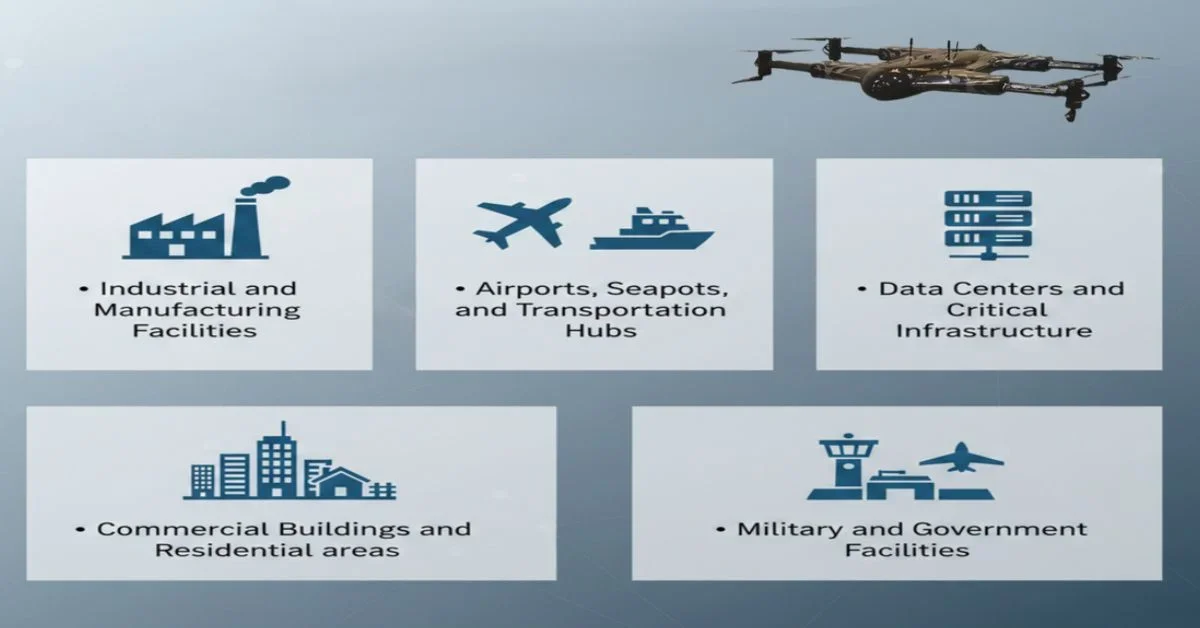
Drone-based perimeter surveillance can be considered for large, remote, complex, or security-sensitive properties.
Potential applications include:
- Industrial Facilities: Industrial sites may have long fence lines, equipment yards, storage areas, and restricted zones. Drones can provide another way to inspect these areas and investigate security alerts.
- Solar Farms and Utilities: Solar farms, substations, and other utility infrastructure may cover large or remote areas. Aerial surveillance can help operators inspect perimeter activity without relying exclusively on ground patrols.
- Warehouses and Logistics Centers: Large logistics properties often contain loading areas, vehicle traffic, parking areas, storage yards, and multiple access points. A drone can provide an additional observation point across these environments.
- Construction Sites: Construction sites change frequently and may contain equipment, materials, temporary fencing, and areas with limited fixed-camera coverage. Drone patrols can provide flexible visibility as site conditions change.
- Data Centers and Critical Facilities: Facilities with high-value infrastructure may use drones as another surveillance layer alongside access control, fixed cameras, perimeter sensors, and trained security personnel.
Are Perimeter Security Drones Worth It?
Whether a perimeter security drone is worthwhile depends on the property and its security requirements.
A small site with comprehensive fixed-camera coverage may gain limited value from aerial patrols. A large, remote, difficult-to-access, or rapidly changing property may have a stronger use case.
Organizations should evaluate the technology based on measurable security needs such as:
- Time required to verify perimeter alarms
- Areas without adequate visual coverage
- Frequency of remote patrols
- Number and type of false alarms
- Time required for personnel to reach remote locations
- Need for nighttime or thermal surveillance
The strongest deployment is usually one where drones complement existing people, procedures, and security technologies rather than operate as an isolated surveillance tool.
Final Thoughts
A perimeter security drone can extend the reach of traditional physical security by giving teams a mobile aerial perspective of their property.
Its most valuable role is not simply flying routine patrols. The technology becomes more useful when it helps security teams investigate alerts, verify activity, monitor difficult-to-access areas, and obtain better information before deciding how to respond.
For organizations evaluating drone-based perimeter security, the starting point should be the site's actual security requirements. Aircraft capabilities, cameras, docking stations, analytics, communications, regulatory requirements, and integration with existing security systems should then be selected around those needs.
When properly integrated with trained personnel and established security procedures, perimeter security drones can become a practical additional layer in a modern site protection strategy.
FAQ About Perimeter Security Drones
What is a perimeter security drone?
A perimeter security drone is an unmanned aerial vehicle used to monitor the boundaries and security-sensitive areas of a protected property. It can provide aerial imagery, conduct patrols, and help security personnel investigate alarms or suspicious activity.
Can a drone replace security guards?
Generally, no. A drone provides surveillance and situational information, while trained personnel make security decisions and carry out physical responses. Drones are better considered an additional layer within a broader security program.
Can perimeter security drones operate at night?
Suitable drones can support authorized nighttime operations. Thermal cameras and low-light imaging systems can help operators monitor areas where visible-light cameras may be less effective. Applicable aviation requirements and operating conditions still need to be followed.
Can perimeter security drones fly automatically?
Some systems can launch from docking stations, follow predefined routes, collect imagery, return, and recharge with a high degree of automation. The level of human supervision and regulatory authorization required depends on the location and type of operation.
Can a security drone respond to an alarm?
A drone can be integrated into workflows where an alert from a sensor, camera, radar, or other security system identifies an area requiring investigation. Depending on the system and operating authorization, the drone may then be dispatched to provide aerial imagery for operator verification.
Do perimeter security drones use thermal cameras?
They can. Thermal imaging is particularly useful for nighttime monitoring and detecting heat differences in low-light environments. Not every security drone requires a thermal camera; the appropriate payload depends on the site's security requirements.
What facilities can use perimeter security drones?
Potential users include industrial facilities, warehouses, logistics centers, solar farms, utilities, construction sites, data centers, ports, mines, agricultural properties, and other large or difficult-to-monitor sites.
What are the main limitations of security drones?
Common considerations include weather, battery endurance, communications coverage, aviation restrictions, privacy, cybersecurity, maintenance, and the need for trained personnel and appropriate operating procedures.
Contact Us
This site is protected by reCAPTCHA and the Google Privacy Policy and Terms of Service apply.