


 Deutsch
 Português
Tethered Drones: How Tethered UAV Systems Are Transforming Modern Defense
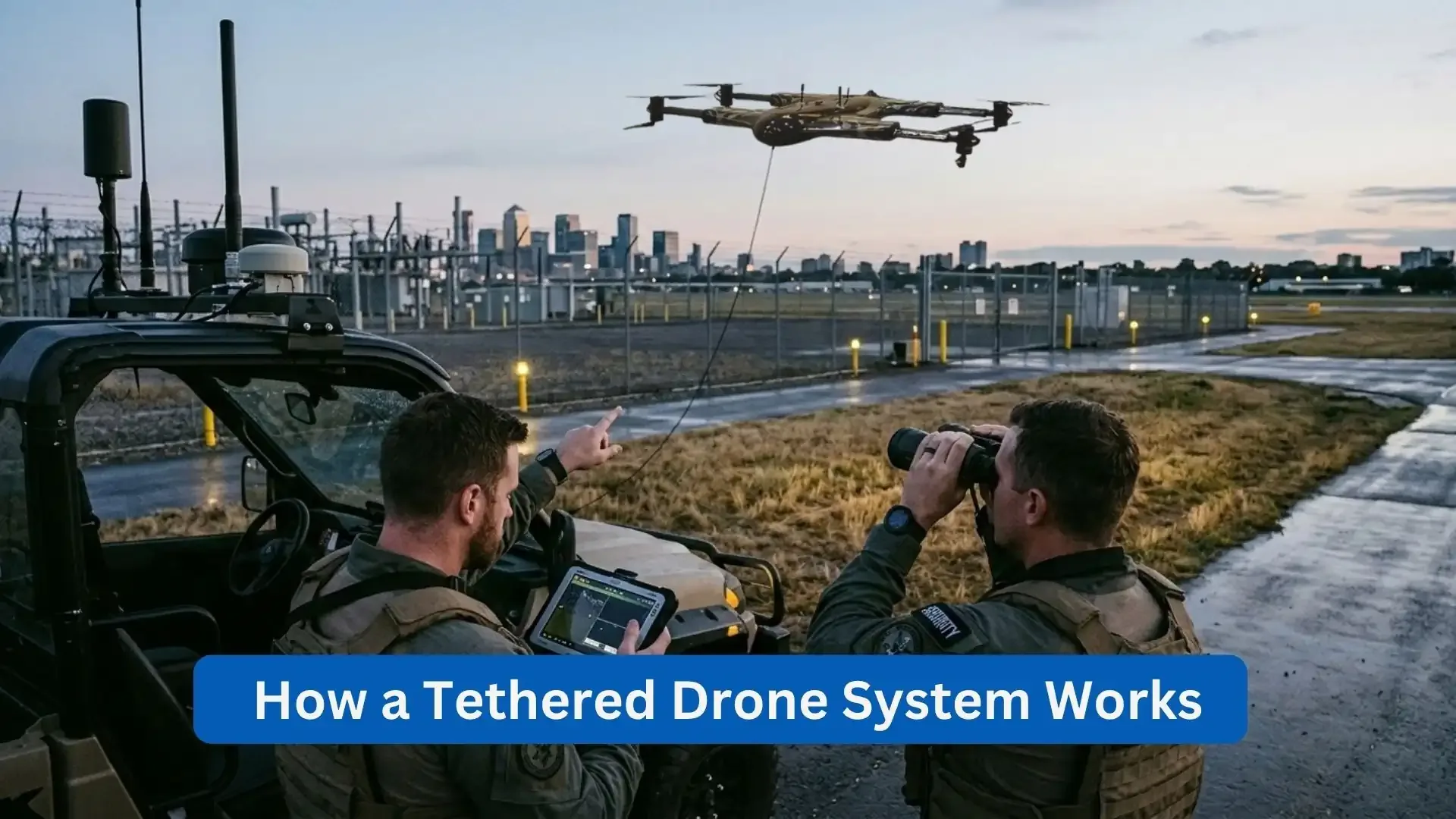
Tethered drones provide persistent aerial coverage by combining constant ground power, extended flight endurance, and reliable data connectivity. It’s different from the conventional battery-powered UAVs because they can remain airborne for longer periods while, at the same time, carrying surveillance, communications, and mission-specific payloads. This is the reason why they’re valuable for defense, security, public safety, infrastructure, and enterprise operations.
What Are Tethered Drones?
Tethered drones are unmanned aerial vehicles that are connected to a ground station through a physical cable that can provide continuous power, data transmission or both. When you use tethered UAV, it typically includes the aircraft, power source, tether management system, communications equipment, and, especially, ground control interface. Conventional drones rely on batteries, while tethered drone systems receive continuous power from the ground that allows longer flight times as well as persistent aerial surveillance. You can achieve all of these without frequent recharging.
How a Tethered Drone System Works
A tethered drone system works by connecting the aircraft to a ground-based power and control unit. The ground unit’s responsibility is to supply electricity through the tether cable while the same connection may carry the command, control, telemetry, video, and other mission data. The architecture generally consists of four main elements, similar to the following components:
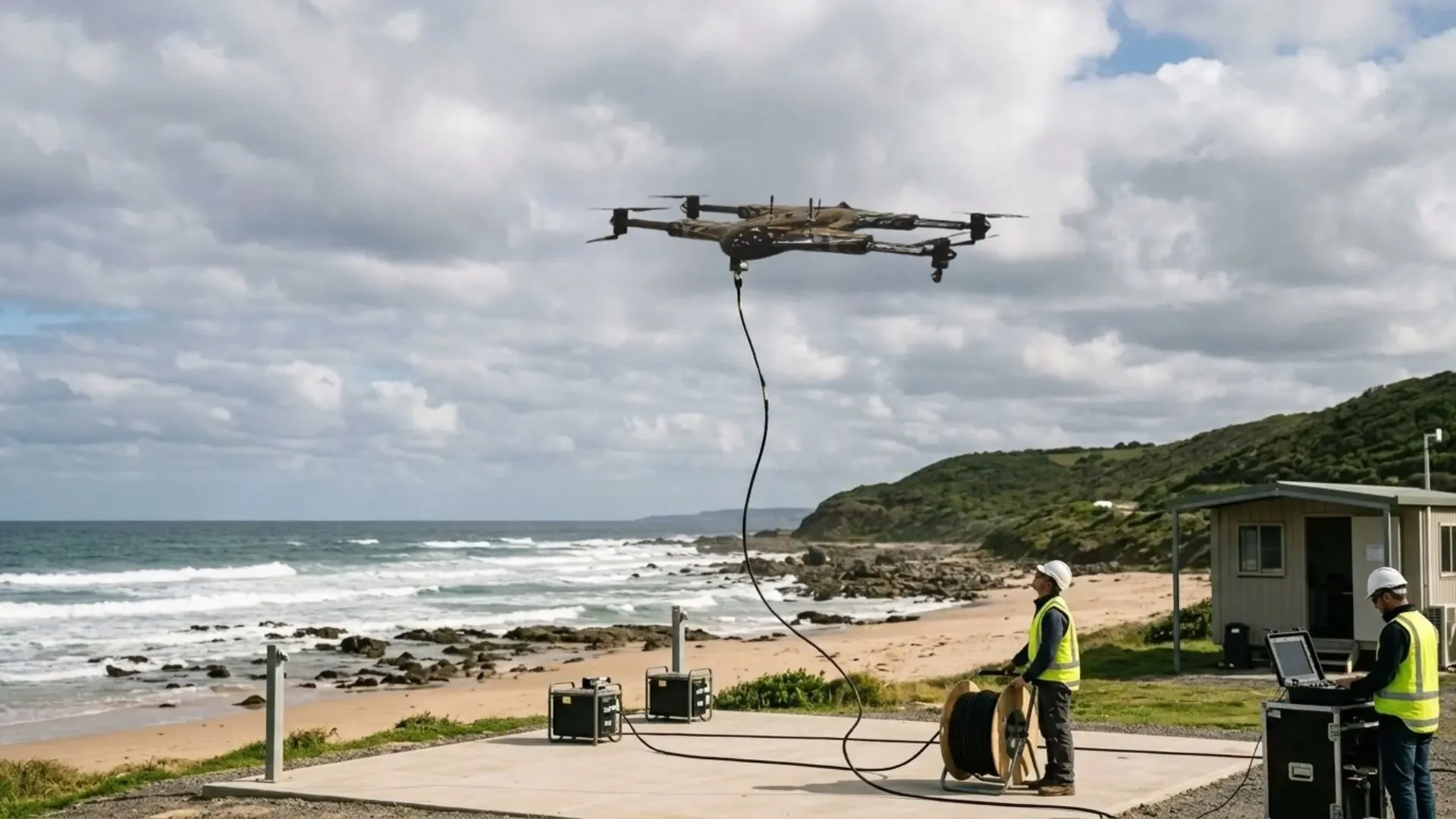
The Physical Tether
The tether is the physical connection between the UAV and ground equipment. It may contain electrical conductors, fiber-optic elements, or other communication pathways. In its design, it must balance the strength, weight, flexibility, electrical capacity, and environmental resistance. A longer tether can provide a greater operating altitude, but it also must increase the weight and drag and handle the requirements.
Ground Power Supply
A ground power unit supplies electricity to the aircraft. Depending on the system, power can come from grid electricity, a generator, vehicle-mounted equipment, or another suitable source.
Power conversion equipment adjusts electrical characteristics before energy is transmitted through the tether. It’s important to remember that through this process, the UAV can continuously operate at the same time, supporting the payloads that would otherwise place significant demands on its onboard battery.
Data and Communication Links
A tethered drone communication system can carry command, telemetry, video, and sensor information between the aircraft and ground station. Reliance on some radio-frequency links can be reduced by a wired connection, although the exact architecture is still based on the platform.
Ground Control Station
The tethered drone ground station manages the aircraft operations, tether deployment, power, communications, payloads, and the health of the system. Operators can monitor altitude, tether tension, power consumption, video feeds, and other mission information from a centralized interface.
Tethered Drones vs. Conventional Free-Flying Drones
It’s expected that when using conventional drone mobility is what it prioritizes, while tethered drones are more focused on persistence. Although tethered platforms are limited by their ground connection, they can still remain over a specific area for an extended period of monitoring. A tethered UAV is suited for facilities, checkpoints, events, emergencies, and military positions, while conventional UAVs are better for mapping, inspection, reconnaissance, and missions requiring greater mobility.
Power-Tethered UAVs vs. Fiber-Optic Drones
Power-tethered UAVs and fiber-optic drones serve different purposes. A power-tethered platform uses its physical connection for continuous electrical power and they may also transmit data through the tether. While a fiber-optic drone mainly uses the cable for communication and control. This distinction is important for tethered UAV systems: power tethers extend the endurance of the flight, while fiber-optic connections primarily improve the resilience of communications.
Why Tethered UAV Systems Are Gaining Attention
The demand for tethered UAV systems is closely linked to a growing need for persistent aerial awareness.
Demand for Persistent Aerial Surveillance
Many missions do not require a drone to travel hundreds of kilometers. Instead, they require an elevated sensor to watch the same area continuously.
The U.S. Army’s Persistent Surveillance System-Tethered (PSS-T) is an example of tethered persistent surveillance. They describe this one as an aerostat system that’s useful in providing persistent, integrated, networked, multi-sensor information collection and force-protection capabilities. Its was highlighted by them in July 2026 focusing on their usage for persistent wide-area surveillance in support of border security.
Limitations of Battery-Powered UAVs
Battery capacity remains one of the central constraints on electric UAV operations. Flight time is affected by aircraft weight, payload, weather, propulsion efficiency, and operating conditions.
For missions requiring continuous observation, repeatedly landing to change and recharge batteries can create gaps in coverage. A tethered drone system addresses this limitation by moving much of the power requirement to the ground.
Operations in Challenging RF Environments
Modern operations increasingly involve contested or congested electromagnetic environments. Wireless communications may experience interference, congestion, or disruption.
A wired connection can reduce dependence on some wireless control and data pathways. However, a tether does not make a platform immune to electronic warfare, detection, physical attack, or other threats.
Growing Defense and Security Requirements
Defense organizations increasingly require persistent sensing and rapid access to information. The U.S. The Army's recent work on persistent surveillance, reconnaissance, and counter-UAS capabilities demonstrates the growing importance of continuous aerial awareness. This environment creates demand for military tethered drones, especially where a persistent observation is much more important than a mobility that’s long range.
Key Components of Tethered Drone Systems
A complete tethered drone system is more than an aircraft and cable. It is an integrated combination of power, flight control, communications, payload, and ground equipment.
· The Tether Management System: The tether management system controls how the cable is deployed, stored, tensioned, and recovered.
· Automatic Tether Deployment: Automatic deployment can make the systems extend the tether as the aircraft climbs. The operator’s workload can be reduced by automated systems and it can also maintain controlled deployment.
· Tension Management: It’s important to control the tensions since an excessive slack can create entanglement risks, while an excessive tension can place additional mechanical loads on both the aircraft and ground equipment.
Tether Length and Operating Altitude
Operating altitude depends on the tether's length, aircraft performance, regulations, terrain, and mission requirements. A longer tether can provide greater elevation but increases system weight and aerodynamic effects.
· Continuous Power System: Continuous power is one of the defining features of power-tethered platforms.
· Ground-Based Power Source: The ground source may be a fixed electrical connection, generator, the battery system, or a vehicle-mounted power unit.
Power Conversion and Transmission
Power conversion equipment prepares the electricity for transmission through the tether. The aircraft then converts the incoming power into the electrical requirements of propulsion, avionics, sensors, and communications.
Communication and Data Transmission
A tethered drone communication system may carry command information, telemetry, video, and also sensor data. Fiber-optic communication can also be incorporated where high-bandwidth or low-latency data transmission is needed. A secure data transmission is particularly important for defense operations because surveillance information can have an operational value.
UAV Platform and Payload
The aircraft provides lift, propulsion, flight control, and payload integration.
Electro-Optical Cameras: EO cameras do provide visible-spectrum imagery as well as full-motion video for observation, inspection, and security.
Thermal Imaging Sensors: Thermal cameras can detect the differences in temperature as well as support nighttime monitoring, perimeter security, search and rescue, and infrastructure observation.
Communication Payloads: A UAV can function as an elevated communications node, extending connectivity or supporting radio relay applications.
Other Mission-Specific Sensors: Depending on the mission, payloads may include multispectral sensors, environmental sensors, mapping equipment, RF sensing equipment, or specialized industrial instruments.
Ground Control and Monitoring Systems: The tethered drone ground station provides the operator with access to the flight controls, payload controls, telemetry, system health, and mission data. Integration with the common-and-control networks can allow aerial information to be part of a broader operational picture instead of remaining isolated at the console of the drone operator.
Major Advantages of Tethered Drones
· Extended Flight Endurance: The primary advantage of Tethered Drones is the ability to operate for much longer than many battery-dependent platforms.
· Overcoming Battery Limitations: A continuous power connection reduces dependence on the aircraft's and onboard energy storage. It can handle payloads that are heavier as well as missions that are longer with enough ground power.
· Supporting Long-Duration Missions: Long-duration missions are useful specifically for security, surveillance, communications, and also emergency response.
· Persistent Surveillance and Monitoring: Tethered surveillance drones can maintain an elevated view of a defined area for extended periods. The tethered drones market varies by how research firms define it. A better measure is its growing use in defense, security, public safety, and infrastructure.
· Reliable Data Connectivity: Using a wired connection provides a dependable path for both the command as well as sensor information. Reliance may reduce on radio communications and support high-bandwidth payloads depending on architecture.
· Continuous Power for Advanced Payloads: Power is important. If it is continuous, it can support cameras, thermal imagers, communications equipment, and other payloads without all energy coming from a small onboard battery.
· Rapid Deployment and Operational Readiness: It’s important to know that appropriate design depends on mission requirements and available infrastructure. Additionally, tethered drone solutions that are modern can be designed for rapid deployment from fixed sites, vehicles, or any temporary operational locations.
· Reduced Dependence on Some Wireless Links: A physical tether can reduce the reliance on certain wireless connections, making them valuable in environments where RF availability is limited or where secure wired data transmission is preferred.
Why Tethered Drones Matter for Modern Defense
Tethered Drones matter because they provide an elevated sensing layer for intelligence, surveillance, and reconnaissance.
· Continuous Observation: A tethered aircraft can maintain observation over a defined area without requiring repeated launch and recovery cycles.
· Real-Time Situational Awareness: Live video and sensor information can help commanders understand changing conditions. The Army has described tethered surveillance platforms as tools for persistent wide-area observation and situational awareness at the southern U.S. border.
· Perimeter and Base Security: Military tethered drones can provide an elevated sensor layer around bases, logistics sites, checkpoints, airfields, and other facilities. Their value is not simply the camera in the sky. The broader advantage comes from integrating persistent sensing with command systems, security teams, alarms, and other surveillance assets.
· Border Surveillance: Border operations can involve large areas that are difficult to monitor continuously from the ground. Tethered drone surveillance can provide a persistent elevated observation point. The U.S. Army reported in July 2026 that PSS-T aerostats were supporting enhanced observation and situational awareness for southern-border security operations.
· Communications Relay: A tethered aircraft can place a communications payload at an elevated position. This can improve line-of-sight connectivity and support a variable-height antenna concept.
· Force Protection and Area Monitoring: Persistent aerial observation can support force protection by providing earlier awareness of movement, activity, or potential threats around operational areas.
· Tethered UAVs in Contested Environments: A tethered platform can reduce some communications dependencies, but it should not be considered inherently resistant to electronic warfare. Physical visibility, tether vulnerability, RF emissions from onboard equipment, and the location of the ground station remain important considerations.
Fiber-Optic Drones and the Changing Electronic Warfare Environment
What Are Fiber-Optic Drones?
Fiber-optic drones use a physical fiber-optic cable to maintain communication between the aircraft and operator. Unlike a power-tethered platform, the aircraft normally remains powered by its onboard battery.
How Fiber-Optic Control Differs From Radio-Frequency Control
Traditional drones often depend on radio links for command, telemetry, and video. Fiber-optic systems replace some of those wireless links with a physical communication path. This can reduce exposure to certain forms of RF interference. It does not eliminate all vulnerabilities.
Why Reduced RF Dependence Matters
Electronic warfare environments can challenge conventional wireless communications. A fiber-optic link can make some forms of radio-frequency jamming less effective against the control connection.
Lessons Emerging From Recent Conflicts
Recent conflicts have demonstrated how rapidly UAS and counter-UAS technologies evolve. The U.S. Army has explicitly incorporated lessons from the Russo-Ukrainian War into its drone doctrine and tactics.
Why Fiber-Optic Drones Present New Detection Challenges
Fiber-optic drones may produce fewer traditional RF signals, making detection more challenging and increasing the need for combined radar, EO/IR, acoustic, and RF sensors.
They differ from military tethered drones because fiber-optic systems focus mainly on communications resilience, while tethered platforms can provide continuous power and persistent aerial operations.
Why Tethered Drones Present New Counter-UAS Challenges
Limitations of RF-Based Detection
Not every UAV can be detected reliably through RF emissions alone. When a tethered UAV is using a physical cable for power or communications, it may have a different electronic signature from a drone that’s radio-controlled and conventional.
Low-Altitude and Persistent Operations
Small tethered aircraft can be used to operate at relatively low altitudes while remaining near a fixed site. This can make challenges in terms of detecting buildings, terrain, and other obstructions.
Identifying Different Types of Tethered UAV Threats
It’s important for the identification to consider behavior of the flight, the tether configuration, payload, location, and also the operating authorization. Additionally, security teams must distinguish between legitimate tethered drones for security and unauthorized aircraft.
The Need for Layered Counter-UAS Approaches
A layered architecture can combine multiple detection and identification methods.
Multi-Sensor Detection
Radar, EO/IR, RF sensing, acoustic systems, and other sensors can complement one another.
Tracking and Classification
Tracking systems can correlate detections and determine whether an aircraft represents a potential threat.
Integrated Situational Awareness
Counter-UAS systems should connect detection information with command-and-control systems. The U.S. Army's Project Flytrap work has emphasized secure and rapid movement of sensor data across coalition counter-UAS architectures.
The U.S. Army’s Project Flytrap 5.0 tests emerging counter-UAS technologies for performance, interoperability, and real-world battlefield use.
Tethered Drone Applications beyond Defense
· Public Safety and Law Enforcement: Public safety agencies can use tethered drone applications for persistent observation, incident management, and emergency response. The FAA maintains specific guidance for public-safety UAS operations and includes a checklist for actively tethered UAS operations.
· Event Monitoring: At large events, a persistent aerial view can help security teams monitor entrances, crowds, traffic, and developing incidents.
· Emergency Situational Awareness: An elevated camera is important during emergencies since it can provide responders with information that may be difficult to obtain from ground level.
· Border and Perimeter Security: Tethered drones for security can monitor defined areas continuously. They can complement fixed cameras, patrols, radar, access-control systems, and other security technologies.
Critical Infrastructure Monitoring
· Power Facilities: Utilities can use persistent aerial observation around substations, generation facilities, and other restricted areas.
· Industrial Sites: Industrial operators can monitor large facilities, storage areas, construction zones, and controlled access points.
· Transportation Infrastructure: Aerial observation can be used in airports, ports, rail facilities, and transportation hubs as part of a broader security architecture. The FAA notes that tethered UAS can present operational challenges that are unique in airport environments and that controlled-airspace operations require appropriate approval.
Emergency and Disaster Response
· Search and Rescue Support: A tethered aircraft can provide an elevated perspective during search operations while remaining near the response team.
· Disaster-Area Communications: A communications payload can help provide connectivity where terrestrial infrastructure has been damaged or overloaded.
· Real-Time Aerial Monitoring: Persistent video can help incident commanders monitor roads, damaged structures, evacuation areas, and emergency zones.
Telecommunications
· Temporary Communication Coverage: An elevated communications payload can extend coverage over an area where conventional infrastructure is unavailable.
· Variable-Height Antenna Applications: A tethered platform can place an antenna above obstructions and change its height according to operational requirements.
· Large Events and Crowd Monitoring: Persistent aerial coverage can complement fixed surveillance systems at stadiums, festivals, public gatherings, and other high-density events.
Tethered Drones Market: What Is Driving Growth?
· The tethered drones market is developing as organizations seek longer endurance, persistent surveillance, and reliable aerial sensing.
· Growing Demand for Persistent Surveillance: Continuous observation is what the security organizations need instead of occasional drone flights. It’s important because this supports demand for tethered surveillance drones that can remain over a defined area.
· Defense and Homeland Security Investment: Defense organizations continue investing in persistent sensing, reconnaissance, force protection, and counter-UAS capabilities. Current U.S. Army programs show continued interest in tethered persistent-surveillance architectures.
· Expansion into Commercial Applications: Commercial tethered drone applications include industrial monitoring, public safety, telecommunications, infrastructure security, and emergency response.
Advances in Tethered UAV Technology
Modern systems are benefiting from improvements in:
· Lighter Tethers: Reduced tether weight can improve aircraft efficiency and payload capacity.
· Improved Power Systems: More efficient conversion and transmission systems can support greater aircraft and payload requirements.
· Higher-Capacity Payloads: Improved payload integration allows a tethered UAV to perform more specialized missions.
· Greater Automation: Automated deployment, tension control, flight stabilization, and system monitoring can simplify operations.
Key Challenges Affecting Market Adoption
Market forecasts vary because research firms define the tethered drones market differently. Instead of relying on one estimate, it’s better to focus on the growing use of persistent aerial systems in defense, security, public safety, and infrastructure.
Limitations and Challenges of Tethered UAV Systems
A balanced assessment of tethered UAV systems must consider their operational limitations.
· Restricted Mobility: The aircraft cannot move freely beyond the tether's operating envelope. This makes it less suitable for missions requiring long-distance travel.
· Tether Length and Altitude Constraints: Altitude depends on tether length, aircraft capability, regulations, terrain, and weather.
· Tether Weight and Drag: The cable adds weight and aerodynamic drag. Wind can increase forces on the aircraft and ground station.
· Weather and Environmental Conditions: Strong winds, rain, lightning, icing, dust, and extreme temperatures can affect operations and equipment.
· Ground Station Requirements: A tethered drone ground station requires suitable space, power, equipment protection, and trained personnel.
· Deployment around Buildings and Obstacles: Tethers can interact with towers, trees, buildings, vehicles, and other obstacles. Site planning is therefore essential.
· Maintenance and Operational Considerations: The tether, winch, power system, aircraft, sensors, and ground equipment all require inspection and maintenance.
Tethered Drones vs. Traditional Drones: Which Is Better?
There is no universal winner. The appropriate system depends on the mission.
FACTOR | TETHERED DRONES | TRADITIONAL DRONES |
Endurance | Extended or continuous operation possible | Typically limited by onboard energy |
Mobility | Restricted by tether | Generally high |
Power | Ground-supplied possible | Primarily onboard |
Data link | Wired options possible | Typically relies more heavily on wireless links |
Deployment | Requires both tether and ground equipment | Generally simpler |
Best suited for | Persistent, localized operations | Mobile missions |
· Flight Endurance: Tethered Drones have an advantage when the aircraft must remain airborne for extended periods.
· Mobility: Traditional drones are better when the mission requires travel between multiple locations.
· Power Availability: A tether can continuously provide power, allowing the platform to support demanding payloads.
· Data Connectivity: Wired connection is a good provider of reliable data transmission, while on the other hand, conventional drones are typically dependent on wireless links more heavily.
· Payload Capability: The availability of ground power can support payloads that would otherwise significantly reduce battery endurance.
· Deployment Requirements: Conventional UAVs generally require less fixed infrastructure. Tethered platforms require a ground station, tether, power source, and suitable operating location.
· Best-Fit Missions for Each System: A tethered drone system for military operations may be appropriate for base security, persistent ISR, perimeter monitoring, or communications relay. A conventional UAV is generally better for mobile reconnaissance, mapping, inspection, and long-range missions.
How to Choose a Tethered Drone Solution
Choosing a tethered solution begins with the mission rather than the aircraft.
· Define the Mission Requirements: It’s important to determine whether the primary requirement is surveillance, communications, security, emergency response, infrastructure monitoring, or if it’s another mission.
· Evaluate Required Flight Endurance: A tethered solution can be advantageous if the aircraft must remain airborne continuously. Free-flying UAV may be more appropriate if the missions require movement between locations.
· Determine Operating Altitude: Operating altitude affects coverage, tether requirements, power transmission, regulations, and environmental exposure.
Consider Payload Requirements
· Camera Payloads: EO cameras support daylight observation and video monitoring.
· Thermal Sensors: Thermal sensors can extend monitoring into low-light and nighttime conditions.
· Communication Equipment: Communications payloads can support relay and connectivity missions.
· Evaluate Power Requirements: The power architecture should support the aircraft, sensors, computing systems, and communications payload simultaneously.
· Consider Environmental Conditions: Wind, rain, temperature, terrain, and site layout should be considered before deployment.
· Assess Deployment and Portability Requirements: A fixed installation may support larger equipment, while vehicle-mounted systems prioritize mobility.
· Evaluate Data and System Integration: Organizations should evaluate how the aircraft connects with existing security systems, GIS platforms, command-and-control software, video management systems, and enterprise data platforms. For government and enterprise buyers, tethered drone solutions should be assessed as complete systems rather than individual aircraft.
The Future of Tethered Drone Technology
The future of tethered drone technology will be focusing on greater automation with better payloads, improved power efficiency, and of course, an integration that’s stronger with broader UAS networks.
· Greater Automation and Autonomy: An operator’s workload can sometimes increase. Their workload can be reduced by automated takeoff, landing, tether management, system health monitoring, and mission routines.
· AI-Assisted Aerial Monitoring: With the assistance of artificial intelligence, they can be helpful in identifying vehicles, people, objects, perimeter breaches, any unusual activity, or even other events that are relevant to a mission.
· Smarter Tether Management Systems: Using advanced systems is a big help as it can automatically regulate the tension as well as adjust the deployment that’s based on altitude, wind, aircraft movement, and system status.
· Lighter and More Efficient Tethers: The materials that are improved can lessen the weight of drag at the same time, maintain both the strength and electrical characteristics that are required for long-duration operation.
· Advanced Sensor Integration: Future platforms may combine EO/IR, multispectral, RF, acoustic, environmental, and other sensors within a single aerial architecture.
· Vehicle-Mounted Tethered UAV Systems: Vehicle-mounted tethered drone systems can provide mobile persistent surveillance for military units, emergency responders, infrastructure teams, and security organizations.
· Integration with Broader UAS Ecosystems: Tethered aircraft can become one layer within a larger unmanned system that includes free-flying UAVs, ground robots, fixed sensors, satellites, and command networks.
The Evolving Role of Tethered Systems in Defense and Security
Military tethered drones’ role will continue to focus on missions where persistence, elevated sensing, communications, and endurance matter more than unrestricted mobility.
ZenaDrone's tethered drone solutions are important since they can be positioned around these operational requirements, particularly where persistent aerial monitoring, as well as both stable power and data connectivity, and mission-specific payload integration are needed.
Conclusion
Tethered Drones offer a practical approach to persistent aerial operations by shifting much of the endurance burden from the aircraft battery to the ground power system. Their ability to remain airborne for extended periods makes them particularly relevant to surveillance, security, communications, emergency response, and infrastructure monitoring.
They are not replacements for every UAV. Their restricted mobility, tether requirements, weather sensitivity, and ground infrastructure needs are the ones that make them most effective when the mission needs a persistent coverage over an area that’s defined.
The value of tethered UAV systems comes from combining continuous power, reliable connectivity, elevated sensing, and mission-specific payloads for defense and enterprise organizations. The importance of these systems can increase, and be part of integrated unmanned and security architectures as tethered drone technology continues to advance.
FAQs
How does a tethered drone work?
A tethered drone connects to a ground station by cable. Depending on the system, the tether can provide continuous power, data transmission, or both.
How long can a tethered drone stay in the air?
A tethered UAV can stay airborne for hours or longer, depending on power, weather, and operating conditions.
What are tethered UAV systems used for?
Tethered UAV systems are used for surveillance, security, border monitoring, emergency response, and infrastructure monitoring.
What is the difference between a tethered drone and a regular drone?
Regular drones use onboard batteries, while tethered drones get power and sometimes data through a ground cable.
Can tethered drones operate in GPS-denied environments?
Yes. Tethered systems can reduce reliance on wireless links, but navigation still depends on the drone’s positioning system.
Are tethered drones used for military surveillance?
Yes. Tethered drones support military surveillance, force protection, communications, and situational awareness.
Contact Us