



US Drone Laws2026 Complete FAA Rules & Regulations Guide
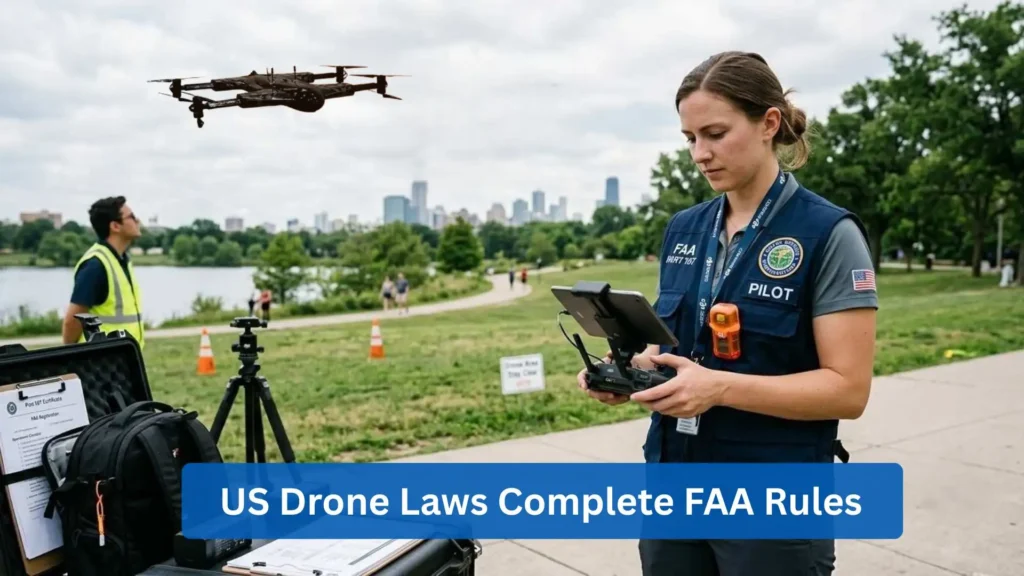
Flying a drone is not a simple task, there are requirements and regulations that you must follow and understand to operate with it. Understanding these will help you fly not just safely but also responsibly and legally.
This guide is helpful for you to understand more about the US drone laws and FAA rules for the year 2026 along with the requirements that are essential enough to help you become a certified good drone operator
US Drone Laws in 2026
US Drone Laws in 2026 and drone technology advances will evolve, including artificial intelligence, autonomous flight, drone delivery, and BVLOS. It is important for you to know that the current laws on drones have established clear requirements for both recreational and commercial pilots, covering registration, Remote ID, airspace authorization, certification for pilot, and operational safety.
These US laws on drones exist to protect the people, property, manned aircraft, and critical infrastructure. Aside from protection, these laws also allow drones to be used in many industries such as construction, agriculture, public safety, surveying, and also inspecting infrastructure.
Why Drone Regulations Continue to Evolve
Drone regulations continue to evolve to keep pace with advancing technology, improve airspace safety, support new commercial applications, and ensure drones operate responsibly alongside manned aircraft. Enterprise organizations now rely on drones for:
- Construction monitoring
- Utility inspections
- Precision agriculture
- Infrastructure surveys
- Emergency Response
- Disaster assessment
- Monitoring of environment
- Asset management in industries
Regulators are constantly doing evaluations since drones are becoming part of everyday airspace.
Who Regulates Drones in the United States?
The FAA primarily oversees the civil drone operations. The responsibilities of FAA as the primary federal authority include:
- Management of Airspace
- Aircraft Registration
- Pilot Certification
- Operational Safety
- Compliance of Remote ID
- Enforcement Actions
The US drone laws are shaped by federal, state, and local rules. It is essential to follow each for the sake of compliance.
Major Regulatory Updates for 2026
In 2026, drone operators should pay close attention to several continuing developments:
- Continued FAA development of BVLOS regulations
- Increased Remote ID enforcement
- Growing use of AI-assisted compliance tools
- Continued UTM (Unmanned Traffic Management) development
- Additional guidance for drone delivery services
Although many foundational FAA rules remain unchanged, enforcement and operational expectations continue evolving as drone adoption increases.
What Are US Drone Laws?
The US drone laws are regulations deemed as federal, state, and local ones that are assigned to govern where the drones are supposed to be used, who can use them, the required certifications, and safe operating practices.
Federal Authority
Federal regulations primarily govern:
- Airspace
- Pilot certification
- Registration
- Flight operations
- Aircraft identification
- Aviation safety
These rules apply nationwide regardless of where a drone is operated.
State and Local Authority
States generally regulate matters such as:
- Privacy
- Surveillance
- Trespassing
- Wildlife protection
- Law enforcement drone usage
- State-owned property
Local governments may establish restrictions involving:
- Public parks
- Municipal facilities
- Special events
- Noise ordinances
- Local permits
These additional rules do not replace FAA regulations; they supplement them.
Why Drone Regulations Exist
Drone regulations exist because they are useful in:
- Preventing if there are mid-air collisions
- Protecting the emergency operations
- Reducing the risks near airports
- Ensuring people and property are safe
- Protecting sensitive infrastructure
- Promoting a responsible innovation
Compliance ultimately supports safer integrations of drones into the National Airspace System.
Who Must Follow US Drone Laws?
Many new drone owners mistakenly consider regulations as needed to be followed solely by commercial operators. The fact is, nearly every drone pilot is responsible for complying with the applicable FAA rules.
Recreational Drone Pilots
Individuals flying purely for enjoyment must still follow FAA recreational drone rules. Recreational pilots are generally required to:
- Pass the TRUST safety test
- Register qualifying drones
- Fly within approved airspace
- Maintain visual line of sight
- Follow altitude limitations
- Respect Temporary Flight Restrictions
These recreational requirements represent one of the most common areas covered by drone laws in US.
Commercial Drone Pilots
For commercial operations done by commercial drone operators, it is important that they meet the additional requirements because they conduct flights in support of business activities. The examples included are:
- Real estate photography
- Infrastructure inspections
- Surveying
- Agriculture
- Utility inspections
- Mapping
- Construction progress monitoring
- Using drones for filming
- Insurance inspections
Most commercial operators require Part 107 certification unless operating under another authorized framework.
Enterprise Drone Operators
Large organizations often manage dozens or even hundreds of aircraft across multiple locations.
Enterprise compliance typically includes:
- Fleet registration
- Management of pilot
- Maintenance records
- Operational manuals
- Risk assessments
- Planning of missions
- Remote ID compliance
- Airspace authorization
It is important for organizations in construction, utilities, energy, transportation, and public safety to integrate regulatory compliance into everyday operations instead of treating it as a one-time requirement only.
Government Agencies
Drones are used by federal, state, tribal, and local government agencies for purposes like:
- Emergency response
- Search and rescue
- Monitoring a wildfire
- Disaster assessment
- Infrastructure inspection
- Public safety
Government operators often fly under different authorities depending on the mission, although many FAA operational principles still apply.
Foreign Visitors Flying in the United States
International visitors bringing drones into the United States should familiarize themselves with applicable FAA requirements before flying.
Depending on the operation, visitors may need to:
- Register an eligible aircraft
- Follow the rules for recreational flights
- Obtain Part 107 certification for commercial work
- Comply with Remote ID requirements
- Observe the local restrictions
If the pilot fails to understand US laws on drones, it can lead to enforcement actions no matter which country they come from.
FAA Drone Rules Every Pilot Should Know
The FAA (Federal Aviation Administration) establishes nationwide operating standards that every drone pilot should understand before taking off. These drone rules become the foundation of drone operations that are both safe and compliant.
FAA Drone Registration
Most drones weighing over 0.55 pounds (250 grams) must be registered with the FAA, and pilots should carry proof of registration during flights.
TRUST Certificate
The TRUST certificate is required for pilots that do recreational flights and it also covers basic aviation safety, airspace awareness, and responsible drone operation. This certificate will prove that you have passed The Recreational UAS Safety Test. It’s a free and mandatory exam administered by the FAA.
Part 107 Certification
Pilots conducting commercial drone operations generally need a Remote Pilot Certificate under Part 107. Part 107 covers topics including:
- Airspace classifications
- Aviation weather
- Performance of the aircraft
- Emergency procedures
- Radio communications
- Flight planning
- Risk management
The certification allows businesses to legally conduct many commercial drone missions across industries ranging from agriculture to infrastructure inspection.
Remote ID Requirements
Remote ID is a digital identification system that broadcasts a drone’s identity and location to support safer and more accountable operations.
Maximum Altitude
In most situations drones are limited to 400 feet above ground level. They can fly higher under specific allowable circumstances only just like certain operations that are near structures under Part 107. It’s important to maintain proper altitude as it reduces conflicts with manned aircraft.
Visual Line of Sight (VLOS)
Pilots must keep their drone within direct visual line of sight throughout the flight. Visual line of sight allows the operators to identify if there are hazards, avoid collisions, and quickly respond to changing conditions.
Flying Over People
The FAA allows certain flights over people if the drone meets specific requirements intended for safety as well as operational categories. These categories are based largely on the weight of the drone, its safety features, and the level of risk posed to the individuals on the ground. It is important for the Commercial Part 107 pilots to understand these rules and to assess the risks before actually flying over people or in populated areas.
Night Operations
Night flights have become increasingly common for inspections, emergency response, security patrols, and infrastructure monitoring. The FAA allows Part 107 night operations if the pilots have already completed the required training. It’s essential for the pilots to plan carefully because of the reduced visibility.
Controlled Airspace
Before flying in controlled airspace, operators typically need FAA authorization, often obtained through LAANC for faster approval near participating airports.
Temporary Flight Restrictions (TFRs)
Temporary Flight Restrictions, commonly known as TFRs, temporarily prohibit or limit aircraft operations in designated areas.
TFRs may be established because of:
- Wildfires
- Natural disasters
- Presidential travel
- Major sporting events
- National security activities
- Emergency response operations
Flying inside a TFR without authorization may result in significant FAA enforcement actions.
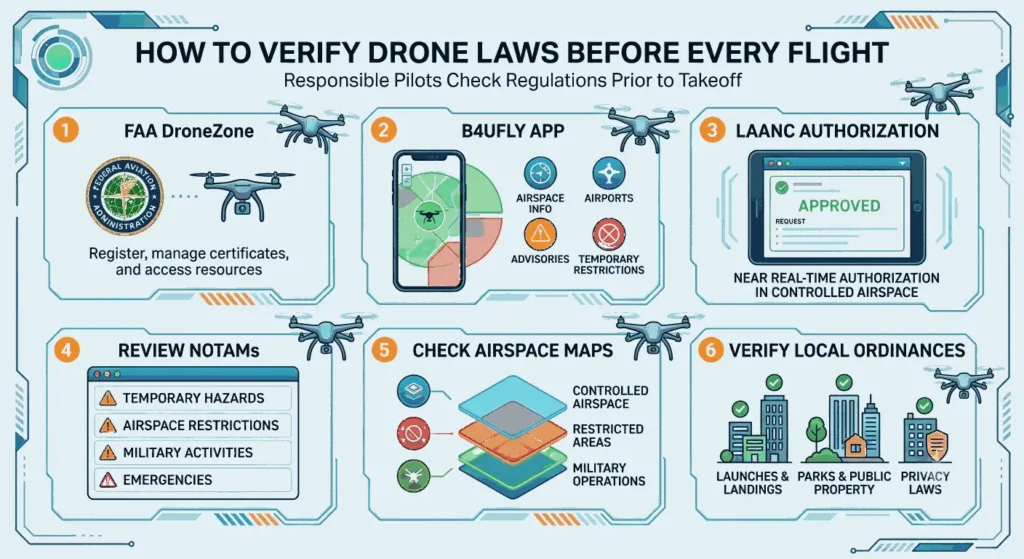
How to Verify Drone Laws Before Every Flight
Responsible drone pilots never assume yesterday’s rules still apply today. Airspace restrictions can change quickly, making pre-flight planning one of the most important steps for safe operations.
- FAA DroneZone: FAA DroneZone is a primary online portal for drone registration and pilot services. Operators can register an aircraft, manage certificates, and access official FAA resources that support the compliance of regulations.
- B4UFLY: B4UFLY helps pilots determine whether it is safe and legal to fly in a particular location. The application displays the airspace information, nearby airports, advisories, and the temporary restrictions before the takeoff.
- LAANC Authorization: LAANC provides near real-time authorization for eligible drone flights in controlled airspace, often granting approval within minutes.
- Review NOTAMs: NOTAMs provide critical information on the temporary hazards, airspace restrictions, military activities, and emergencies possibly affecting drone flights.
- Check Airspace Maps: Understanding classifications of airspace is a big help for pilots to identify where authorization is required and recognize controlled, restricted, and military airspace.
- Verify Local Ordinances: Federal rules don’t override all local restrictions. It’s important to verify both the requirements of the FAA as well as the local laws because it covers launches, landings, parks, privacy, and public property.
Recreational vs Commercial Drone Laws in US
Although recreational and commercial pilots operate under many of the same safety principles, their legal responsibilities differ significantly.
Requirement | Recreational Flying | Commercial (Part 107) |
Primary Purpose | For personal enjoyment only | Business or compensation |
Certification | TRUST Certificate | FAA Part 107 Remote Pilot Certificate |
Registration | Required for qualifying drones | Required for qualifying drones |
Airspace Access | Authorization is required in controlled airspace | Authorization required in controlled airspace |
Commercial Use | Not permitted | Permitted |
Flight Restrictions | FAA recreational rules | Part 107 operational rules |
Remote ID | Required when applicable | Required when applicable |
Recordkeeping | Limited | Often maintained for compliance and business operations |
Commercial operators must meet stricter FAA requirements than recreational pilots, and any paid drone work generally requires compliance with commercial regulations under US drone laws.
Drone Filming Regulations and Laws in the US
The growing use of drones in media and real estate has made drone filming regulations and laws in the US essential for both professionals and hobbyists.
Commercial Filming Requirements
If your goal for filming is for commission or to support a business, the FAA generally classifies it as a commercial operation that would require a Part 107 Remote Pilot Certificate.
Commercial filming includes:
- Real estate photography
- Wedding videography
- Construction progress documentation
- Infrastructure inspections
- Promotional videos
- Tourism marketing
- Industrial site documentation
- Corporate advertising
Production companies should also verify whether property owners or local governments require filming permits before operating.
Private Property Considerations
Even if the FAA regulates airspace, the property owners may still have control access to their land. Launching and landing on private property without permission may violate trespassing laws.
Privacy Laws
The privacy regulations vary between states. Regardless of FAA compliance, it’s a violation to state laws if you are recording an individual in places where they expect privacy.
Pilots should avoid:
- Recording inside someone’s home intentionally
- Hovering unnecessarily over private residences
- Conducting surveillance without authorization
- Collecting personal information without consent
Respecting privacy is one of the easiest ways to maintain public trust while complying with drone laws in the US.
Flying Over Events
Large public events may have additional restrictions and Temporary Flight Restrictions (TFRs). It’s a must do to check the restrictions of FAA airspace, the event rules, and local ordinances before filming.
News Gathering
Due to the nature of their job, journalists use drones to cover disasters, infrastructure, and events. Even if the purpose of using such technology is for the benefit of the masses, they are still required to comply with FAA regulations as well as respect the privacy of everyone.
It’s also important to avoid flying near emergency response operations because it may interfere with life-saving efforts and lead to severe penalties.
Best Practices for Drone Filming
Whether filming recreationally or professionally it’s important to remember to:
- Obtain the required FAA certifications.
- Check airspace before doing a flight.
- Respect the privacy rights.
- Secure the permission of the property owner when needed.
- Avoid emergency response operations.
- Keep visual line of sight throughout the mission.
Drone filming regulations and laws in the U.S. are important for protecting both operators and the communities they serve.
Where Can You Legally Fly a Drone in the US?
Knowing where you can legally fly is just as important as understanding how to operate a drone safely. Here are the following places where you can legally fly a drone in the US:
- Public Parks: Rules vary by city. Some parks allow drones, some don’t.
- State Parks: Drone policies differ by state. There are flights allowed in designated areas,there are also that ban them to protect the visitors and wildlife.
- Residential Neighborhoods: Flying may be legal under FAA rules, but avoid disturbing residents and violating privacy laws.
- Beaches: Drone use depends on local regulations. Restrictions may apply during busy seasons, wildlife nesting periods, and special events.
- Public Land: Many public lands that are managed locally allow drone operations if pilots follow FAA rules and posted restrictions.
- Controlled Airspace: FAA authorization is typically required when flights are done near airports, often through LAANC.
- Uncontrolled Airspace: FAA rules must still be followed by the pilots even though it generally offers more flexibility, including altitude limits, Remote ID, and visual line of sight.
- National Forests: Many National Forests allow drones unless temporary restrictions are in place due to wildfires or environmental concerns. Authorization may be required near airports, military airfields, controlled airspace, government facilities, special events, and TFRs. Because US laws on drones combine federal, state, and local rules, always check regulations before every flight.
Where Are Drones Prohibited in the US?
- Military bases
- Airports that are not authorized
- Federal facilities
- Critical infrastructure
- Emergency response areas as well as wildfire
- Stadiums during a specific event
Understanding State Drone Laws
There is a continuous expansion in individual states on their own legislation related to drones. On the other hand, the FAA regulates the airspace nationwide.
Privacy Laws: Many states prohibit the use of drones for unlawful surveillance, stalking, or recording individuals in situations where they reasonably expect privacy.
Property Rights: Although property ownership does not automatically extend into navigable airspace, disputes involving repeated low-altitude drone operations may still arise under state law.
Law Enforcement Drone Rules: Numerous states have enacted legislation governing how law enforcement agencies may deploy drones, particularly regarding surveillance, warrants, and evidence collection.
States with Stricter Regulations
Some states impose additional restrictions involving:
- Hunting with drones
- Critical infrastructure inspections
- Correctional facilities
- Government buildings
- Wildlife protection
- Agricultural operations
Because these requirements vary significantly, operators should review applicable state regulations before traveling.
Always Verify Local Rules: County and city ordinances may regulate launches, landings, park access, or public events even when FAA rules permit flight. Remaining informed about both federal and state requirements ensures full compliance with drone laws in the US.
Common Violations and FAA Penalties
Even experienced pilots can violate regulations without proper planning. The FAA may investigate unsafe operations and impose civil or criminal penalties for serious violations.
- Flying without Registration: Most drones weighing over 0.55 pounds (250 grams) must be registered with the FAA before flight. Pilots should keep their registration current and carry proof of registration when required.
- Ignoring Remote ID Requirements: Remote ID is required for many drone operations. Pilots should ensure their drone is Remote ID compliant or flown within an FAA-recognized identification area when applicable.
- Unauthorized Commercial Flights: Many new pilots mistakenly think paid drone work is recreational. In reality, business operations generally require Part 107 certification, including real estate photography, inspections, mapping, construction documentation, and paid aerial videography. Operating without certification may violate US drone laws.
- Flying in Restricted Airspace: Entering controlled or restricted airspace without authorization is a common FAA violation that’s why it’s important to check the airspace before flying.
- Privacy Violations: While the FAA regulates aviation safety, state and local governments enforce privacy laws. Respecting privacy helps avoid legal issues and maintain public trust in drone operations.
- Civil Penalties: The FAA may impose civil penalties based on the severity of the violation, with repeat offenders often facing higher fines.
- Criminal Penalties: Serious violations, such as reckless flying or interfering with emergency operations, may result in criminal prosecution. The best approach is to stay compliant before every flight.
Best Practices for Staying Compliant with US Drone Laws
Drone regulations continue to evolve, making ongoing education essential. Following compliance best practices helps recreational and commercial pilots avoid violations and improve safety.
- Register Your Drone: Complete FAA registration whenever required and ensure registration details remain accurate if ownership or contact information changes.
- Complete TRUST or Part 107 Certification: Recreational pilots should complete the TRUST certificate before flying, while commercial operators should obtain and maintain their Part 107 Remote Pilot Certificate. Selecting the correct certification depends on the purpose of each flight.
- Use LAANC When Required: When flying in controlled airspace, obtain LAANC authorization when required to avoid airspace violations.
- Check Temporary Flight Restrictions: Conditions can change quickly due to emergencies or public events. Always check Temporary Flight Restrictions (TFRs) before every flight.
- Respect Privacy: Responsible drone pilots respect privacy by avoiding unnecessary surveillance, minimizing disturbances, and obtaining permission before filming private property.
Maintain Flight Records
Commercial operators often benefit from maintaining detailed documentation, including:
- Flight logs
- Maintenance records
- Pilot certifications
- Risk assessments
- Airspace authorizations
- Equipment inspections
Good documentation supports safer operations and simplifies regulatory audits.
- Keep Remote ID Active: Verify that Remote ID is functioning properly before each flight whenever applicable.
- Stay Updated: FAA guidance continues evolving alongside drone technology. Reviewing regulatory updates periodically helps operators remain compliant with changing requirements under US drone laws.
Enterprise Drone Compliance with ZenaDrone
ZenaDrone designs enterprise drone platforms to support FAA-compliant commercial operations for applications such as inspections, surveying, agriculture, infrastructure, and public safety when operated in accordance with applicable regulations. ZenaDrone has ZenaDrone 1000 that’s built to be used for agriculture and defense field-cargo applications. Zenadrone’s IQ Square is also used to support autonomous commercial operations, and the IQ Nano is made and designed for inspections in indoor and confined spaces.
Beyond the aircraft, enterprise compliance includes fleet registration, pilot qualifications, maintenance, mission planning, airspace verification, Remote ID, and operational documentation. Integrating these into daily workflows helps organizations reduce administrative effort while meeting FAA requirements for commercial drone operations.
Future of Drone Laws
As drones become more autonomous as well as they get integrated into the national airspace, US drone laws will also continue to evolve. The future regulations are expected to expand the BVLOS (Beyond Visual Line of Sight) operations, commercial drone delivery, Advanced Air Mobility (AAM), and Unmanned Traffic Management (UTM) to support both safe and efficient operations.
Along with these, artificial intelligence (AI) will also play a larger role by assisting with the monitoring of airspace, planning the route, weather analysis, risk assessment, and compliance verification. Additionally, Future Remote ID updates are expected as well to improve the coordination of the drones, regulators, and the management systems of the air traffic.
Conclusion
If you’re someone who’s flying a drone in the United States, it’s essential for you to understand the US drone laws. The FAA regulations cover the registration, certification, Remote ID, and rules regarding airspace. At the same time, state and local governments may also impose additional requirements that are related to privacy, property, and public spaces. Checking the airspace restrictions as well as obtaining the authorization when needed can help pilots stay compliant and avoid penalties.
For businesses, it’s important to maintain compliance as it will become their key to safe and efficient drone operations. Enterprise solutions just like the ZenaDrone 1000, IQ Square, and IQ Nano support inspections, surveying, agriculture, infrastructure, and public safety missions. These solutions are deemed as such since they help the organizations to responsibly operate along with the evolution of drone technology and regulations.
Frequently Asked Questions
What are the latest US drone laws for 2026?
The latest regulations focus on FAA registration, Remote ID, TRUST, Part 107 certification, and controlled airspace authorization.
Do I need to register every drone with the FAA?
No, only drones that meet FAA registration requirements based on their weight and use.
Can I legally fly a drone over private property in the US?
Yes, but you must follow FAA rules and respect state privacy and property laws.
What is the difference between TRUST and Part 107 certification?
TRUST is for recreational pilots, while Part 107 is generally required for commercial drone operations.
Do drone laws differ by state in the United States?
Yes, states and local governments may have additional drone regulations beyond FAA rules.
Can foreign visitors legally fly drones in the US?
Yes, as long as they comply with applicable FAA regulations.
What are the penalties for violating FAA drone regulations?
Violations may result in warnings, fines, certificate actions, or criminal penalties.
What are the commercial drone filming regulations and laws in the US?
Commercial drone filming generally requires Part 107 certification and compliance with FAA and local regulations.
Contact Us

Thank you for your message. It has been sent.